Writing a strong abstract and title is essential for academic success. These two elements determine whether readers, reviewers, and editors engage with your work—or scroll past it. In fact, a 2020 Nature Communications analysis found that well-structured, specific titles significantly increase citation rates, while clear abstracts improve discoverability.
Whether you’re a student submitting a term paper or a researcher preparing work for a journal, this guide will help you craft both an effective abstract and an effective research title. You’ll learn practical techniques, strategies backed by research, and examples that demonstrate what works (and what doesn’t).
Why Your Abstract and Title Matter More Than You Think
Your title and abstract serve as the first impression of your work. They determine:
- Whether your paper appears in search results
- Whether a reader clicks to learn more
- Whether editors send your manuscript for peer review
- Whether scholars cite your work
Studies show that most readers decide whether to continue reading within 5–8 seconds, based solely on the title and abstract. In other words, these sections function as your paper’s marketing tools—clear, concise, keyword-rich summaries that invite readers into your research.
What Is an Abstract and What Should It Include?
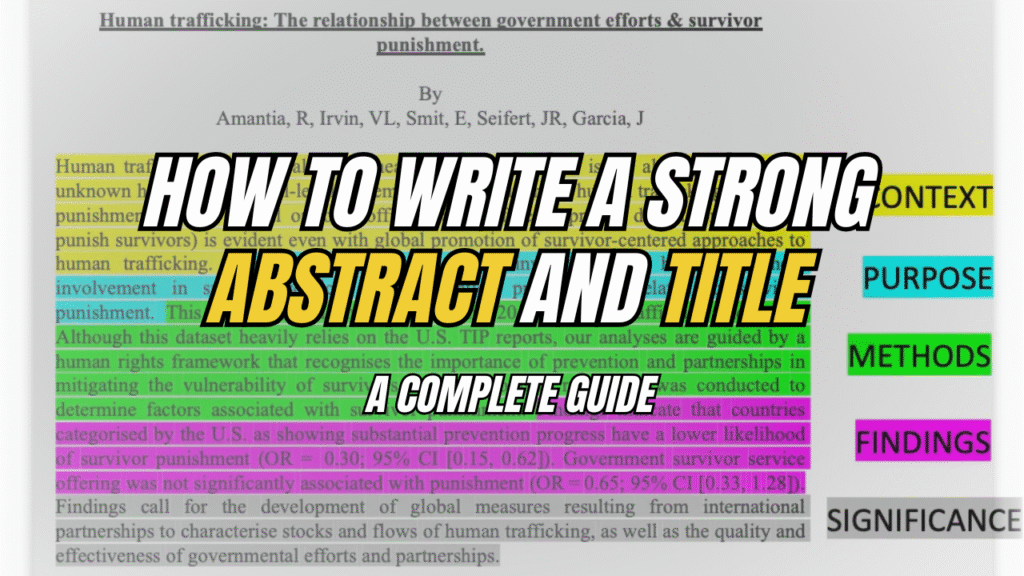
An abstract is a short summary of your research, usually between 150–250 words. It should provide readers with a quick understanding of your study’s purpose, methods, key results, and conclusions.
Think of it as the “movie trailer” of your paper: enough information to spark interest, but not so much that it overwhelms the reader.
A strong abstract typically includes:
- The research problem
- The purpose of the study
- The methods used
- The major findings
- The main conclusion or implication
Abstracts vary depending on discipline, but the most common types are descriptive, informative, and structured abstracts. Scientific and social-science papers almost always use informative or structured versions.
Tips for Writing a Strong, Effective Abstract
Start With the Research Purpose
Open with one or two sentences describing the problem or gap your research addresses. This tells readers exactly why your study matters.
Example:
“Although online learning continues to expand, little is known about how self-regulation strategies support student engagement in virtual classrooms.”
Summarize Your Methods Clearly and Concisely
Readers want to understand what you actually did without unnecessary detail.
Example:
“We conducted a mixed-methods study using surveys (n=210) and interviews (n=20) to evaluate engagement levels.”
Present the Most Important Results
Avoid vague language. Include numbers or trends when possible.
Example:
“Students who used weekly self-regulation prompts showed a 27% increase in engagement compared to the control group.”
State Your Conclusion in One Sentence
End with the central takeaway of your study.
Example:
“These findings suggest that structured self-regulation activities significantly enhance online learning outcomes.”
Avoid Common Abstract Mistakes
- Beginning with overly broad statements
- Using jargon or unexplained abbreviations
- Adding citations (don’t cite in an abstract)
- Exceeding word limits
- Including information not covered in the paper
Use Keywords Naturally
To increase discoverability, integrate target keywords such as:
- how to write a strong abstract
- writing effective abstract
- abstract writing tips
These help databases, journals, and search engines categorize your work accurately.
A Simple Abstract Template You Can Use
Here’s a ready-to-use structure that works for most academic papers:
Background: Identify the problem or purpose.
Methods: Provide a brief overview of how you conducted the study.
Results: Highlight the key findings using specific, concrete details.
Conclusion: Summarize the main takeaway or implication.
Aim for 150–250 words unless your instructor or journal specifies otherwise.
How to Write a Strong Research Title
If your abstract is the trailer, your title is the headline. A strong title attracts attention, communicates key information, and improves search ranking.
The strongest research titles are:
- Accurate
- Specific
- Clear
- Concise (typically under 15–20 words)
- Keyword-rich
- Informative
What Makes an Effective Research Title
Identify the Core Elements
Most impactful titles include:
- The topic
- The method or approach
- The focus, population, or context
Example:
“Self-Regulation Strategies and Online Engagement: A Mixed-Methods Study of Undergraduate Learners”
Use Colons Strategically
Colons help separate the main topic from additional specificity.
Examples:
- “Digital Literacy Skills: An Analysis of First-Year Students”
- “Teacher Burnout in 2024: Causes, Impacts, and Recommendations”
Use them to add clarity—not to sound academic for the sake of it.
Avoid Clickbait or Overly Clever Titles
Fun titles are tempting, but clarity always wins in academic writing.
Weak:
“You Won’t Believe What We Found About Student Stress!”
Strong:
“Predictors of Stress Among First-Year College Students: A Longitudinal Study”
Integrate Keywords Naturally
To improve visibility, incorporate phrases like:
- how to write a strong title
- effective research title
- research title writing guide
These help your article appear in academic search tools like Google Scholar.
Keep It Concise
If readers need to take a breath in the middle of your title, it’s too long.
Aim for clarity and brevity.
Examples of Weak vs. Strong Titles
Weak Titles:
- “A Study of Students”
- “Effects of Technology”
Strong Titles:
- “Effects of Smartphone Use on Sleep Patterns Among Teenagers: A Cross-Sectional Study”
- “Gender Differences in Academic Confidence: Evidence From a Multi-University Survey”
Putting It All Together: Title + Abstract Example
Sample Title:
“Self-Regulation and Student Engagement in Virtual Classrooms: A Mixed-Methods Study”
Sample Abstract:
Online learning environments require greater student self-management, yet little is known about how self-regulation strategies affect engagement. This mixed-methods study surveyed 210 undergraduates and conducted interviews with 20 participants to evaluate the relationship between self-regulation behaviors and online engagement. Results showed that students who completed weekly self-regulation prompts reported a 27% increase in engagement scores compared to students without structured guidance. Interview data revealed that prompts improved time management, focus, and motivation. These findings suggest that integrating simple self-regulation activities into online courses can significantly improve student engagement and academic outcomes.
Conclusion
Your abstract and title shape how readers perceive your work before they even begin reading it. By focusing on clarity, precision, and strong keyword use, you can dramatically improve the visibility, credibility, and overall impact of your research.
Take a moment to revise one of your past abstracts or titles. Apply the techniques in this guide, and you’ll instantly see the difference in readability and effectiveness.
Ready to improve your writing further? Explore more of our research and academic writing tips—and start strengthening every part of your scholarly work.
Need help refining your abstract or title?
We offer quick proofreading and editing—just send over your draft!