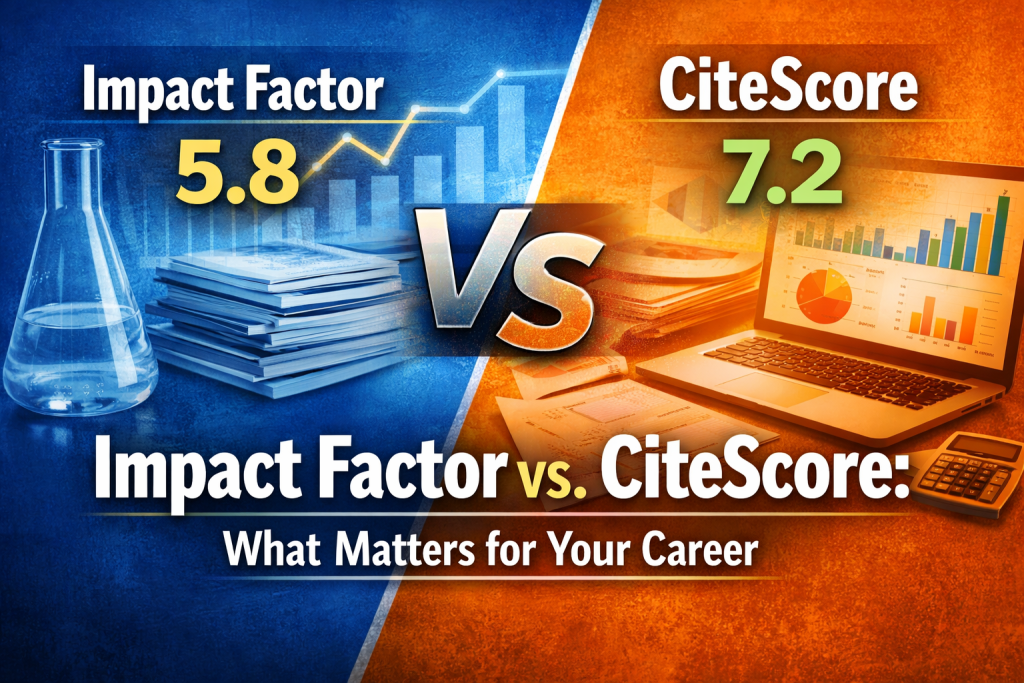
What They Mean for Your Career
Publishing isn’t a vibe. It’s survival. And if you don’t understand impact factor vs CiteScore, you’re playing the academic game blind — especially when hiring committees, funders, and promotion boards still judge you through journal metrics.
Let’s cut through the hype and talk about what actually moves your career needle.
Impact Factor vs CiteScore: Why This Debate Exists
The academic world runs on reputation economics.
Your paper can be brilliant, but if it lands in a weak journal, it won’t save your CV.
That’s why impact factor vs CiteScore isn’t a technical debate — it’s a power struggle between two systems deciding who gets funded, promoted, or ghosted.
What Is Impact Factor — And Why It Still Dominates
Impact Factor (IF) was created by Clarivate to measure how often articles from a journal are cited over two years.
Formula (simplified):
Citations in Year X to papers from Years X-1 and X-2 ÷ Total citable papers in X-1 and X-2
That number controls editorial prestige.
When a supervisor tells you to publish in “a high-impact journal,” they’re not being poetic. They mean journals like Nature or Nature Communications — whose current natura impact factor and nat commun impact factor still intimidate funding panels worldwide.
CiteScore: The Metric Built to Expose Bias
Elsevier launched CiteScore because Impact Factor was too selective and too manipulable.
CiteScore uses:
• 4-year citation window
• Counts all document types
• Data pulled from Scopus — not cherry-picked sources
That’s why newer multidisciplinary journals like iScience now outperform many traditional titles in CiteScore — check the rising iscience impact factor trend.
CiteScore is built for transparency. IF is built for prestige. Choose your battlefield.
H-Index: The Number That Haunts Researchers Forever
Your journal doesn’t get hired. You do.
That’s where the H-index enters.
Your H-index = the number of papers (h) with at least h citations.
When people Google highest h index in the world, they’re usually staring at the citation monsters of physics and medicine who’ve crossed h = 200.
This metric follows you for life.
It’s why hiring committees now search weird stuff like h inurl:index ext:cgi to dig out hidden faculty citation profiles. If your citations are weak, no journal logo can hide it.
Scientific Journals and Impact Factor: The Career Gatekeepers
Here’s the brutal truth.
When promotion boards scan your CV, they don’t read abstracts. They scan:
• Journal name
• scientist journal impact factor
• Indexing status
• Whether the journal is recognized in policy documents
That’s why submitting blindly is career sabotage.
Before choosing a journal, you must evaluate:
• The real impact factor for a journal
• Its citation volatility
• Whether it’s indexed in Web of Science and Scopus
ClinicaPress’s guide on how to evaluate journal credibility breaks this down step-by-step — not theory, real screening practice:
Why Metric Obsession Is Destroying Early Careers
High metrics don’t equal ethical publishing.
Impact chasing fuels:
• Salami slicing
• Citation cartels
• Editorial favoritism
• Predatory behavior disguised as “fast-track”
The U.S. National Library of Medicine has repeatedly warned about metric-driven publishing harming research quality .
ClinicaPress recently exposed how early-career authors fall into fake metric traps — a must-read if you’re submitting this year:
When Impact Factor Beats CiteScore — And When It Doesn’t
Let’s be tactical.
Use Impact Factor when:
• Applying for tenure in conservative institutions
• Targeting flagship discipline journals
• Your department explicitly lists IF thresholds
Use CiteScore when:
• Publishing interdisciplinary research
• Submitting to fast-moving applied science fields
• Targeting Scopus-only journals
Elsevier explains why CiteScore includes broader document types on their official site — which is exactly why early-stage journals climb faster there than in Web of Science.
How Hiring Committees Actually Read Your Metrics
No one admits this publicly, but it happens in every panel room.
Reviewers scan:
• Journal IF tier
• Your H-index growth trend
• Whether your articles sit inside respected scientific journals and impact factor clusters
• Citation velocity in first 18 months
Editorial teams silently filter submissions based on metrics, scope, and credibility.
Impact Factor vs CiteScore-The Real Hierarchy:
What Carries Weight in 2026
Let’s rank the influence honestly:
- Journal reputation in your field
- Article citation velocity
- Your H-index
- Impact Factor
- CiteScore
That’s why obsessing over only IF is outdated thinking.
Nature itself now emphasizes article-level metrics over journal branding.
How to Choose the Right Journal Without Tanking Your CV-Impact Factor vs CiteScore
Here’s your decision framework:
• Check the journal’s impact factor for a journal — not the publisher average
• Compare IF vs CiteScore gaps
• Review editorial board credibility
• Track recent citation performance, not lifetime prestige
Many early-career researchers fail not because of weak science, but because they misunderstand the complete process of publishing a research paper, from journal screening to post-publication indexing.