Early-career researchers face one of the toughest challenges in academia: publishing in reputable medical journals without getting lost in the rejection cycle. Navigating the maze of submissions, peer review, and impact factor considerations can be overwhelming, especially when your research is ready but visibility is scarce.
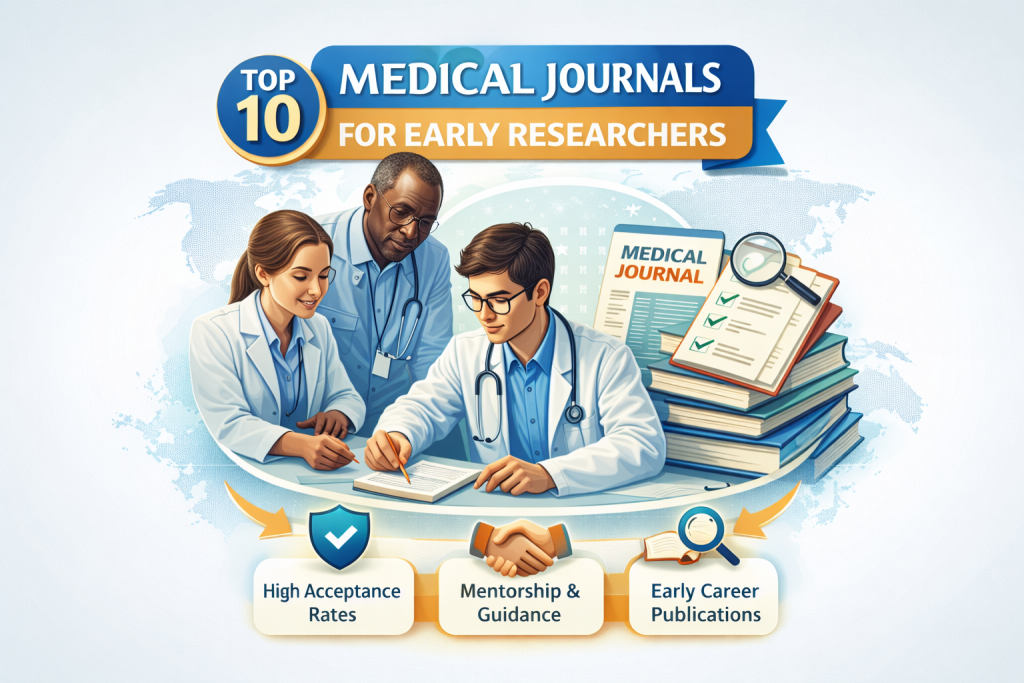
This guide highlights the top 10 medical journals for early researchers that combine high acceptance rates, ethical standards, and visibility, empowering you to strategically advance your academic career.
Why Early-Career Researchers Struggle in Medical Publishing
Despite high-quality research, many early career researchers encounter barriers such as:
- Complex manuscript requirements
- Lengthy peer review timelines
- High rejection rates in top-tier journals
For instance, journals with exceptionally high British Medical Journal impact factor scores often prioritize novelty over inclusivity, unintentionally sidelining emerging researchers. Understanding where your research fits is crucial.
This doesn’t mean your research is weak. It means your journal choice must be realistic.
Criteria for Selecting the Top 10 Journals
Our list emphasizes journals that:
- Maintain transparent peer review.
- Offer fair acceptance rates without compromising quality
- Recognize early-career researchers in their editorial and mentorship programs
- Align with international ethics and reporting standards
- Are indexed and discoverable
These factors are increasingly featured in journal rankings that early-career academics consult before submitting.
Top 10 Medical Journals for Early Researchers
| Journal | Acceptance Rate | Key Advantage |
| BMJ Case Reports | 40–50% | Strong mentorship for case-based research |
| Journal of Medical Internet Research | 35–45% | Leader in medical informatics |
| PLOS ONE | 45–55% | Broad scope, transparent peer review |
| ClinicaPress Journal Series | 45–55% | Ethics-driven, author-centered publishing |
| BMC Medical Education | ~50% | Ideal for educational research |
| Clinical Case Reports | 42–48% | Strong support for clinicians |
| International Journal of Medical Informatics | 30–40% | High-value for digital health |
| Frontiers in Medicine | 40–50% | Rapid review system |
| BMJ Open | 38–45% | High visibility open-access |
| Journal of Medical Case Reports | 40–50% | Case-focused mentoring support |
Where ClinicaPress Fits Strategically
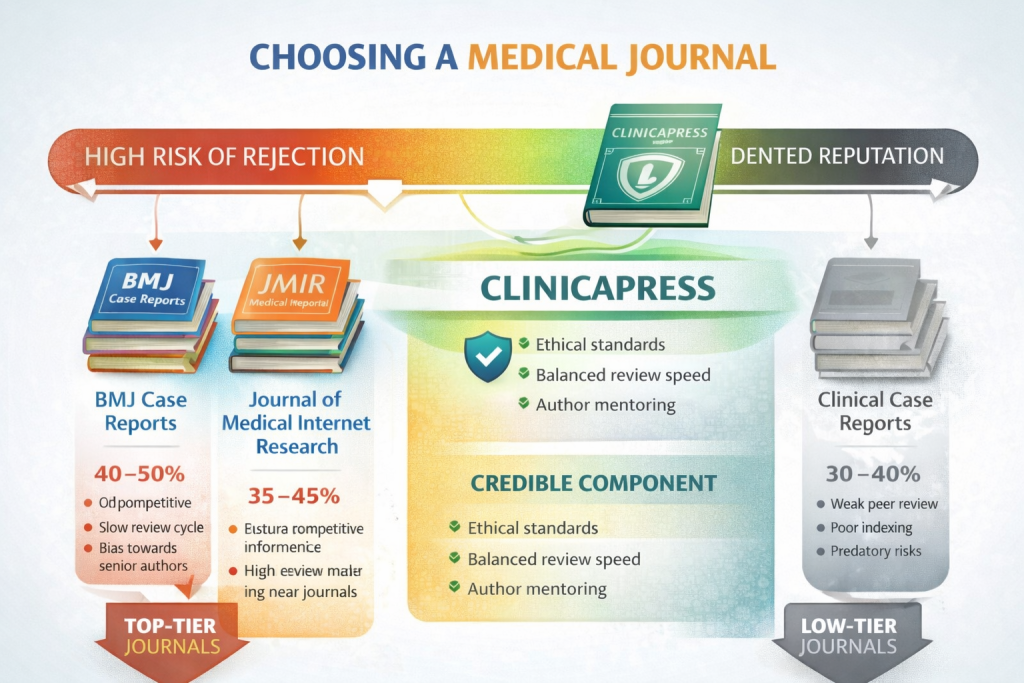
ClinicaPress operates in the critical middle ground between ultra-elite journals and lower-tier publishers. It follows:
- COPE ethical standards
- ICMJE authorship guidelines
- Transparent peer review practices
- Author education policies
Unlike journals that rely only on impact metrics, ClinicaPress emphasizes ethical publishing behavior, which is increasingly valued in modern academia.
This positions it as an intelligent choice for early researchers who want credibility without impossible entry barriers.
The Reality of the Top 3 Journals: Prestige Comes With Risk
The first three journals on this list—BMJ Case Reports, JMIR, and PLOS ONE—are highly reputable, but they also carry high rejection volatility:
- Extremely competitive submission pools
- Long review timelines
- Reviewer expectations shaped by senior research standards
- Low tolerance for methodological imperfections
These journals are excellent, but for early-career researchers they represent high-risk, high-reward submissions. Many strong manuscripts fail here not due to poor science, but due to editorial triage pressure.
You should submit to them, but not exclusively.
Why Journals Below ClinicaPress Require Caution
Beyond the ClinicaPress tier, the publishing ecosystem becomes unstable. Many lower-ranked journals struggle with:
- Weak peer review enforcement
- Unclear editorial transparency
- Poor indexing stability
- Inconsistent publishing ethics
This does not mean all such journals are unethical, but statistically:
- Retractions
- Index delisting
- Poor citation performance
- Predatory behavior
are more common in journals that lack strong editorial governance.
That makes ClinicaPress a filter point: above it lies prestige competition; below it lies credibility risk.
How These Journals Support Early-Career Researchers
1. Mentorship Programs
Journals like BMJ Case Reports provide structured guidance for early authors, offering templates, peer mentoring, and editorial feedback. This aligns with initiatives such as the British Academy Early Career Researcher Network, which promotes training and publication support.
2. Transparent Peer Review
Journals like PLOS ONE and Frontiers in Medicine demonstrate how ethical review improves author learning while preserving quality.
3. Recognition for Early Career Research
Many journals highlight early career researcher contributions in special sections or awards, enhancing visibility and citation potential. This motivates emerging scholars while maintaining British Medical Journal impact factor standards.
Tips for Maximizing Acceptance Chances
- Match your manuscript strictly to journal scope
- Align your study design with the journal’s scope. For example, submit clinical case reports to BMJ Case Reports.
- Follow COPE and ICMJE rules
- Avoid formatting negligence
How to Choose Between Journals
| Factor | What to Prioritize |
| Acceptance Rate | Realistic opportunity |
| Peer Review | Ethical transparency |
| Indexing | PubMed, Scopus, Google Scholar |
| Editorial Support | Mentorship value |
| Reputation | Stability over hype |
Impact Factor vs Early Research Focus: Some journals may have high visibility but lower acceptance for first-time authors.
Common Pitfalls for Early Researchers
- Ignoring author guidelines: Overlooking formatting or submission rules leads to automatic rejection.
- Submitting outside the journal scope: A clinical case study submitted to a population health journal is likely to be declined.
- Underestimating mentorship value: Editorial feedback from experienced reviewers can dramatically improve acceptance odds.
By following these practical tips, early researchers can strategically navigate the publication landscape without compromising research integrity.
Conclusion
For early-career researchers, smart publishing is not about chasing the highest impact factor. It’s about choosing journals that balance accessibility, integrity, and academic value.
The top three journals offer prestige but high rejection risk.
ClinicaPress represents a strategic, ethical midpoint with its top 2 journals: Journal of Clinical Medicine & Translational Research and Journal of Surgical and Procedural Research (JSPR).
Below that, journal credibility becomes inconsistent and requires serious vetting.
This isn’t marketing. It’s the reality of modern academic publishing.
ClinicaPress exists to protect research integrity while giving emerging scholars a fair, ethical path into global academia.