The academic publishing landscape has shifted dramatically over the past decade. Journals are no longer simply platforms for disseminating knowledge—they are guardians of credibility. In our guide, you can explore top 10 journals with high acceptability rates. With the rise of high-profile retractions and the growing scrutiny of scientific rigor, editorial caution has intensified. Today, editors evaluate manuscripts not just for scientific merit but for how a submission could affect the long-term reputation of the journal. Understanding why journals reject papers for credibility is essential for researchers aiming to navigate this stricter environment.
The Rise of Editorial Vigilance
Retractions have become more visible in the academic community, amplified by open-access databases and news coverage. Studies indicate that most retractions are linked to misconduct or honest errors that compromise the integrity of the publication. In response, editorial boards have tightened criteria for manuscript acceptance, prioritizing trustworthiness over novelty.
Editorial vigilance is no longer optional. Journals actively monitor trends, cross-check data integrity, and scrutinize methodologies before peer review. This heightened scrutiny ensures that a single misstep does not compromise years of scientific credibility.
Example: The National Library of Medicine maintains a database of retracted publications highlighting how quickly journals act to preserve their reputations.
Editorial Decision-Making: Beyond the Peer Review
While peer review evaluates the scientific soundness of a manuscript, the editorial team considers broader implications:
- How the paper aligns with the journal’s scope
- The clarity and transparency of data presentation
- Potential ethical concerns or conflicts of interest
- Overall readability and adherence to submission guidelines
An editorial assistant often conducts the initial screening, flagging manuscripts that could pose reputational risks. This process explains why papers that appear scientifically sound may still be rejected—not for quality, but for credibility.
Retractability: The Invisible Criterion
Retractability refers to the likelihood that a published paper could require future retraction due to errors, misinterpretation, or ethical violations.
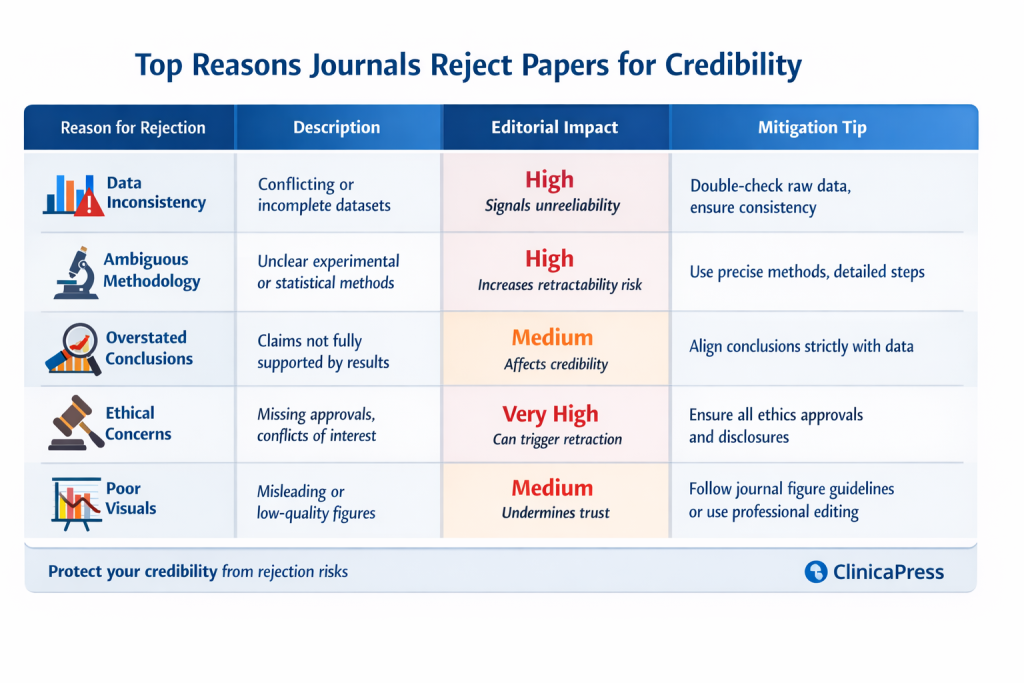
| Reason for Rejection | Description | Editorial Impact | Mitigation Tip |
| Data Inconsistency | Conflicting or incomplete datasets | High – signals unreliability | Double-check raw data, ensure consistency |
| Ambiguous Methodology | Unclear experimental or statistical methods | High – increases retractability risk | Use precise methods, detailed steps |
| Overstated Conclusions | Claims not fully supported by results | Medium – affects credibility | Align conclusions strictly with data |
| Ethical Concerns | Missing approvals, conflicts of interest | Very High – can trigger retraction | Ensure all ethics approvals and disclosures are included |
| Poor Visuals | Misleading or low-quality figures and tables | Medium – undermines trust | Follow journal figure guidelines, consider professional editing |
Journals now actively assess risk factors during submission:
- Inconsistent data or missing raw datasets
- Ambiguous methodology or unclear statistics
- Overstated conclusions or unsupported claims
By evaluating retractability early, editors reduce the likelihood of damaging the journal’s reputation later. This proactive approach reinforces trust with readers, peer reviewers, and funding bodies. For more guidance on manuscript readiness, authors may consider professional support through PaperEdit’s editing services, which focus on ensuring that research papers are publication-ready.
Newsletter Editorials and Community Engagement
Many journals maintain editorial newsletters to communicate policy updates, retraction notices, and submission guidelines. These newsletters serve as a transparent interface between editorial boards and the research community. By sharing insights on why journals reject papers for credibility, newsletters help researchers understand emerging standards and avoid common pitfalls.
Internal CP articles like “How One Weak Figure Can Sink Your Entire Paper” also highlight how presentation impacts credibility, bridging awareness between submission quality and editorial caution.
Editorial Magazines: Learning from Industry Trends
Academic publishing magazines and blogs provide another lens on evolving editorial standards. These publications analyze retraction cases, editorial trends, and ethical challenges. By monitoring insights from editorial magazines, authors can anticipate which practices increase retractability risk and adapt accordingly. For instance, consistently poor figure labeling or unclear methodology often appears as recurring themes in retraction analyses.
The Role of Editorial Staff
The editorial assistant is more than a gatekeeper; they are the first line of defense against reputational risk. Their responsibilities include:
- Screening manuscripts for policy compliance
- Detecting plagiarism or unethical reporting
- Evaluating whether figures, tables, and graphs meet journal standards
Editors rely heavily on their assistants to flag issues that may threaten credibility, making this role a critical factor in understanding why journals reject papers for credibility.
The Ethical Imperative: Post-Retraction Awareness
The post-retraction era has made ethics central to editorial judgment. Editors now weigh the potential impact of publishing errors on:
- Institutional trust
- Funding body relationships
- Future citations and scholarly influence
The goal is not to punish authors but to protect the broader scientific ecosystem. Authors can safeguard their work by adhering to ethical standards and ensuring their manuscripts are meticulously prepared. For theses, specialized support fromThesisEdit helps align academic writing with journal expectations before submission.
Best Practices for Authors
To navigate heightened editorial caution:
- Review journal guidelines carefully before submission.
- Ensure figures, tables, and references are accurate and clear.
- Seek professional editing services (PE for papers, TE for theses) to reduce risk.
- Maintain transparency in methodology and data reporting.
- Stay informed through editorial newsletters and industry magazines.
Adopting these measures demonstrates integrity and enhances the likelihood of acceptance in a post-retraction landscape.
Conclusion
The post-retraction era has transformed academic publishing. Journals reject papers for credibility, not merely for scientific content, reflecting a commitment to ethical standards, transparency, and long-term trust. Authors who understand editorial priorities, mitigate retractability risks, and leverage professional editing support position themselves for successful publication. Publishers like ClinicaPress continue to set these standards, while services like PaperEdit and ThesisEdit help researchers meet them without compromising integrity.