
The academic publishing ecosystem is undergoing one of its most disruptive transitions in decades. Traditional journals, once the uncontested gatekeepers of scientific credibility, are now being openly questioned. The open science movement is not merely proposing an alternative publishing route—it is fundamentally challenging how knowledge is produced, validated, and shared. At stake is not just the future of journals, but the credibility and efficiency of global research itself.
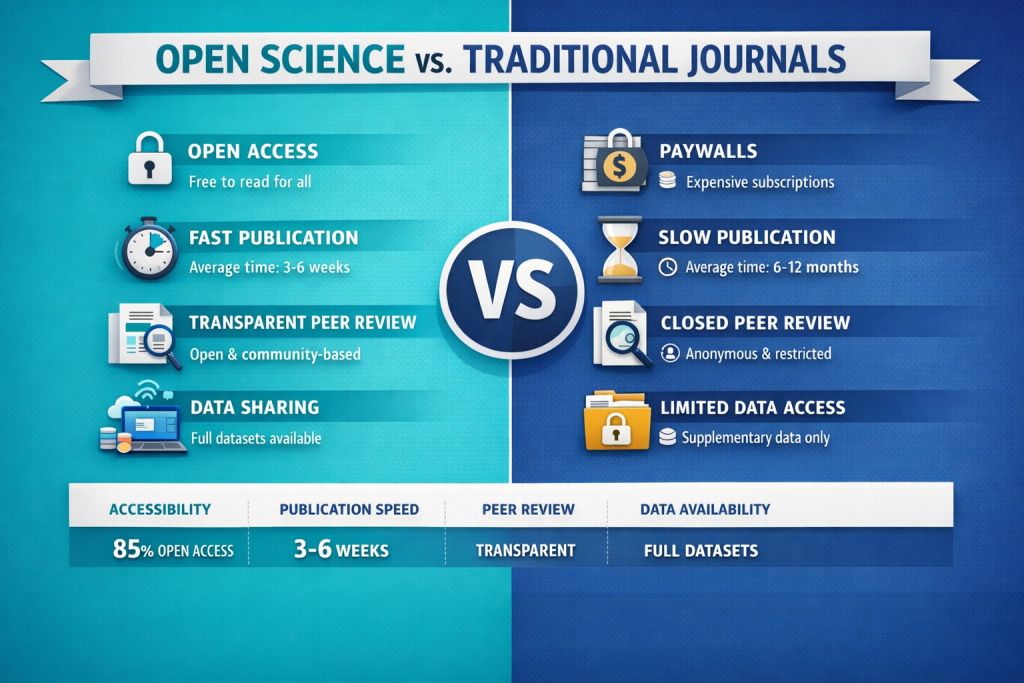
Understanding Traditional Journals and Open Science
Traditional journals are built on structured peer review, editorial oversight, and prestige-based metrics such as impact factor. For decades, this system shaped academic careers, funding decisions, and institutional rankings. In contrast, open science advocates transparency, early sharing, and public accessibility. Data, protocols, and findings are made openly available, often before journal acceptance, allowing broader scrutiny and collaboration.
This ideological divide explains why journals traditional models and open science now sit in visible tension rather than quiet coexistence.
Why the Open Science Movement Is Accelerating
Open science gained momentum due to practical failures in conventional publishing. Lengthy review cycles, inaccessible paywalls, and irreproducible research outcomes have weakened trust in the system. Platforms such as the Open Science Framework allow researchers to preregister studies, store datasets, and document workflows openly, reducing selective reporting and publication bias.
From a public health and policy perspective, delayed access to findings can translate into delayed decisions. Open science responds to this urgency by prioritizing speed without abandoning accountability.
Why Traditional Journals Are Under Pressure
Traditional journals are not collapsing—but they are being outpaced. Subscription-based access restricts readers, particularly in low- and middle-income countries. At the same time, article processing charges in some open-access journals shift financial burden onto authors, creating a different form of inequality.
More importantly, rigid publication timelines are increasingly incompatible with fast-moving research fields. Researchers now expect dissemination to happen in weeks, not years. The dominance of preprints reflects this shift in priorities.
Peer Review: Still the Non-Negotiable Standard
Despite criticism, peer review remains central to research integrity. Journals provide structured evaluation, conflict-of-interest checks, and editorial accountability that open repositories alone cannot guarantee. However, open science does not reject peer review—it reimagines it.
Open peer review, post-publication review, and reviewer transparency are emerging practices that maintain quality while increasing accountability. This evolution signals that peer review is changing form, not disappearing.
Hybrid Publishing Models Are Becoming the Norm
Rather than choosing sides, many publishers are adopting hybrid strategies. Journals such as PLOS ONE combine open access with editorial rigor, while legacy journals increasingly accept preprints prior to submission. These models preserve journal authority while aligning with open science values.
Hybridization suggests that survival does not depend on resisting open science, but on integrating it intelligently.
Reading Journals, Bullet Journals, and Research Transparency
Seemingly unrelated practices like reading and journaling are becoming central to open research culture. Researchers increasingly maintain structured reading journals, lab notebooks, and bullet journals to track hypotheses, data decisions, and revisions.
These documentation practices strengthen transparency and reproducibility. A well-maintained reading journal acts as an intellectual audit trail, making research decisions traceable and defensible. This cultural shift supports open science principles even before publication begins.
Structural Barriers Slowing Open Science Adoption
Despite strong advocacy, open science faces resistance. Academic promotion systems still reward publication in high-impact traditional journals. Concerns about data misuse, premature criticism, and intellectual property remain valid.
Additionally, not all disciplines are equally suited to immediate openness. Clinical research, for example, requires ethical safeguards that complicate full transparency. These realities mean open science adoption will be uneven rather than universal.
How Traditional Journals Can Remain Relevant
| Dimension | Traditional Journals | Open Science Models |
| Access to Research | Restricted by subscriptions or institutional paywalls | Freely accessible to researchers, policymakers, and the public |
| Publication Speed | Slow review cycles (often 6–12 months) | Rapid dissemination via preprints and open platforms |
| Peer Review Style | Closed, anonymous, pre-publication | Open, transparent, and sometimes post-publication |
| Data Availability | Limited to supplementary files | Full datasets shared openly by default |
| Reproducibility | Often difficult due to missing protocols | Strong emphasis on methods and reproducibility |
| Equity in Knowledge | Skews toward well-funded institutions | Promotes global research equity |
| Academic Prestige | High (impact-factor driven) | Growing, but still uneven across disciplines |
| Alignment with Open Science Framework | Partial or optional | Core operational principle |
Survival for traditional journals depends on reform, not denial. Key adaptations include:
- Accepting and linking preprints during submission
- Mandating data availability statements
- Offering transparent peer review options
- Reducing unnecessary review delays
These changes allow journals to retain authority while restoring trust in the publishing process.
Lessons from the COVID-19 Publishing Surge
The COVID-19 pandemic exposed both the strengths and weaknesses of academic publishing. Preprints enabled rapid global access to findings, while journals provided later validation and correction. Platforms such as medRxiv became essential bridges between urgency and rigor.
This period demonstrated that speed and quality are not mutually exclusive when systems cooperate rather than compete.
The Future of Traditional Journals in an Open Era
Traditional journals are unlikely to disappear, but their dominance is no longer guaranteed. Their future role will be narrower but more focused—certifying quality rather than controlling access. Journals that embrace transparency, support open workflows, and prioritize ethical editing will continue to matter.
Those that rely solely on prestige and paywalls risk becoming irrelevant in a research culture that increasingly values openness over exclusivity.
Conclusion
The question is no longer whether open science will reshape publishing—it already has. The real question is whether traditional journals will adapt fast enough to remain credible. By integrating open science practices, supporting transparent peer review, and acknowledging cultural shifts like structured reading and journaling, journals can survive and even thrive.
The future of academic publishing belongs to systems that balance rigor with openness, authority with accessibility, and tradition with reform.