Translational science lives in the uncomfortable space between discovery and delivery. It is not basic science, not purely clinical, and not satisfied with theoretical impact. If your work moves evidence from bench to bedside — or back again — choosing the right translational research journals determines whether your findings actually influence medicine or disappear into citation limbo.
This guide cuts through prestige myths and shows where serious translational work belongs, how editors evaluate it, and what separates credible outlets from opportunistic ones.
What Makes a Journal Truly “Translational”
Many journals claim translational scope. Few actually prioritize research that changes clinical pathways.
Translational publishing is defined less by topic and more by trajectory — studies must demonstrate movement toward application. According to the , translational science spans stages from basic discovery to public health implementation. Journals aligned with this spectrum expect evidence of real-world direction, not just mechanistic novelty.
If you are still asking what is translational research in nursing or debating clinical vs translational research, understand this: translational work must show how findings will alter practice, not merely expand knowledge.
Editors look for:
- Clinical relevance beyond theory
- Feasible implementation pathways
- Multidisciplinary collaboration
- Patient or population impact
Anything less reads as basic science in disguise.
The Elite Tier of Translational Research Journals
These journals define the field. Acceptance rates are brutal because they publish studies likely to shift medical standards.
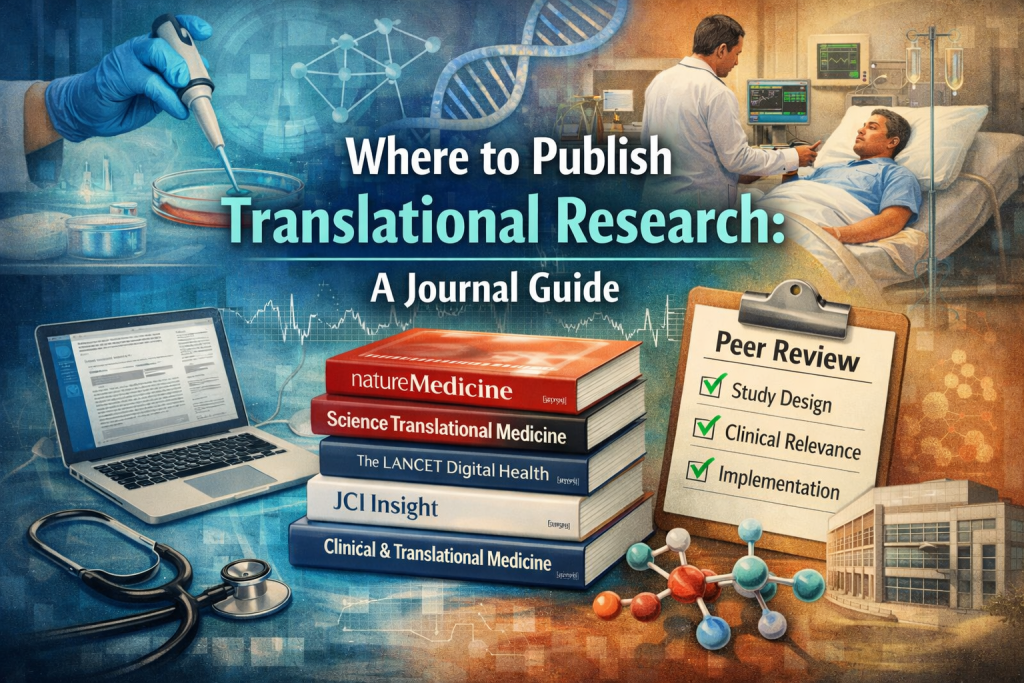
1. Nature Medicine
Publishes breakthroughs with immediate clinical implications. Mechanistic work alone rarely survives peer review unless paired with human data.
Get to know more about peer review in our guide.
2. Science Translational Medicine
Prioritizes cross-disciplinary studies linking laboratory discoveries to therapeutic strategies. Strong fit for work emerging from a translational research lab.
3. The Lancet Digital Health
Ideal for AI-driven diagnostics, digital interventions, and health system implementation studies — core areas of clinical research translations today.
4. JCI Insight
Publishes mechanistic clinical investigations with direct disease relevance.
5. Clinical and Translational Medicine
Focuses explicitly on moving biomedical discoveries into therapies, making it a natural home for work produced in a clinical and translational research building.
These journals expect airtight methodology, ethical transparency, and a narrative showing how discoveries reach patients.
Mid-Tier Journals That Still Deliver Impact
Not every study needs a top-tier platform. Many high-quality translational papers achieve stronger visibility in specialized journals.
Consider:
- Translational Research — Dedicated entirely to translational medicine
- EMBO Molecular Medicine — Strong for mechanistic work with clinical relevance
- Molecular Therapy — Gene and cell therapy focus
- NPJ Regenerative Medicine — Tissue engineering and regenerative approaches
Publishing in these venues often leads to higher engagement within the exact communities that implement findings.
Clinical vs Translational Research: Why It Affects Journal Choice
Clinical research evaluates interventions in humans. Translational research builds the bridge that made those interventions possible.
If your manuscript is purely trial-based, traditional clinical journals may be better. But if your study explains how discoveries were adapted for human use — dosing strategies, biomarkers, delivery systems — translational outlets are appropriate.
The emphasize that translation must prioritize safety, equity, and applicability. Journals increasingly assess whether innovations can realistically reach low-resource settings, not just elite hospitals.
How Editors Evaluate Translational Manuscripts
Top translational research journals reject most submissions for one reason: lack of a credible pathway to practice.
Editors scrutinize:
Real-World Feasibility
Can clinicians adopt the intervention without unrealistic infrastructure?
Evidence Continuity
Does the paper connect preclinical data to human outcomes?
Implementation Insight
Does the study anticipate barriers to adoption?
If your work originated in a translational research lab but stops at proof-of-concept, reviewers will push back.
For a deeper breakdown of manuscript pitfalls that derail strong studies, see our analysis on ClinicaPress about research clarity failures.
Choosing Based on Your Study Type
Not all translational studies are equal. Match your journal to the phase of translation.
| Study Type | Best Journal Tier | Key Requirement |
| Drug target validation | Mid–High | Human relevance evidence |
| Biomarker discovery | Mid | Clinical utility proof |
| Digital health tool | High | Implementation data |
| Therapy optimization | High | Patient outcomes |
| Health system intervention | Specialized | Scalability analysis |
Researchers working in clinical and translational research building environments often produce multi-phase studies. Consider splitting findings into targeted manuscripts rather than forcing one paper into an unsuitable journal.
Ethical Publishing in Translational Science

Translation without ethics is exploitation.
Responsible journals require:
- Transparent patient consent
- Data reproducibility
- Conflict-of-interest disclosure
- Accessibility considerations
The outline protections that reputable journals enforce strictly.
Avoid predatory journals promising rapid acceptance for translational topics. If a journal does not clearly describe peer review standards, indexing status, and editorial board credentials, walk away.
Where Nursing and Allied Health Translation Fits
Translational research is not limited to biomedical labs. Nursing science increasingly drives implementation studies that change care delivery.
If your focus is what is translational research in nursing, target journals emphasizing practice transformation and patient outcomes rather than molecular mechanisms.
Implementation-focused outlets often value:
- Community health interventions
- Care coordination models
- Patient education strategies
- Workforce innovations
These studies may not attract basic science journals but can reshape healthcare systems when published strategically.
For practical writing strategies tailored to applied health research, see our editorial on improving clarity in clinical manuscripts.
A Practical Submission Strategy
Do not submit blindly. Build a publication pathway.
Step 1: Map Your Study on the Translational Spectrum
Basic → Preclinical → Clinical → Implementation
Step 2: Analyze Recent Articles in Target Journals
If your study does not resemble what they publish, reconsider.
Step 3: Prepare for Multiple Submissions
Even strong papers face rejection. Plan alternative journals in advance.
For early-career researchers navigating this process, our guide on ethical authorship practices offers essential preparation.
The Future of Translational Publishing
The field is shifting toward interdisciplinary platforms that integrate genomics, AI, population health, and policy.
According to , the most influential studies now combine laboratory discovery with real-world evidence from healthcare systems.
Future-ready journals will prioritize:
- Data sharing
- Cross-sector collaboration
- Global applicability
- Equity in implementation
If your work addresses only high-income settings, expect tougher scrutiny.
Final Takeaway
Publishing translational research is not about prestige — it is about placement. The right journal amplifies impact, accelerates adoption, and ensures discoveries reach patients instead of sitting behind paywalls unread.
Choose outlets that value application as much as innovation. If your study genuinely bridges discovery and care, the best translational research journals will recognize it.


