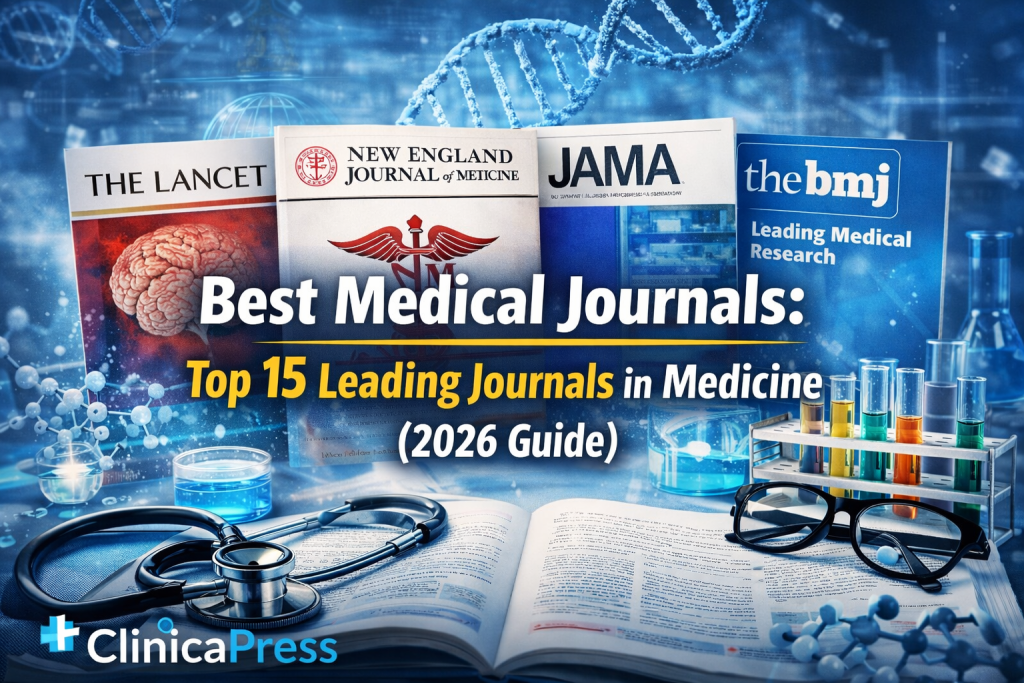
Top 15 Leading Journals in Medicine (2026 Guide)
Medicine does not advance through opinions. It advances through peer-reviewed evidence published in the best medical journals. These journals decide which discoveries shape clinical practice, which therapies become standard care, and which research directions receive global funding.
In 2026, the role of elite medical publications is even more critical. The volume of research has exploded, misinformation spreads faster than data, and clinicians are under pressure to rely only on rigorously validated findings.
For researchers, publishing in top journals determines career trajectory. Reading them determines patient outcomes for clinicians. For policymakers, they guide national health strategies.
According to the World Health Organization, evidence-based decision-making is the backbone of effective healthcare systems worldwide. Without trustworthy journals, modern medicine would collapse into anecdote and speculation.
ClinicaPress has repeatedly emphasized how editorial integrity influences scientific credibility and public trust in research.
Why the Best Medical Journals Define Global Healthcare
Top-tier journals are not simply repositories of research. They are gatekeepers of scientific truth.
Their influence extends to:
- Clinical guidelines
- Pharmaceutical approvals
- Medical education curricula
- Public health policy
- Funding priorities
During global health emergencies, journals become rapid-response platforms for disseminating lifesaving data.
The impact factor of British Medical Journal reflects its long-standing authority in public health discourse, clinical research, and health policy debates.
High-impact journals also enforce strict ethical requirements:
- Trial registration
- Data transparency
- Conflict-of-interest disclosures
- Ethical approval verification
These safeguards protect medicine from flawed or manipulated research.
ClinicaPress analyzed how stricter peer-review processes are reshaping academic publishing standards.
Top 15 Best Medical Journals in the World (2026)
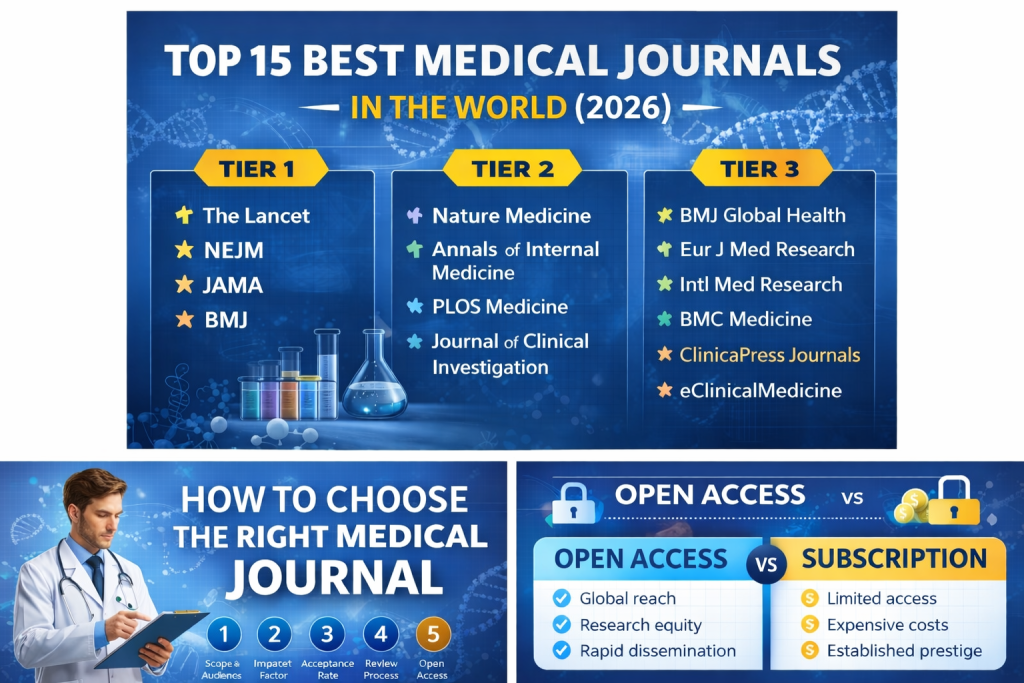
Tier 1 — The Most Influential Medical Journals
- The Lancet
- New England Journal of Medicine (NEJM)
- JAMA (Journal of the American Medical Association)
- BMJ (British Medical Journal)
These journals publish landmark clinical trials, global disease burden analyses, and practice-changing guidelines. Acceptance rates are extremely low, often below 5%.
Their articles frequently influence recommendations issued by organizations such as the WHO and national health agencies.
Tier 2 — High-Impact Specialized Journals
- Nature Medicine
- Annals of Internal Medicine
- PLOS Medicine
- Journal of Clinical Investigation
These journals focus on translational research — converting laboratory discoveries into clinical applications.
Tier 3 — Emerging Leaders in Global Medicine
- British Medical Journal Global Health
- European Journal of Medical Research
- Journal of International Medical Research
- BMC Medicine
- Clinicapress Journals
- eClinicalMedicine
- npj Digital Medicine
The European Journal of Medical Research impact factor continues to rise due to interdisciplinary studies and strong open-access visibility.
Meanwhile, the Journal of International Medical Research has gained prominence for multinational clinical trials addressing region-specific diseases.
Impact Factor: Useful Metric or Academic Obsession?
Impact factor measures how frequently articles are cited, serving as a proxy for influence.
Clarivate’s methodology, detailed on Wikipedia calculates citations over a defined period. However, this metric has limitations.
Critics argue that:
- It favors trendy topics
- It disadvantages niche specialties
- It does not measure clinical usefulness
- It can be manipulated through citation practices
Despite flaws, institutions still use impact factor for hiring, promotions, and grant decisions.
ClinicaPress has published a complete guide on Understanding H-index, CiteScore, and Other Research Metrics.
Medical Education Journals Shaping Future Physicians
Clinical competence begins long before residency.
Leading medical education journals include:
- Academic Medicine
- Medical Education
- Medical Teacher
- Teaching and Learning in Medicine
These journals study how doctors are trained, assessed, and prepared for evolving healthcare challenges.
Research supported by the U.S. National Institutes of Health shows that evidence-based education improves diagnostic accuracy and patient safety
Medical Humanities: The Human Side of Science
Technical expertise alone does not produce compassionate physicians.
The Journal of Medical Humanities examines ethics, narrative medicine, cultural competence, and patient experience.
Healthcare systems increasingly recognize that empathy and communication directly affect outcomes.
Coverage by major outlets like BBC Health highlights research showing that patient-centered care improves treatment adherence and recovery rates
Humanities research now influences:
- Palliative care
- Mental health services
- Communication training
- End-of-life decision-making
Medicine is rediscovering that science without humanity is incomplete.
Open Access vs Subscription Journals
The publishing model itself is undergoing transformation.
Advantages of Open Access
- Global accessibility
- Faster dissemination
- Equity for researchers in low-income regions
Concerns
- Predatory journals
- Publication fees
- Inconsistent peer review
Elite journals are adopting hybrid models — maintaining rigorous standards while expanding access.
ClinicaPress examined the financial and ethical implications of open-access publishing in its analysis of academic publishing economics.
How Researchers Should Choose the Right Journal
Selecting a journal is a strategic decision.
Key considerations include:
Scope and audience — Match your research to the journal’s readership
Impact vs relevance — Prestige matters, but so does practical influence
Acceptance rate — High-impact journals reject most submissions
Review timeline — Some decisions take over a year
Ethical standards — Avoid predatory publishers
Publishing in the wrong journal delays dissemination and reduces impact.
Ethical reporting, statistical rigor, and professional editing significantly improve acceptance chances.
Key Metrics of Leading Medical Journals (2026)
| Journal | Focus Area | Influence Level | Access |
| The Lancet | Global health & trials | Extremely High | Hybrid |
| NEJM | Clinical medicine | Extremely High | Subscription |
| JAMA | General medicine | Very High | Hybrid |
| BMJ | Public health | Very High | Hybrid |
| Nature Medicine | Translational research | Very High | Hybrid |
| PLOS Medicine | Open science | High | Open Access |
| BMC Medicine | Multidisciplinary | High | Open Access |
| Journal of Medical Humanities | Ethics | Moderate | Hybrid |
The Future of the Best Medical Journals
The definition of excellence is evolving.
The best medical journals in 2026 share three defining characteristics:
- Methodological rigor
- Ethical transparency
- Global relevance
Medicine is entering an era where research must not only be statistically sound but socially responsible.
Journals that prioritize equity, diversity, and real-world impact will shape the next generation of healthcare.
Clinicians, researchers, and students who stay connected to these publications will remain ahead of the curve — scientifically and professionally.