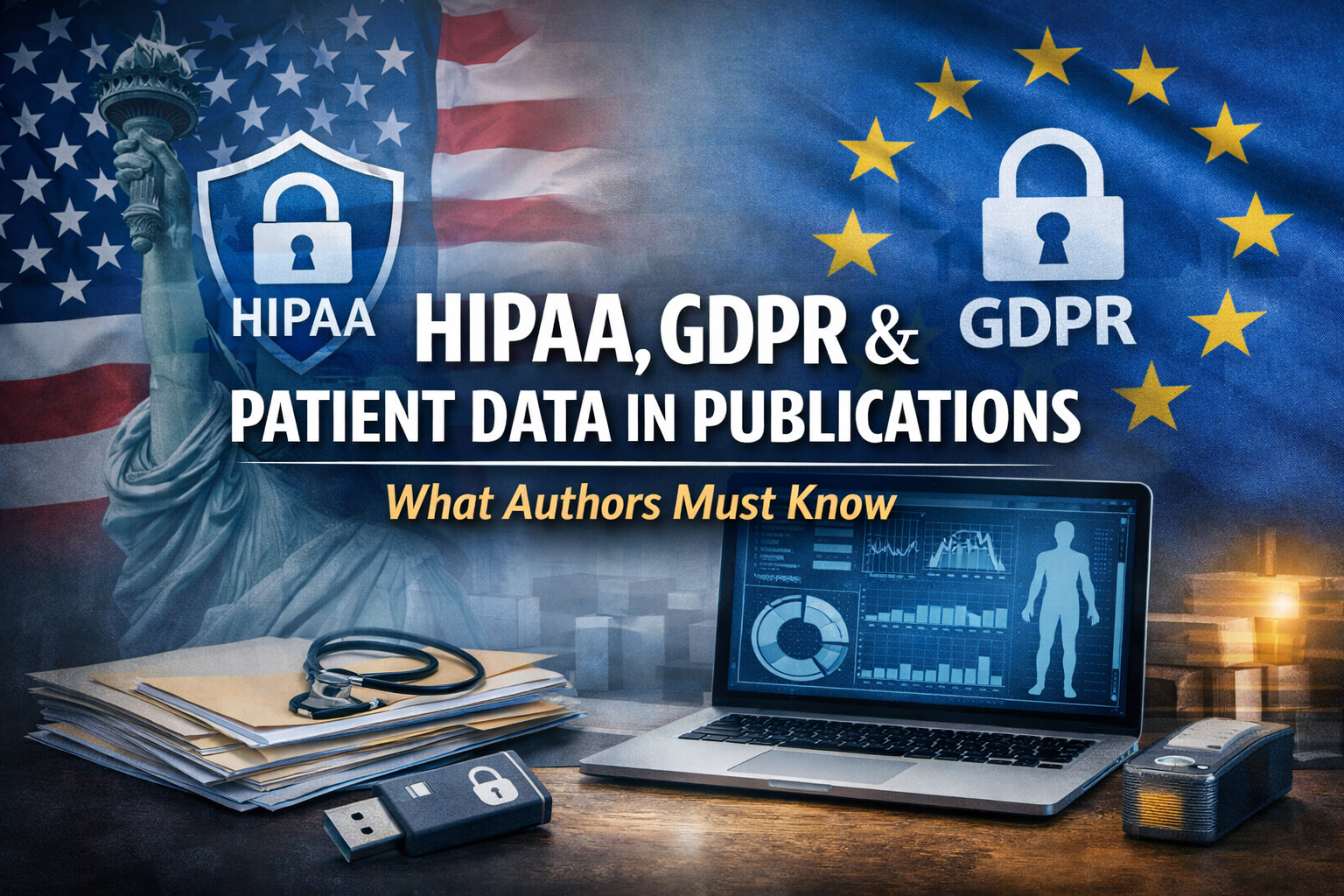
Clinical research runs on data. But when that data involves real patients, the margin for error disappears. Publishing without mastering privacy law is no longer a technical oversight — it is an ethical failure. Authors today operate under two dominant regulatory regimes: the U.S. Health Insurance Portability and Accountability Act and the EU’s General Data Protection Regulation. Together, they shape how patient information can be analyzed, stored, shared, and ultimately published.
This breakdown cuts through legal fog and focuses on what researchers, editors, and institutions must actually do to publish responsibly.
Why Patient Data Laws Now Directly Control Publication Decisions
Medical publishing used to treat privacy as a consent-form issue handled at the hospital level. That era is over. Regulations now extend into manuscript preparation, peer review, data repositories, and supplementary files.
The U.S. Department of Health & Human Services explains that the HIPAA Privacy Rule governs how identifiable health information can be disclosed, including in research contexts (see the official guidance at https://www.hhs.gov/hipaa/for-professionals/privacy/index.html). Meanwhile, the European Commission enforces GDPR across member states, giving patients control over how their data travels beyond clinical settings (overview at https://commission.europa.eu/law/law-topic/data-protection_en).
For authors, this means journals are no longer the final gatekeepers — regulators are.
Research teams submitting to international journals must assume both frameworks apply, especially in multinational trials.
HIPAA Requirements Authors Cannot Ignore
HIPAA applies to “protected health information” handled by covered entities and their partners. Once data leaves the hospital and enters the manuscript pipeline, obligations remain.
Authors must ensure:
- Direct identifiers are removed (names, exact dates, addresses)
- Indirect identifiers cannot reasonably re-identify individuals
- Data sharing agreements exist if collaborators accessed raw files
- Institutional review board approval aligns with disclosure scope
The de-identification standard is strict. The National Institutes of Health details two accepted methods: expert determination and safe harbor removal of 18 identifiers (https://privacyruleandresearch.nih.gov/pr_08.asp).
Failure here has real consequences. Several high-profile retractions occurred after supposedly anonymous datasets were found re-identifiable.
GDPR’s Global Reach — Even Outside Europe
GDPR applies based on where the patient is located, not where the researcher sits. A Pakistani or American author publishing European patient data must comply.

Key GDPR principles affecting publications:
- Data minimization — only necessary variables included
- Purpose limitation — data used only for stated research aims
- Storage limitation — no indefinite retention of identifiable files
- Accountability — authors must prove compliance, not just claim it
Article 28 becomes critical when journals, statisticians, or editing services process data on behalf of researchers. Contracts must specify privacy safeguards, creating a chain of responsibility that extends into publishing workflows.
Recent coverage in BBC News highlighted fines against institutions mishandling research data, underscoring that academic intent does not excuse non-compliance.
Where HIPAA and GDPR Collide in Publications
Many authors mistakenly treat the laws as interchangeable. They are not.
| Issue | HIPAA Approach | GDPR Approach | Publication Impact |
| Consent requirements | Can allow waivers | Requires explicit lawful basis | Consent language must meet GDPR if EU data involved |
| De-identification | Safe harbor list | Risk-based anonymization | Extra scrutiny for small datasets |
| Data subject rights | Limited | Extensive (erasure, access) | Patients may request removal post-publication |
| Geographic scope | U.S. entities | Global if EU data used | International collaborations affected |
The strictest rule effectively wins. Journals increasingly demand statements confirming compliance with both.
GDPR Article 28 and Third-Party Publishing Services
Many researchers use editing agencies, statistical consultants, or manuscript formatting services. Under GDPR Article 28, these become “data processors.”
Authors must verify that any service handling patient data offers:
- GDPR-compliant document storage
- Encryption and access controls
- Data deletion guarantees
- Processor agreements specifying responsibilities
Using non-compliant software tools creates liability even if the final paper contains no identifiers.
The World Health Organization has repeatedly warned that digital health research must treat cybersecurity as a patient safety issue, not just IT hygiene.
What Journals Now Expect From Authors
Editorial policies are tightening fast. High-impact journals increasingly request:
- Data availability statements clarifying privacy protections
- Confirmation that consent permits publication
- Proof of ethical approval covering secondary analyses
- Documentation of anonymization methods
Some journals reject submissions outright if authors cannot demonstrate compliant data handling throughout the research lifecycle.
At http://ClinicaPress.com, recent editorials on publication ethics emphasize that privacy compliance is becoming a core criterion for acceptance, not a bureaucratic add-on.
Common Mistakes That Trigger Ethical Red Flags
Even experienced researchers slip on preventable issues:
- Including rare disease cases with identifiable timelines
- Publishing images without removing metadata
- Sharing raw datasets as supplementary files
- Assuming consent for treatment equals consent for publication
A widely cited case discussed on Wikipedia’s page about data protection law (https://en.wikipedia.org/wiki/General_Data_Protection_Regulation) shows how indirect identifiers can expose individuals despite anonymization attempts.
Building a Publication-Safe Data Workflow
Responsible authors now design privacy compliance into research from day one.
Minimum workflow for publishable patient data:
- Plan anonymization strategy before data collection
- Draft consent forms allowing publication use
- Maintain secure, GDPR-compliant document storage
- Limit dataset access to essential personnel
- Prepare a transparency statement for journals
ClinicaPress guidance on ethical manuscript preparation (http://ClinicaPress.com/ethical-manuscript-preparation) stresses documenting each step — regulators care about process as much as outcome.
The Future: Privacy as a Research Competency
The next generation of researchers will need legal literacy alongside methodological skills. Data protection is becoming part of research training, grant evaluation, and peer review.
Institutions that fail to adapt risk losing international collaboration opportunities.
ClinicaPress has noted in its policy analysis section (http://ClinicaPress.com/publishing-policy-analysis) that journals may soon require formal privacy compliance checklists similar to CONSORT or PRISMA reporting standards.
Final Takeaway
Publishing patient data without mastering HIPAA and GDPR is no longer naive — it is reckless. Authors carry legal, ethical, and professional responsibility for how information moves from clinic to journal page.
Privacy compliance is now part of scientific credibility.
Researchers who treat it seriously will publish globally without friction. Those who ignore it will face retractions, sanctions, and reputational damage.
ClinicaPress resources on responsible data handling (http://ClinicaPress.com/research-data-governance) provide deeper guidance for authors navigating this evolving landscape.