What Today’s Researchers Must Understand
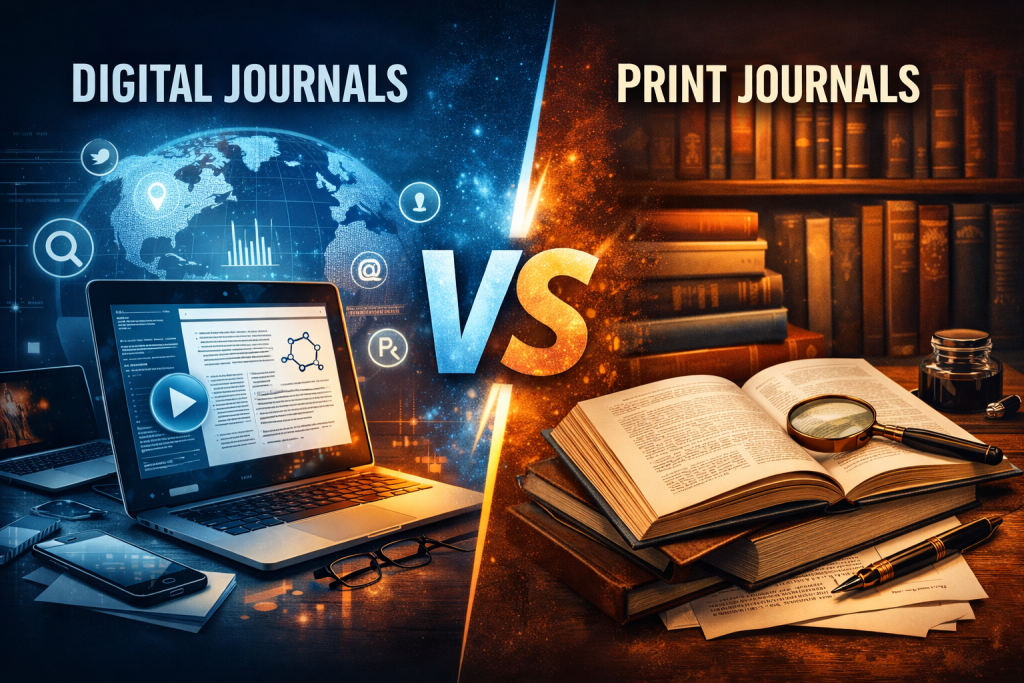
Academic publishing is not evolving quietly. It is restructuring itself. The debate around Digital vs Print Journals is no longer philosophical — it is operational, financial, and strategic.
Researchers are not just choosing formats. They are choosing visibility models, cost structures, environmental positions, and career trajectories.
If you publish without understanding the ecosystem, you publish blindly.
Let’s dissect this properly.
The Digital Acceleration of Scholarly Communication
Digital journals transformed academic publishing from a localized system into a global network.
Before online indexing, discovery depended heavily on physical library access. Today, databases maintained by the U.S. National Library of Medicine allow researchers to locate peer-reviewed literature within seconds. Discoverability is no longer a geographic privilege.
Digital platforms provide:
- Immediate publication after acceptance
- DOI-based permanent identifiers
- Search engine visibility
- Citation analytics and altmetrics
- Integrated plagiarism screening
Standards enforced through organizations like Crossref ensure persistent linking and metadata integrity.
The shift also aligns with broader transparency movements in science. Open-access publishing has expanded knowledge distribution beyond institutional paywalls — particularly important for low- and middle-income regions.
However, speed comes with responsibility. Rapid digital workflows must maintain peer-review rigor. As outlined in our discussion on Ethical Challenges in Multi-Center Research, digital scalability cannot compromise ethical oversight.
Efficiency should amplify integrity — not weaken it.
The Enduring Authority of Traditional Print Models
Print journals carry institutional symbolism. A bound volume placed in a university library signals permanence. Archival preservation through institutions such as the Library of Congress reinforces the cultural weight of printed scholarship.
Traditional print models offer:
- Tangible archiving
- Controlled circulation
- Curated editorial processes
- Physical institutional presence
In some academic systems, particularly where promotion criteria remain conservative, printed editions are perceived as more credible.
This perception fuels continued demand for:
- Journal printing for academic societies
- Annual compilations via custom journal printing
- Conference-based custom print journals
Print creates a physical academic footprint. It transforms research into an object — something held, catalogued, displayed.
But prestige without discoverability limits reach.
Financial Architecture: Where the Money Actually Goes
Printing is capital-intensive.
Paper procurement, ink production, layout formatting for press, physical distribution, storage, and unsold inventory all contribute to escalating costs.
Departments investing in custom journal printing often absorb:
- Printing setup charges
- Minimum order quantities
- Warehousing expenses
- International shipping fees
Digital journals eliminate many of these physical burdens. Yet digital publishing is not “free.” Costs shift toward:
- Server hosting
- Content management systems
- Cybersecurity infrastructure
- DOI registration
- Editorial software licenses
The difference lies in scalability. Digital infrastructure grows incrementally. Print infrastructure multiplies proportionally with volume.
Emerging models such as print on demand journals attempt to reconcile cost efficiency with physical availability. Instead of mass printing, copies are produced only when requested — reducing waste while maintaining optional tangibility.
Hybrid cost models are becoming the norm rather than the exception.
Environmental Accountability in Publishing
Sustainability is no longer optional branding. It is measurable policy.
The United Nations Environment Programme has repeatedly highlighted how paper production contributes to deforestation and industrial emissions. Large-scale printing amplifies resource consumption across:
- Timber harvesting
- Water-intensive pulping processes
- Chemical bleaching
- Transportation logistics
Digital journals reduce physical waste, though they are not emission-neutral. Data centers consume electricity, and electronic devices have environmental footprints.
However, lifecycle analyses generally show that digital dissemination produces lower material consumption compared to traditional mass print distribution.
Institutions aiming to align with global sustainability goals increasingly adopt digital-first publishing strategies.
Environmental responsibility now intersects directly with academic credibility.
Cognitive Engagement: How Format Shapes Reading Behavior
Reading is not just consumption. It is cognition.
Research reported by BBC News suggests that some readers demonstrate improved comprehension and retention when engaging with printed text compared to screens.
Print encourages:
- Deep reading
- Fewer digital distractions
- Physical annotation
- Visual-spatial memory cues
Digital formats enable:
- Keyword search functionality
- Instant cross-referencing
- Hyperlinked citations
- Accessibility tools for visually impaired readers
- Cloud-based synchronization
The rise of digital journaling reflects how younger academics integrate annotation apps, PDF markups, and cloud note systems into their workflow.
At the same time, niche interest in tools such as the best mini printer for journaling reveals that tactile reinforcement still plays a role in personal research organization.
This is not a generational divide. It is a workflow preference.
The strongest researchers master both environments.
Metrics, Visibility, and Academic Influence
Impact in academia is quantified.
Digital journals integrate:
- Real-time citation tracking
- Download statistics
- Social media engagement metrics
- Altmetric scoring
- Cross-platform indexing
Print journals lack real-time analytics unless mirrored digitally.
Visibility influences:
- Grant approvals
- Institutional ranking
- International collaboration
- Career mobility
In our analysis of How Publishing in Clinical Journals Influences Medical Careers, we explored how citation visibility directly affects professional advancement.
If your work cannot be easily found, it cannot be cited.
And if it cannot be cited, its impact diminishes — regardless of quality.
Accessibility and Global Equity
Digital publishing enhances equity.
Researchers in resource-constrained environments can access open-access journals without waiting for imported physical copies. Digital archives eliminate shipping delays and customs barriers.
Global collaboration depends on instant access.
We highlighted this in our discussion on International Collaboration in Medical Publications, where digital infrastructure enables cross-border authorship and real-time peer engagement.
Print-only models restrict dissemination to institutions capable of physical distribution.
In global health and policy research, delayed access can delay real-world impact.
Archiving and Longevity: Digital Permanence vs Physical Preservation
A common argument for print is durability. A book stored properly can last centuries.
Digital permanence, however, depends on:
- Server maintenance
- Backup protocols
- Metadata integrity
- DOI resolution systems
Reputable digital journals implement archiving solutions such as LOCKSS (Lots of Copies Keep Stuff Safe) and CLOCKSS to ensure redundancy.
The reality: both print and digital formats require stewardship.
A printed volume can decay. A digital file can corrupt. Preservation is a process, not a format.
Hybrid Publishing: Strategic Flexibility
The future is not binary.
Many reputable journals now:
- Publish articles digitally first
- Offer optional printed compilations
- Provide limited-edition conference prints
- Operate print on demand journals for collectors or institutions
Print becomes ceremonial. Digital becomes functional.
This hybrid system allows institutions to preserve tradition without sacrificing scalability.
As we’ve previously explored on Digital Journals vs Traditional Print Models, adaptability defines sustainability in publishing.
Rigid loyalty to one model limits growth.
Ethical Publishing Remains Format-Independent
The format does not determine legitimacy.
What determines legitimacy?
- Transparent peer review
- Clear editorial board credentials
- DOI registration
- Indexing in recognized databases ( read the article on Understanding H-index, CiteScore, and Other Research Metrics)
- Conflict-of-interest disclosures
- Adherence to international publication standards
Predatory behavior can exist in both digital and print ecosystems.
Researchers must evaluate journals based on governance and transparency — not paper thickness or website design.
Publishing ethically is a decision, not a format.
The Strategic Decision Framework
Before choosing where and how to publish, researchers should assess:
- Audience reach
- Indexing status (view the guide on How to Check if a Journal Is Indexed: 7 Proven Tips for Researchers (2025 Guide))
- Long-term accessibility
- Archiving systems
- Environmental implications
- Institutional expectations
If impact and international collaboration matter most — digital publication dominates.
If ceremonial archiving and physical institutional display matter — selective print editions maintain value.
Smart academics do not choose sides emotionally. They choose strategically.
Final Perspective: Knowledge Must Travel
The debate around Digital vs Print Journals often turns nostalgic. That nostalgia should not guide policy.
Digital publishing offers:
- Speed
- Scale
- Measurable influence
- Environmental efficiency
Print publishing offers:
- Tangibility
- Symbolic authority
- Curated presentation
In modern academia, knowledge must travel instantly, ethically, and globally.
Read Ethics Training for Journal Editors and Reviewers.
Format is a vehicle. Integrity is the engine.
Researchers who understand both systems — and use them intentionally — build careers that are not just published, but impactful.