You picked a clinical research topic that felt bulletproof — confirmed safe, ethically clean, and methodologically sound. Then the rejection letter arrived. This isn’t bad luck. It’s editorial gatekeeping doing exactly what it’s designed to do. Here’s what they’re actually looking for, and why “safe” is not the same as publishable.
The Illusion of the “Safe” Clinical Research Topic
Every year, thousands of researchers — from students pursuing a masters in clinical research to seasoned clinical research associates — fall into the same trap: they choose topics that feel uncontroversial, methodologically familiar, and academically acceptable. The assumption is straightforward — if the topic won’t cause problems, it won’t get rejected.
That assumption is wrong, and journal editors know it immediately.
“Safe” clinical research topics — those that confirm existing knowledge, revisit well-established interventions, or merely replicate prior findings in a new geography — are among the most frequently rejected categories of submissions, often desk-rejected before a single peer reviewer ever reads them. According to a 2024 editorial analysis published in Cureus, more than 50% of articles submitted to top medical journals are rejected before they even enter peer review — and “lack of novelty” ranks consistently among the top reasons.
The clinical research field is vast. Whether you’re working as a clinical research assistant, planning a career transition into clinical research positions, or coordinating trials as a clinical research nurse, understanding what makes a topic publishable is not optional. It is foundational.
Editor’s Reality Check: A topic that won’t get you in ethical trouble won’t automatically get you into print. “Safe” describes your risk. Editors are asking about your contribution.
For a detailed study on this review: How Editors Judge Clinical Relevance in Medical Research Papers?
What Editors Are Actually Evaluating: The Publishability Framework
When a journal editor opens your manuscript, their mental checklist isn’t anchored to safety — it’s anchored to value. The publishability of clinical research topics is judged against a multi-dimensional framework that most researchers only partially understand.
The Committee on Publication Ethics (COPE) international standards for editors make this clear: editors are accountable for ensuring that published work advances knowledge, not merely documents it. Editors must make fair, unbiased decisions that guard the integrity of the scientific record. That mandate specifically means filtering out research that confirms what is already confirmed.
Here’s the framework editors apply — often unconsciously but systematically:
- Novelty: Does this change, challenge, or meaningfully extend current knowledge?
- Clinical Relevance: Will this affect how clinicians, clinical research nurses, or policymakers make decisions?
- Methodological Rigor: Is the design strong enough to support the conclusions being drawn?
- Scope Fit: Does this belong in this journal’s intellectual universe?
- Ethical Integrity: Does this meet Declaration of Helsinki standards for human subjects research?
- Reporting Quality: Is the work transparent, reproducible, and completely disclosed?
Learn more about all these in our blogs section.
Notice that “safety” does not appear anywhere on that list. Safety is a prerequisite, not a criterion. A topic without ethical violations has simply cleared the minimum bar for submission — it has not earned publication.
The Publication Bias Problem: Why “Safe” Results Are Systematically Disadvantaged
There is a structural bias built into academic publishing that actively works against confirmatory, low-risk research. Publication bias — the systematic tendency to publish positive, novel, or significant results over null or confirmatory findings — is not a rogue editor’s prejudice. It is an embedded feature of the academic publishing ecosystem, and it disproportionately affects clinical research.
The data is stark: statistically significant positive findings are 27% more likely to be included in meta-analyses than other findings. In a retrospective survey of research projects approved by the Central Oxford Research Ethics Committee, only 52% of analyzed studies were ever published — and the dominant predictor of publication was the significance and novelty of results, not their methodological quality.
This creates a fundamental paradox for researchers in clinical research management: the topics that feel safest to study — well-understood interventions, established patient populations, widely used protocols — are the ones most likely to produce confirmatory results, which are the ones most likely to be rejected.
“Research findings that do not provide clear, significant, or clinically relevant results face a steep uphill battle in even entering peer review, regardless of how rigorous the methodology was.” — Bhende et al., Cureus, 2024
For those working in organizations like Everest Clinical Research or other contract research organizations, this insight has direct operational implications. Topic selection is not just a scientific decision — it is a strategic publishing decision that must be made before a single patient is enrolled.
The Six Deadly Sins of “Safe” Clinical Research Topics
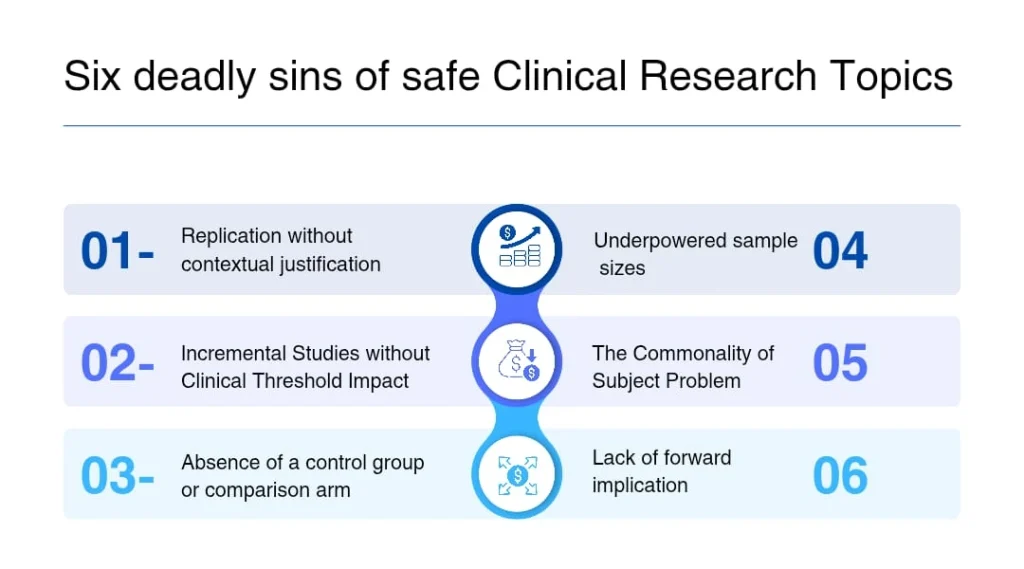
Let’s get specific. When editors flag a topic as unpublishable, the complaint almost never looks like “this topic is too safe.” It looks like one of these six very precise criticisms:
1. Replication Without Contextual Justification
Conducting the same study in a new hospital or a different country, without a compelling reason why that geographic or demographic context adds something new, is the most common version of the safe-but-unpublishable trap. The question editors ask: “If we already know this works in three continents, why does your local data change anything?”
2. Incremental Studies Without Clinical Threshold Impact
Showing that Drug A reduces biomarker X by 3% in a subgroup of patients already known to respond is incremental to the point of irrelevance. Editors want findings that cross a clinical decision threshold — the kind that would actually change what a physician, clinical research nurse, or protocol committee does on Monday morning.
3. Absence of a Control Group or Comparison Arm
According to a large-scale editorial analysis of manuscript rejections, the absence of a control group is a leading cause of rejection across medical journals. Without a comparison arm, causality cannot be established, and without causality, clinical conclusions cannot be drawn — making the study, however safe its topic, academically worthless.
4. Underpowered Sample Sizes
Ten subjects. Twenty subjects. Even fifty subjects in many intervention designs. Underpowered studies produce inconclusive results by design, and inconclusive results are the academic publishing equivalent of a null submission. This is a critical lesson for those entering clinical research jobs or aspiring to CRA clinical research roles where trial design approval often depends on sample size justification.
5. The “Commonality of Subject” Problem
In an editorial retrospective of 902 manuscripts, one of the most cited rejection reasons was simply: “commonality of subjects.” Translated from editor-speak, this means the topic has been studied, analyzed, and published so many times that another entry adds nothing to the conversation. This is the defining failure of the “safe” research approach.
6. Lack of Forward Implication
Perhaps the subtlest sin: the topic is accurate, rigorous, and methodologically sound — but the discussion section offers no forward-looking implication. Editors don’t just want to know what you found. They want to know what your field should do next because of what you found. Safe topics rarely generate bold implications.
TABLE: Publishability Assessment of Common Clinical Research Topic Types
| Research Topic Type | Example | Common Rejection Reason | Verdict | Path to Salvage |
|---|---|---|---|---|
| Confirmatory replication | Re-studying metformin efficacy in T2D | Lack of novelty | LOW | Add a novel subgroup or comparative arm |
| Local prevalence study | Hypertension rates in a single district hospital | Commonality of subject | LOW | Compare against national data; identify causative gaps |
| Single-arm intervention (no control) | Outcomes after IV iron therapy without placebo arm | No control group; causality cannot be established | VERY LOW | Redesign with comparison arm or use historical controls |
| Clinical laboratory science research topics | Standard biomarker reference ranges in a healthy cohort | Incremental; lacks clinical decision impact | CONDITIONAL | Contextualize in disease state or ethnic population gap |
| Novel intervention study | First-in-region trial of a new drug delivery mechanism | N/A — passes the novelty test | HIGH | Focus on rigorous methodology and CONSORT reporting |
| Research topics in clinical laboratory science | ML model for early sepsis detection via CBC patterns | N/A — novel application of existing tools | HIGH | Validate in prospective cohort; report sensitivity/specificity |
| Negative / null result study | Drug X shows no benefit over placebo in comorbid population | Publication bias against null results | MEDIUM (improving) | Pre-register the study; submit to null-results-friendly journals |
| Systematic review of saturated area | 8th meta-analysis on aspirin for primary prevention | Redundant overlap with existing reviews | VERY LOW | Narrow the PICO question; identify gaps in prior reviews |
The Gap Between Clinical Care and Clinical Research: Where Publishable Topics Live
Here is the insight that separates researchers who publish consistently from those who don’t: the most publishable topics almost always live at the intersection of clinical care and clinical research — specifically in the gaps between the two.
When a clinical research nurse observes a pattern of adverse events that doesn’t match what the trial protocol predicted, that’s a publishable gap. And when a clinical laboratory scientist finds that a standard reference range for a biomarker doesn’t hold in a specific ethnic population, that’s a publishable gap. When CRA clinical research teams notice that protocol adherence consistently breaks down at a particular trial phase, that’s a publishable gap.
These are not comfortable observations. They are not “safe” in the social or political sense — they challenge assumptions, expose practice variations, and sometimes embarrass institutions. But they are the observations that editors are waiting for.
The Cairo Consensus Statement on Research Integrity of Randomised Clinical Trials specifically emphasizes that trialists, ethics committee members, and journal editors must all receive integrity training that promotes not just methodological compliance, but active pursuit of findings that challenge existing practice. Research that simply confirms what clinicians already do does not serve that mandate.
How to Assess Publishability Before You Begin: A Pre-Research Checklist
The expensive mistake in clinical research is spending eighteen months conducting a study and then discovering the topic has a publishability problem. That mistake is entirely preventable. Before a single ethics application is filed, every researcher — from those in entry-level clinical research jobs to senior clinical research associates — should be asking these questions:
- What is the current state of the literature on this topic?
- Conduct a systematic mapping review. If there are twelve similar studies, yours needs a genuinely different angle — not just a different hospital.
- What clinical decision does this finding change?
- If you cannot articulate a specific decision that would be different after your study, your topic lacks clinical threshold impact.
- Is there a comparison?
- Every intervention study needs an arm to compare against. No comparison, no causality. No causality, no publication in any credible indexed journal.
- Does it have adequate power?
- Run the sample size calculation before designing the study, not after collecting the data. Underpowering is a design failure, not a data failure.
- Am I answering a question the field is actually asking?
- Read the “Future Research” sections of the ten most recent papers on your topic. Those are literally the questions editors want answered.
- Would this finding change practice in a measurable timeframe?
- Research with a 15-year implementation horizon is less compelling than research that could inform next year’s clinical guidelines.
Pro Tip for Clinical Research Laboratory Scientists: The highest-value publishable territory right now sits at the intersection of point-of-care diagnostics, AI-assisted pattern recognition in lab data, and underrepresented patient populations. These three factors together almost guarantee editorial interest.
In order to avoid rejection, also read this: Factors Influencing Desk Rejection in Clinical and Surgical Journals.
Null Results, Replication Science, and the Evolving Editorial Landscape
There is a countermovement worth knowing. The rigid anti-null-result bias that has dominated academic medicine for decades is beginning to crack — and this matters for anyone evaluating the publishability of clinical research topics.
Pre-registration platforms like ClinicalTrials.gov have created a mechanism for establishing research intent before outcomes are known, which in turn creates an ethical obligation for journals to publish results regardless of direction. The emergence of journals specifically designed to publish null and replication results — including ClinicaPress’ explicit policy of evaluating methodological soundness over result novelty — is opening new pathways.
But this evolution does not rescue poorly designed confirmatory studies. What it does is create a legitimate publishing home for well-designed studies that happen to produce negative or inconclusive findings. The key phrase is “well-designed.” A mediocre study that confirms existing knowledge remains unpublishable. A rigorously designed study with pre-registration that produces a null result is increasingly publishable — and critically important for clinical research management, because it prevents unnecessary replication of treatments that don’t work.
For those pursuing a masters in clinical research or preparing to enter competitive clinical research positions at contract research organizations, understanding this shift is a professional advantage. The researchers who can navigate both the traditional novelty-first publishing model and the emerging transparency-first model will have a significant edge.
Building Publishable Research Topics: Strategic Moves That Actually Work
There are concrete, repeatable strategies for converting a “safe” clinical research topic into a publishable one — without compromising ethics or inflating claims.
Disaggregate to Find Signal
If a topic has been studied broadly, narrow it aggressively. Instead of “outcomes of diabetes management in adults,” go to “glycemic outcomes in adults aged 60–75 with concurrent chronic kidney disease stage 3 on SGLT2 inhibitors.” The specificity itself creates novelty. This is one of the most effective strategies used by experienced clinical research associates working in specialty trial environments.
Apply Novel Methodology to Established Questions
If the research question itself is established, the methodology can be the novelty. Applying machine learning analysis to existing EHR datasets, using ecological momentary assessment in patient-reported outcomes research, or leveraging wearable device data in a traditional clinical pharmacology question can transform a safe topic into a methodologically innovative one.
Cross-Disciplinary Integration
Some of the most publishable work in current clinical research — including hot-topic clinical laboratory science research topics — emerges from combining two fields that haven’t talked to each other. Genomics plus environmental exposure. Pharmacokinetics plus social determinants of health. Biomarker science plus implementation research. These combinations are novel almost by definition.
Identify the Assumption Your Field Has Never Challenged
Every clinical specialty has foundational assumptions that haven’t been rigorously tested because everyone assumes they’re true. Finding and testing one of those assumptions — even if your finding is confirmatory — carries publishability because the explicit challenge to the assumption is itself the contribution.
Anchor to a Policy or Guideline Gap
Studies that directly inform a clinical guideline revision are nearly always publishable. If your topic can be framed as answering a specific evidence gap identified in a current WHO, NICE, or CDC guideline — editors from clinical and policy-facing journals will take notice. This framing is something that professionals in clinical research management should be building into project planning from day one.
Final Word: Stop Hiding Behind Safety
The clinical research field does not reward researchers who avoid risk. It rewards researchers who take the right kinds of risk — intellectual risk, methodological ambition, willingness to challenge what everyone else assumes is settled.
Whether you are a clinical research nurse designing your first independent study, a clinical research assistant supporting a large multicenter trial, or a senior CRA with fifteen years of experience considering a new independent research agenda, the same principle applies: the publishability of clinical research topics is determined by their capacity to move knowledge forward, not by their capacity to stay out of trouble.
Editors are not adversaries. They are gatekeepers of a public resource — the scientific literature — that millions of clinicians, patients, and policymakers depend on to make decisions. When they reject a “safe” topic, they are doing their job. When you build a genuinely publishable topic, you are doing yours.
The gap between the two is not talent. It is strategic thinking applied to research design from the very first question.
Start here: Before your next research proposal, read the “Future Research” sections of the five most-cited papers in your specialty published in the last two years. That reading list is an editor’s wishlist in disguise.
Once done with cross checking all the necessary checks, submit your research for publication in our Journal of Clinical Medicine & Translational Research (JCMTR).
Reference Books
- Designing Clinical Research (4th Edition) — Stephen B. Hulley, Steven R. Cummings, Warren S. Browner et al. Link: https://www.lww.com/product/9781451190618
- How to Write and Publish a Scientific Paper (9th Edition) — Barbara Gastel & Robert A. Day Link: https://www.abc-clio.com/products/a4830c/