
There is something deeply satisfying about uncovering how a biological system works at its most elemental level. A mechanistic researcher would be most interested in questions like:
- Why does this enzyme misfold?
- How does this receptor cascade trigger apoptosis?
- What exact pathway does this pathogen exploit to evade innate immunity?
These questions are beautiful. They are also, by themselves, insufficient for top-tier clinical publication.
This is not an opinion. It is the editorial standard of nearly every high-impact clinical journal currently operating. All of them explicitly require evidence that findings hold relevance beyond cell lines and animal models. Mechanistic research is the foundation. It is not the building.
Understanding what is mechanistic research requires precision. It refers to studies that explain the biological, chemical, or molecular processes underlying a disease, drug interaction, or physiological phenomenon. It answers “how” and “why” at a cellular or molecular level. But clinical science answers a different question: “So what does this mean for the patient sitting in front of me?”
“Science that cannot be translated into clinical relevance is science that cannot yet be published in the journals that shape practice.” — ClinicaPress Editorial Position, 2026
What Is Mechanistic Research — and Where It Lives in the Evidence Hierarchy
So, what is mechanistic research, formally? It is defined as research designed to understand the underlying processes by which an intervention or exposure produces an effect. It operates primarily at the preclinical level — in vitro studies, animal models, computational simulations, and molecular pathway analyses.
In the traditional evidence pyramid, mechanistic studies sit at the foundational tier. Above them are case reports, observational studies, cohort studies, randomized controlled trials, and finally systematic reviews and meta-analyses. The higher you climb, the more clinical journals care about your work.
This hierarchy matters enormously when you are seeking the best clinical cancer research funding with the highest publication impact factor. Funding bodies like the NIH and the Welcome Trust increasingly require translational endpoints — not just mechanistic elegance. A brilliant paper on how a tumor suppressor is dysregulated will not attract a Nature Medicine editorial if it cannot gesture convincingly toward therapeutic implication.
Key statistics:
- ~85% of top journals require clinical relevance statements in submissions
- 3–12 years: average bench-to-bedside translational timeline
- Less than 14% of preclinical findings successfully replicate in human trials
- $2.3 billion: estimated annual US investment in mechanistic disease research
The Clinical Approach vs. Public Health Approach: A Framework Researchers Confuse
One of the most underappreciated conceptual divides in biomedical science is the clinical approach vs. public health approach. The confusion between these two frameworks directly explains why mechanistic papers get desk-rejected from clinical journals.
A clinical approach is focused on the individual patient — diagnosis, treatment, prognosis, pharmacotherapy. It asks: “What is the best intervention for this person?” A public health approach, by contrast, is population-level — it asks: “What shifts in exposure, behavior, or policy will reduce disease burden across thousands or millions of people?”
Mechanistic research, by nature, operates at neither of these scales. It operates at the sub-individual level — the cell, the molecule, the gene. When a researcher submits mechanistic findings to a clinical journal without bridging to either the clinical or public health lens, editors reject the paper not because the science is weak, but because the framing is mismatched.
This is a solvable problem. At ClinicaPress, we have written extensively on Clinical relevance. Read:
- How Editors Judge Clinical Relevance in Medical Research Papers?
- Clinical Research Relevance: Why Journals Prefer Research Questions That Feel Clinically “Urgent”
The Translation Gap: What Editors Actually Want to See
Peer reviewers at clinical journals are not anti-mechanistic. Many of them run mechanistic labs themselves. What they are against is the implicit assumption that revealing a biological mechanism is, on its own, a contribution to clinical science.
What editors want is a translational bridge. This means your mechanistic finding must be contextualized with one or more of the following:
- Human tissue validation or human biomarker correlate data alongside your animal or in vitro findings
- Epidemiological plausibility — does the mechanism you’ve uncovered align with known patterns of disease in human populations?
- A hypothesis for a clinical or therapeutic intervention that logically follows from your mechanism
- Subgroup analyses in patient cohorts that support the mechanistic hypothesis
- Pilot clinical data, even N-of-1 cases, suggesting the mechanism operates in vivo
Without at least one of these, your mechanistic research clinical publication journey will end at the editorial desk — not at peer review.
Cancer Research: The Highest-Stakes Arena for Translational Gaps
In oncology, the stakes of this gap are most visible. Researchers pursuing the best clinical cancer research funding with the highest publication impact factor know that journa operate with explicit policies requiring human relevance. According to the National Cancer Institute, translational endpoints are now built into the grant review criteria for most NCI R01 mechanisms — meaning the funding ecosystem has already moved ahead of many researchers’ publication strategies.
If your mechanistic cancer finding cannot point to a patient population, a biomarker, or a drug target with clinical trial feasibility, the impact factor competition will not favor you — regardless of how novel the mechanism is.
Public Health Clinics and the Real-World Laboratories We Ignore
Here is something the academic publishing ecosystem rarely discusses openly: some of the most valuable mechanistic-to-clinical bridges exist not in tertiary research hospitals but in public health infrastructure.
Take the Lentz public health clinic model, which operates within a framework of integrated community care. Or the Beaumont public health clinic system in Michigan, serving diverse socioeconomic and ethnic populations. Or the Butte County public health clinic network in Northern California, which has generated real-world chronic disease exposure data across decades. These are not academic silos. They are translational gold mines.
Similarly, the Sterling VA public health clinic STD testing program has produced some of the most externally valid prevalence data on sexually transmitted infections in veteran populations — data that mechanistic immunology researchers have used to contextualize mucosal immunity findings in ways that journals actually accept.
Mechanistic researchers who build formal partnerships with public health dental clinic systems, community health networks, and VA-affiliated clinics are not just doing good community science. They are solving their own publication problem. They are giving their mechanisms a population to live in.
Mechanistic vs. Translational Research: What Clinical Journals Evaluate
| Criterion | Mechanistic Research | Translational / Clinical Research | Journal Priority |
| Primary Question | How/why does this biological process occur? | Does this finding change patient outcomes? | High |
| Study Model | Cell lines, animal models, computational | Human cohorts, RCTs, real-world data | Very High |
| Outcome Measure | Molecular endpoint (enzyme activity, gene expression) | Clinical endpoint (mortality, quality of life) | Critical differentiator |
| Generalizability | Limited — species/model-specific | High — patient population-facing | Required statement in most journals |
| Replication Standards | Lab-to-lab reproducibility | Multi-site, multi-population replication | Systematic review eligibility |
| Funding Alignment | Basic science grants (R21, exploratory) | R01, NIH translational grants, PCORI | Higher funding ceilings |
| Impact Factor Access | Basic science journals (avg IF: 5–10) | Clinical journals (avg IF: 15–70+) | Significant publication advantage |
| Policy Influence | Indirect — shapes future clinical hypotheses | Direct — informs guidelines, drug approvals | WHO, FDA, NICE criteria |
The Replication Crisis and Why Mechanistic Research Is Most Vulnerable
The replication crisis in biomedical science has hit mechanistic research disproportionately hard. Multiple large-scale replication projects, including the Reproducibility Project: Cancer Biology, found that a significant proportion of high-profile preclinical mechanistic findings failed to replicate across laboratories, species, or cell line batches.
This is not a scandal unique to bad actors. It is a structural feature of mechanistic research: the closer you are to the molecule, the more sensitive your results are to environmental variables — cell passage number, reagent batch, housing conditions of animal subjects, even the time of day experiments are conducted. These variables do not exist in the same form in clinical research, which uses human subjects whose biological variability is inherently part of the study design.
The WHO’s framework on research for universal health coverage explicitly identifies translational failures — the gap between mechanistic discovery and clinical application — as one of the primary bottlenecks in global health improvement. This is not peripheral concern. It is a WHO-level systems problem.
Clinical journals know this. Their editorial standards reflect it. Demanding human-level evidence or at least robust multi-model mechanistic convergence is not gatekeeping for its own sake. It is a quality filter born from two decades of painful replication failures.
How to Elevate Mechanistic Research for Clinical Publication: A Practical Framework
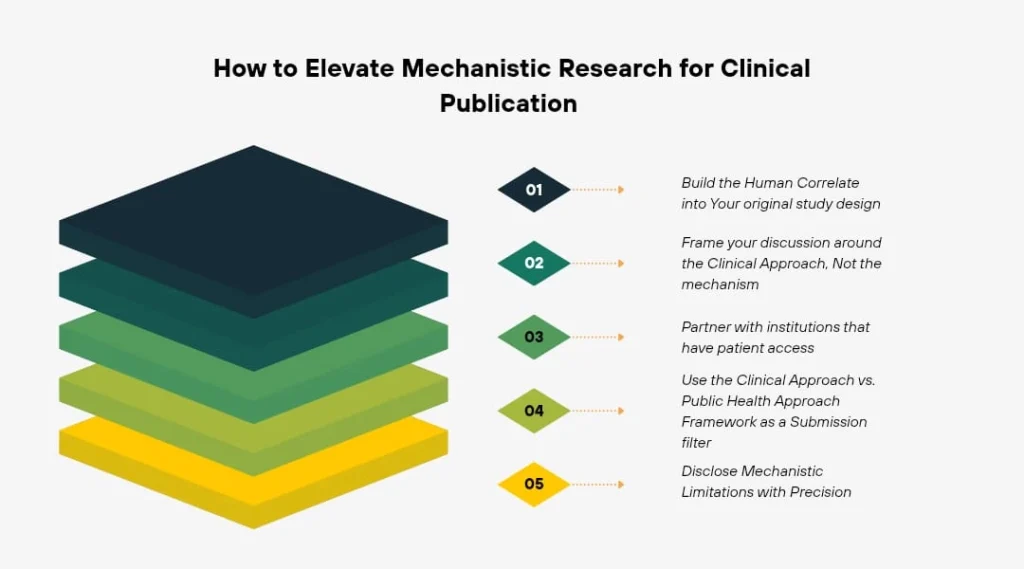
If you are a mechanistic researcher who wants to publish in clinical journals — and who doesn’t? — here is what you actually need to do. This is not theoretical advice. It is the distillation of editorial feedback patterns across the major clinical journals.
1. Build the Human Correlate Into Your Original Study Design
Do not finish your mechanistic study and then scramble for a human dataset to bolt on. Design the human correlate into the study from the start. Even a tissue microarray of 40 patient samples, validated against your in vitro findings, changes the entire editorial reception of your paper.
2. Frame Your Discussion Around the Clinical Approach, Not the Mechanism
Your introduction and discussion should be written in the language of clinical medicine. Open with the patient problem, not the molecular gap. Close with a clinical implication, not just a call for “further mechanistic investigation.” Editors read your discussion to decide whether their readership — primarily clinicians — will care.
3. Partner With Institutions That Have Patient Access
This is where collaborations with public health clinic systems — including public health dental clinics, the Butte County public health clinic network, or a Lentz public health clinic-affiliated academic center — become strategically valuable. These institutions have the IRB infrastructure, the patient populations, and increasingly the research appetite to co-author translational work.
4. Use the Clinical Approach vs. Public Health Approach Framework as a Submission Filter
Before submitting, ask yourself honestly: Is this paper written for a clinician managing individual patients? Or is it written for a public health policy audience? Or is it currently written for neither, still aimed at a molecular biology audience? That third category will not survive clinical editorial review. Choose your framework and commit to it in every section of the manuscript.
5. Disclose Mechanistic Limitations With Precision
The worst thing you can do in a clinical journal submission is pretend your mechanistic study proves what it cannot prove. Reviewers penalize overclaiming more harshly than they penalize methodological limitation. Acknowledge that you are working in a model system. Acknowledge the translational caveats. Then make the strongest possible case for why your mechanism is still worth the reader’s attention. Confidence and humility are not opposites in scientific writing — the best clinical papers carry both.
The Role of Specialty Clinics and High-Throughput Environments in Bridging the Gap
Not all clinical environments are created equal for translational bridge-building. High-volume specialty clinics — STD testing services like those at the Sterling VA public health clinic, oncology infusion units, and integrated behavioral health programs — offer mechanistic researchers something that academic hospitals often cannot: population-level diversity within a controlled service delivery model.
When mechanistic findings are validated in data generated from these settings, the external validity of the work increases substantially. Editors notice. Reviewers notice. The conversation shifts from “interesting mechanism” to “potentially practice-changing insight.”
At ClinicaPress, our coverage of specialty clinic-based translational research shows this is not a niche trend — it is becoming the standard expectation for translational science submissions at journals above an impact factor of 10.
Learn more about translational research from Translational Research in Medical Journals.
Funding, Impact Factor, and the Strategic Logic of Going Clinical
Let us be blunt about incentives. If you are pursuing the best clinical cancer research funding with the highest publication impact factor, staying exclusively in mechanistic research is a strategic disadvantage. The gap in impact factor between top basic science journals and top clinical journals remains large and persistent.
Nature Medicine carries an impact factor above 58. The Lancet above 98. Compare that to Journal of Biological Chemistry (IF ~5) or PLOS ONE (IF ~3). The difference is not about the quality of science — it is about proximity to clinical application. Journals with physician readerships attract more citations because clinicians, policymakers, pharmaceutical companies, and science journalists all track high-impact clinical publications far more aggressively than preclinical literature.
This matters for career progression, grant renewal, and institutional standing. A mechanistic researcher who publishes exclusively in basic science journals is not doing lesser science. But they are operating with a significant disadvantage in the modern academic metrics ecosystem. The solution is not to abandon mechanistic research — it is to translate it.
To increase your funding competitiveness and publication range simultaneously, refer to our Blogs section for detailed guidance.
Final Word: The Mechanism Is the Beginning, Not the Destination
None of this is an argument against mechanistic research. Without it, clinical medicine would have no intellectual engine. Statins would not exist. Immunotherapy would not exist. CRISPR would be a curiosity rather than a therapeutic platform. Mechanistic research is the origin of every clinical revolution in modern medicine.
But origin is not destination. A mechanistic researcher would be most interested in the machinery of biology — and that curiosity is exactly what drives discovery. The discipline, however, lies in recognizing that journals, funders, and ultimately patients need more than machinery. They need to know what the machine does for human beings.
The researchers who understand this — who can hold a molecular mechanism in one hand and a clinical population in the other — are the ones who publish in the journals that matter, attract the funding that sustains careers, and ultimately contribute to the guidelines that save lives.
That is the standard. It is high. It should be.
Publish your Journals here.
Reference Books
1. Translational Medicine: From Lab to Clinic — A Systematic Guide to Bridging Preclinical Discovery and Human Application Edited by Bhavesh D. Bhatt & Dilip R. Bhatt | Publisher: Springer Covers mechanistic-to-clinical translation methodology, study design for bridging preclinical evidence, and journal submission strategy for translational manuscripts.
2. Clinical Epidemiology: The Essentials Authors: Robert H. Fletcher, Grant S. Fletcher | Lippincott Williams & Wilkins5th Edition Foundational text for understanding why clinical journals require population-level evidence, and how to design studies that satisfy both mechanistic and clinical publication criteria.