
The way you present your thoughts may be just as critical to the success of your work as the content itself. There is a continuing trend in the rejection of articles due to the article’s tone; it is often rejected for being (1) vague, (2) over-confident, or (3) culturally tone deaf, regardless of the data quality of the research. Unfortunately, most graduate programs do not offer coursework on the subject of delivery.
The basis for the assessment of Scientific Credibility is not only based upon the research methods used but also based upon the words that are read out loud from a research article; this means that when the editors of the most credible journals in the world evaluate the quality of a research document they will evaluate the tone of the document before they perform any assessment of the methods section; peer reviewers will also assess the tone of the document in the same manner. This statement is not subjective; rather, it is a theoretical foundation for the concept of scholarly communication. The tone of a manuscript ultimately will determine whether your work is seriously considered, published or rejected.
The objective of this article is to more clearly define how the tone of a manuscript can facilitate the assessment of credibility in the medical publishing industry, what the expectations of the research community are with respect to that measurement and what you can do to improve the quality of the manuscript.
Get further guidance with “How to Maintain Formal Tone in Academic Writing: 10 Proven Strategies for Professional Excellence?”
What “Tone” Actually Means in a Scientific Manuscript
The tone in academic writing is not limited to professionalism or formality; however, it describes the overall attitude of the manuscript towards (a) the subject matter, (b) the supporting data, and (c) the intended audience. Tone is determined by the selection of vocabulary; the use of hedging language; and the degree of certainty shown in claims; as well as the syntax present in the sentences, and the similarity (or otherwise) between the evidence and conclusion.
A suitable tone should perform a number of functions at once: give confidence while avoiding excessive claims; acknowledge uncertainty without undermining the findings; appeal to a specialist audience but not distance interdisciplinary readers who may contribute to the citation network; and, very importantly, show the authors’ appreciation for both the ethical and epistemological limitations of their discipline.
There can be specific complications associated with achieving the appropriate tone when conducting clinical versus public health research. The tone associated with clinical writing tends to be: individual-specific, case-driven and outcome-focused; whereas the tone of public health writing is population-driven and requires a different set of hedging practices, degrees of statistical humility and policy-related contextualization. Combining the two tonal registers into one manuscript produces dissonance in the tone, which is easily recognised by the reviewer even though the reviewer may not be able to articulate it.
The Credibility Architecture of a Medical Manuscript
Envision the architecture of scientific legitimacy in health research publishing as a structural framework containing several weight-bearing columns. Part of one’s structure involves methodology, while quality of data, as well as ethical conduct, also act as weight-bearing structural elements; however, through scientific writing, tone can either bond the components of the structure like mortar binds bricks together or separate the components of the structure and create failure within the structure (e.g., collapse).
According to the International Committee of Medical Journal Editors (ICMJE), clear, concise, and complete reporting both technically meet the expectation of the ICMJE, as well as satisfy a professional and ethical duty. Tone dictates the extent to which a submitted manuscript provides transparent information versus evasive information; authoritative information versus irresponsible information; and accurate information versus misleading information.
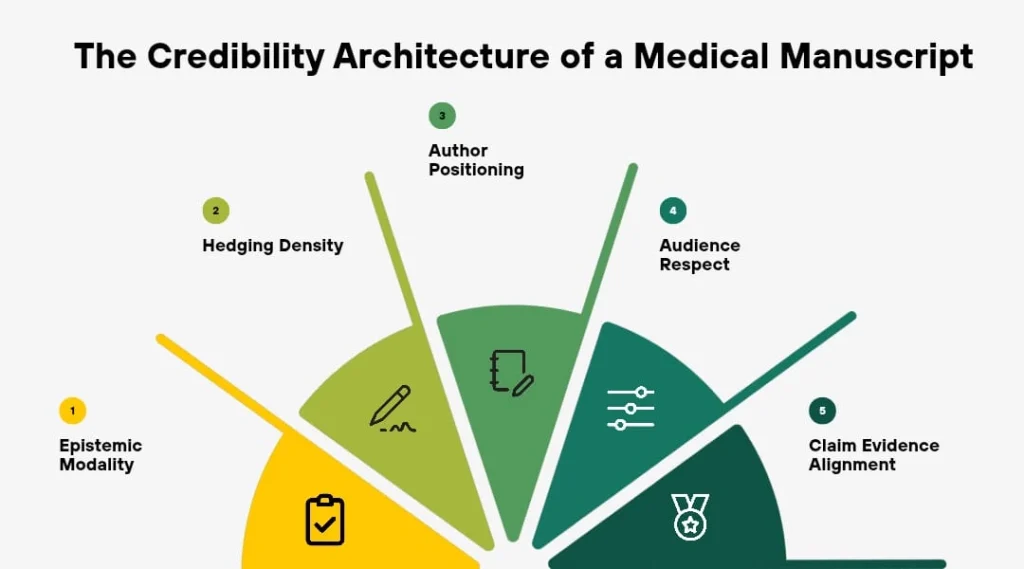
There are four elements within the tonal dimension(s) that affect how credible the author(s) of the submitted manuscript will report their findings:
- Epistemic modality — How confident do you feel you can make the claims you are making? Using “demonstrates”, “proves” or “confirms” suggests you are overconfident when evidence does not necessarily support it. “Suggests”, “indicates”, or “is consistent with” would present a more credible alternative.
- Hedging density —Too little hedging indicates scientific naiveté, while excessive hedging indicates defensiveness and weakness. The optimal amount of hedging indicates a serious interest in the uncertainty surrounding your claims/perceptions.
- Author positioning — Are you presenting yourself as a neutral bystander, or are you advocating for your hypothesis? Both are acceptable ways of positioning yourself; however, each demands a different level of tonal register.
- Audience respect — Insult specialists with too much elaboration. Alienate generalists with too little. Determine level of elaboration based upon journal scope.
- Claim-evidence alignment — Your conclusion must align to the evidence presented.
“The language of a manuscript is not a wrapper around science — it is science. How you frame a finding shapes what that finding means to the community that reads it.”
Also read, How Journals Reject Papers for Credibility in the Post-Retraction Era?
Mechanistic Research and the Demand for Precision Language
The goal of mechanistic research is to determine the biological, physiological, and/or molecular mechanisms underlying an event (the “how”) rather than simply describing the result of an event (the “what”). In mechanistic research, the researcher wants to establish how a specific disease produces its effects based on the genome of the individual with the disease by identifying the mechanism by which it does so (e.g., the cellular signaling cascade leading to the disease, the pharmacodynamic interaction that caused the disease, etc.).
Mechanistic research uses a very precise and precise style; the researcher is making causal claims based on the biological mechanisms of their research, rather than simply having correlations between variables. Using the most accurate and appropriate language possible for the researcher’s goals and to maintain an impression that the data/intervention/experiment provided definitive evidence of causation, the language of mechanistic research must be very definable and precise.
It can often be difficult to maintain this tone; many investigators tend to overstate their causal assumptions by saying things such as “treatment X causes activation of pathway Y,” even though the data suggested only that they were both associated (i.e., treatment X was associated, co-occurred, or was related to the activation of pathway Y). Some investigators hedge their causal assumption, causing a loss of the mechanistic insight that provided the foundation for the investigation.
Researchers who do mechanistic studies at the junction between clinical and mechanistic research have one simple guideline for writing their article: First, relate the mechanism of function of the disease without hesitation. Second, relate how that mechanism functions with hesitation. Third and last, indicate the experimental conditions associated with that mechanism. This three-step sequence gives the impression of both good science and truthful representation of the work.
Tone Calibration Across Journal Tiers: A Comparative Framework
Not all medical journals expect identical tonal registers. The manuscript voice appropriate for a high-impact generalist journal differs significantly from what’s expected in a specialist clinical journal. Understanding this landscape is essential for strategic submission.
Among the considerations for authors seeking the best clinical cancer research funding with highest publication impact factor, tone calibration relative to journal audience is frequently underestimated. High-impact-factor journals attract broader, more interdisciplinary readership — and that demands a tone that is simultaneously precise for specialists and accessible for adjacent disciplines.
| Journal Category | Typical IF Range | Expected Tone Register | Common Tonal Errors | Key Publishers |
| Top-tier generalist (NEJM, Lancet, JAMA) | 40–120+ | Authoritative, accessible, policy-aware, evidence-grounded without jargon overload | Excessive jargon, overconfident clinical claims, insufficient population context | Elsevier, Springer Nature, AMA Press |
| High-impact specialty (Nature Medicine, Cell Host & Microbe) | 25–60 | Precise, mechanistic, innovation-forward; novelty must be stated clearly and defensibly | Incremental framing, failure to situate findings in broader scientific context | Springer Nature, Cell Press |
| Clinical specialty journals | 5–25 | Clinically grounded, practice-relevant, patient-outcome focused | Overly basic explanations, failure to link findings to clinical decision-making | Thieme Medical Publishers, Wolters Kluwer, BMJ Group |
| Public health journals (AJPH, BMC Public Health) | 4–15 | Population-level framing, equity-conscious, policy-translatable | Clinical individualism applied to population data; ignoring social determinants | Oxford University Press, BioMed Central |
| Open-access multidisciplinary (PLOS Medicine) | 10–20 | Transparent, reproducibility-focused, accessible global readership in mind | Jargon-heavy abstracts, inadequate methods transparency, narrow geographic framing | PLOS, Quality Medical Publishing |
| Emerging/regional specialty journals | 1–8 | Contextually specific, locally relevant, developing-field appropriate | Mimicking top-tier tone without the data to support it; inappropriate generalization | Various regional academic presses |
Table 1 — Manuscript Tone Expectations Across Medical Journal Categories · ClinicaPress.com, 2026
How Scientific Credibility Is Damaged by Common Tonal Mistakes
Most tonal errors in medical manuscripts are not dramatic failures — they’re subtle signals that accumulate into a pattern that makes reviewers uncomfortable. Here are the ones that most consistently damage scientific credibility in medical publishing.
Overclaiming Without Epistemic Support
The most prevalent and harmful tonal error is authors writing “We showed that X causes Y” when they are using observational data to back up their findings; this demonstrates that the authors either lack knowledge about causal inference or are abusing their conclusions in order to make an impact. Either way, both cases would have an extremely negative effect on the author’s reputation.
In mechanistic studies as well, where casual terminology should be easy to utilise since researchers are examining mechanisms, the precision of your tone is very important. What was the state of the cells during the experiment? And, what was the concentration? What was the type of model system used?
Hedging Paralysis
The opposite problem — hedging so heavily that no clear claim is made — is equally damaging. It reads as scientific anxiety rather than scientific caution. Reviewers want authors who can state what they found and what it means, with appropriate qualification. A manuscript that refuses to commit to any interpretive position offers readers nothing to engage with.
Inappropriate Register for Journal Audience
Writing a clinically toned paper for a basic science journal — or a molecular biology paper for a public health audience — creates cognitive friction. The reader has to work to translate the manuscript into their own framework. Elite journals do not ask their editors to do this work. The burden is entirely on the authors.
Advocacy Masquerading as Science
This occurs when authors’ enthusiasm for their findings leads them to write in promotional rather than analytical tones. Phrases like “this groundbreaking study fundamentally changes how we understand…” signal advocacy, not science. It may feel compelling, but it triggers credibility skepticism in expert readers immediately.
Editorial Rule of Thumb: For every strong claim you make in your manuscript, ask: “What tone does my evidence actually warrant here?” If you’re a mechanistic researcher, ask: “Am I describing the mechanism or claiming universal causation?” The answer should directly determine your word choice.
The Role of Medical Publishers in Shaping Tone Standards
The publishing infrastructure of medical science plays a larger role in tone standards than most authors realize. Major publishers embed tonal expectations in their author guidelines, peer-review frameworks, and editorial decision processes.
Thieme Medical Publishers is widely recognized for its rigorous standards in surgical, clinical, and radiological specialties. Their editorial culture expects a tone that is precise, evidence-anchored, and clinically translatable. Authors who pitch speculative claims in Thieme-targeted manuscripts find themselves rejected at desk review — not because the science is wrong, but because the tone doesn’t match what the publication stands for.
Meanwhile, publishers celebrated for thought leadership and insights — like Scientific American for lay-adjacent science communication — demand a different tonal mastery entirely. Scientific American has built its reputation over 180 years on translating expert science for intelligent non-specialists. Writing for that audience requires authors to maintain scientific accuracy while shedding the defensive hedging language that marks journal-style writing. Both registers have credibility — but they are not interchangeable.
Understanding the publishing ecosystem is as important as understanding journal scope. Authors seeking the best medical info publishers for thought leadership and insights should study each publisher’s existing body of work before submitting — not just their impact factor or scope statement.
Public Health Contexts and Tonal Equity Considerations
In public health medicine — spanning everything from dental and reproductive health clinics to county-level epidemiology programs — manuscript tone carries additional dimensions that purely clinical research sometimes bypasses. Public health writing must grapple with equity, social determinants, and policy implications in its framing. Ignoring these dimensions doesn’t just reduce impact — it signals a fundamental misunderstanding of the field’s values.
Consider how researchers reporting outcomes from community health infrastructure — whether studying populations served by public health dental clinics, primary care programs in rural areas, or specialized county services like a Butte County public health clinic or a Beaumont public health clinic — must frame their findings within structural context. Writing “patients failed to comply with treatment” in a public health manuscript is a tonal failure that signals clinical bias. The credible alternative — “treatment adherence was lower among populations with limited transportation access” — demonstrates social literacy and methodological sophistication simultaneously.
The World Health Organization’s framework on social determinants of health provides the conceptual backbone for this kind of equity-aware framing. Authors who have internalized this framework write differently — and that difference is palpable to reviewers who share it.
Similarly, research emerging from settings like a Sterling VA public health clinic focused on STD testing — where stigma intersects with clinical science — must deploy a tone that is non-judgmental, patient-centered, and public-health literate. The absence of this tonal awareness is itself a form of methodological bias that compromises the manuscript’s credibility.
Building a Credibility-Optimized Manuscript Voice: Practical Strategies
Knowing the theory is one thing. Building the skill is another. Here’s how researchers and clinicians can actively develop manuscript tone that enhances rather than undermines their scientific credibility in medical publishing.
1. Read Published Work in Your Target Journal Critically — for Tone
Most authors read published papers for content. Read them instead for voice. Notice how the authors introduce their hypothesis. How do they frame their limitations? How do they connect their findings to the existing literature? This active reading practice builds an intuitive feel for journal-specific tonal norms faster than any style guide.
2. Apply the “Reviewer Simulation” Test
Before submitting, read your manuscript as a skeptical expert reviewer in your field. Where would you push back? What claims feel inflated? Where is the evidence thinner than the tone suggests? This exercise almost always reveals tonal misalignments that revision can correct.
3. Use the ICMJE Reporting Guidelines as Tonal Benchmarks
The ICMJE recommendations aren’t just checklists — they encode tonal expectations. When you read their guidance on discussing results and conclusions, you’re reading a roadmap for appropriate claim strength. Following these guidelines tends to naturally produce a more credible tonal register.
4. Distinguish Between “Interesting” and “Important”
Authors who frame all their findings as “important” lose credibility quickly. Not all findings are equally significant. A manuscript that calibrates its excitement — noting where findings are truly novel, where they confirm existing knowledge, and where they raise new questions — projects scientific maturity. Readers trust authors who can make these distinctions.
5. Get Pre-Submission Peer Review from Outside Your Lab
Your collaborators are too close to the work to detect tonal problems. Seek feedback from colleagues in adjacent fields who will read your manuscript as a somewhat outside reader. Their instinctive reactions to your tone — even if they can’t articulate why — are extremely valuable signals.
For additional resources on scientific writing excellence and editorial strategy, ClinicaPress’ editorial policies offer curated guidance on building a credible, publication-ready voice across specialties.
Why the Scientific Community Is Starting to Take Tone More Seriously
The replication crisis in biomedical science — in which a significant proportion of published findings have failed to replicate — has focused renewed attention on every aspect of scientific communication, including tone. Researchers have begun to identify a correlation between overclaiming language and non-replication. Papers that make bolder, more sweeping claims tend to replicate less reliably than those that make more modest, carefully hedged ones.
This is not just a stylistic concern. It has profound implications for how public health policy is made, how clinical guidelines are written, and how resources are allocated in medical research. The NIH’s analysis of reproducibility and rigor in biomedical research highlights that language choices in manuscripts contribute to the overall transparency and reliability of scientific findings.
Journals are responding. They have implemented stricter guidelines around causal language and conclusion scope. Peer reviewers are increasingly trained to flag tonal over claiming as a peer review criterion, not merely an editorial preference. The field is moving — and researchers who adapt their tone now are positioning themselves ahead of where the credibility bar is already going.
This matters even for researchers engaged in marine scientific research, environmental health studies, or other fields adjacent to medicine that publish in medical and public health journals. The same tonal credibility standards apply across the full spectrum of health sciences publishing.
“A manuscript that says less than the data permits is fixable. A manuscript that says more than the data permits is a credibility problem that follows authors across their careers.”
Conclusion: Tone Is Not Decoration — It Is Evidence
Every word choice in your manuscript is a signal. Every claim is a bet on your credibility. Scientific credibility in medical publishing is not conferred by prestigious affiliations or high-budget studies alone — it is earned through the disciplined, honest, and precise use of language that reflects genuine understanding of both the data and its limits.
Whether you’re submitting to a top-tier generalist journal or a specialized clinical publication, whether your research is mechanistic, epidemiological, or translational — the same principle holds. Tone is not decoration. It is evidence of how you think as a scientist.
Invest in it accordingly.
For further guidance, refer to our blogs especially curated to guide researchers at every stage of their publication.
PUBLISH NOW ON ClinicaPress!
Reference Books
1. Gastel, B., & Day, R. A. (2016). How to Write and Publish a Scientific Paper (8th ed.). Greenwood / ABC-CLIO. The foundational text on scientific writing conventions, tone, and structure in biomedical publishing. Widely used in WHO and NIH training programs globally.
2. Strunk, W., White, E. B., & Angell, R. (2000). The Elements of Style (4th ed.). Pearson. Though a general style manual, its principles on clarity, brevity, and voice remain the bedrock of credible scientific prose and are referenced in manuscript development curricula worldwide.