Every medical researcher who has ever submitted to a high-impact journal knows the feeling. You spend months — sometimes years — running trials, collecting data, writing with obsessive precision, and then you send it off. Two weeks later, a politely devastating rejection email arrives in your inbox. No fanfare, no real explanation. Just a quiet door slammed in your face.
And here’s the brutal truth most publishing guides won’t say out loud: rejection is not the exception in academic publishing — it is the rule. The New England Journal of Medicine rejects over 90% of submissions. The Lancet is only marginally more forgiving. Even among the top journals tracked by PubMed and the National Library of Medicine, acceptance rates at journals with an impact factor above 10 rarely exceed 10–15%. If you are submitting without a deliberate plan to convert rejection to acceptance, you are playing a losing game.
This guide is the action plan you actually need. It doesn’t coddle. It gives you a structured, evidence-driven framework for turning that rejection letter into eventual acceptance — at the journal your research genuinely deserves.
Why High-Impact Journals Reject Good Research
Rejection doesn’t always mean your research is flawed. Many decisions are driven by factors that have nothing to do with scientific validity. Understanding these saves you from misreading the feedback — and misapplying the fix.
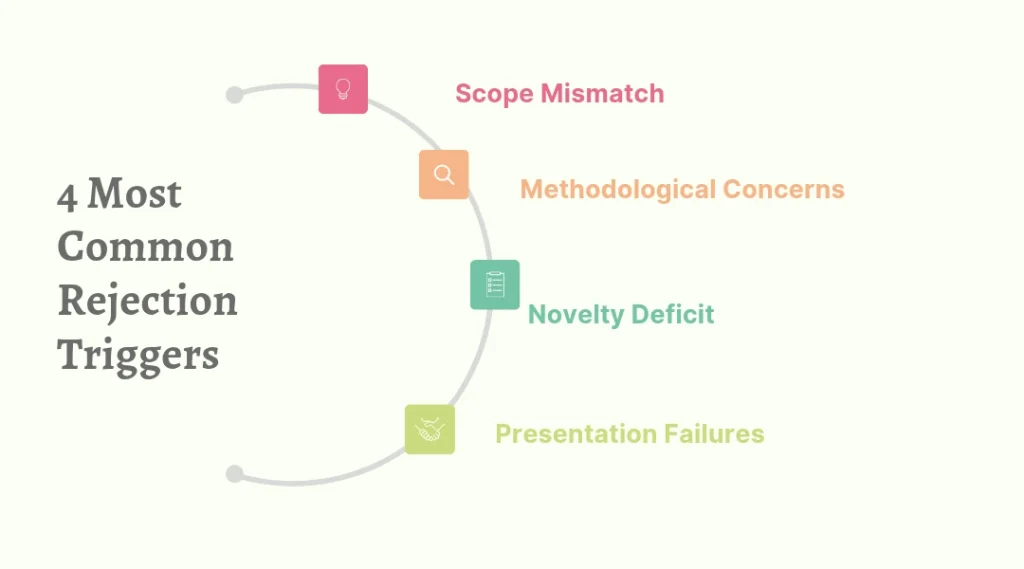
The most common rejection triggers at high-impact journals are:
- Scope mismatch — the topic doesn’t align with the journal’s current editorial priorities
- Methodological concerns — small sample sizes, inadequate controls, or unclear statistical analysis
- Novelty deficit — reviewers don’t see a genuine advance beyond what’s already published
- Presentation failures — a weak abstract, poor structure, or an underdeveloped discussion section
The distinction matters enormously because your action plan depends entirely on your diagnosis. A scope mismatch demands a different response than a methodological flaw. Conflating the two is one of the most expensive mistakes a medical research scientist can make — both in time lost and career capital burned.
For researchers at the greatest health and medical research programs globally, rejection carries institutional weight beyond the personal. It affects grant renewal conversations, tenure timelines, and collaboration invitations. The pressure to publish in journals recognized by the WHO and global health bodies is real and sustained. That’s all the more reason to approach revision and resubmission with surgical precision rather than emotional reactivity.
Step One: Decode the Rejection Letter Like a Scientist
The rejection email is not your enemy. It’s data. Before you do anything — before you complain to colleagues, before you consider abandoning the paper, before you impulsively fire it off to the next journal on your list — read that letter three times. Slowly. Analytically.
Editors and peer reviewers, even when they reject, leave signals embedded in their language. Words like “scope,” “priority,” and “readership” indicate a scope mismatch. Phrases like “insufficient evidence,” “limited generalizability,” or “small cohort” point to methodology. Language like “incremental advance” or “prior literature has addressed” signals a novelty problem.
Mark every specific critique. Then build a two-column document: one column for the reviewer’s concern, one for your planned response. This is not optional busywork. This is how broadening medical research happens in practice — through deliberate, systematic iteration, not gut instinct. If the journal explicitly states it would consider a revised version, treat that as a formal invitation, not a polite formality.
“A rejection letter decoded correctly is worth more than five acceptance letters from journals your field doesn’t actually read.
For further clarity, review these guides:
- Why Manuscripts Get Different Decisions in Clinical Publishing?
- Rejection of Public Health Research Articles: Why It Happens
Step Two: The Surgical Revision Framework
Now that you’ve diagnosed the problem, it’s time to revise — not randomly, but with precision. Address every substantive concern raised by reviewers while strengthening the manuscript’s overall quality. Think of your revision as a second study, not a cleanup job. That mental shift changes everything about how you approach the work.
Addressing Methodological Concerns
If reviewers flagged sample size, statistical power, or control conditions, decide quickly whether you can feasibly address the concern. Can you run an additional validation cohort? Also, can you perform a post-hoc power analysis that satisfies the critique? Can you pull supplementary data that directly responds to the reviewer’s specific worry?
If yes — do it, document it thoroughly, and make the addition visible in your revision notes. If no — reframe your paper explicitly as a pilot study or proof-of-concept. Use language that signals this framing to the next set of reviewers before they raise the same flag independently. Proactive transparency reads as scientific maturity. Silence reads as oversight.
Strengthening Novelty and Contribution
A novelty critique means reviewers don’t yet see why your work changes the field. The fix is rarely more data — it is a sharper argument. Your introduction must be rewritten so that by the end of the first page, any expert reviewer understands precisely what gap this paper fills and why filling it now is consequential. Your discussion must move beyond describing results and into interpreting their real-world implications — for clinical practice, health policy, or the next frontier of progressive medical research.
Fixing the Abstract and Presentation
Abstract quality is criminally underestimated across academic medicine. In research published in JAMA Network, editorial decisions are frequently made within 48 hours of initial submission, driven partly by how clearly the abstract communicates significance. If your abstract buries the finding, hedges on methods, or uses five sentences to convey what two would accomplish — that is your first fix, before anything else.
The same logic applies to your title. A title should deliver the finding, not merely describe the study. “A Study on the Relationship Between X and Y in Adult Patients” is not a title. “X Reduces Y by 34% in High-Risk Adults: A Multicenter Cohort Analysis” is a title. The difference is not cosmetic — it determines whether a busy editor keeps reading.
For further understanding, read Presenting Clinical Data: Tables, Figures, and Supplementary Files Done Right
Table 1 — Top Journals for Original Medical Research: Impact Factor, Acceptance Rate & Scope
| Journal Name | Impact Factor | Est. Acceptance Rate | Primary Scope | Selectivity |
| New England Journal of Medicine | ~176 | <5% | Clinical medicine, RCTs | Ultra-selective |
| The Lancet | ~168 | ~5% | Global health, clinical research | Ultra-selective |
| JAMA | ~157 | ~5% | Clinical practice, public health | Ultra-selective |
| Nature Medicine | ~87 | ~8% | Translational, biomedical | Highly selective |
| BMJ | ~107 | ~7% | Clinical research, health policy | Highly selective |
| PLOS Medicine | ~15 | ~15% | Public health, global medicine | Accessible (IF>10) |
| Journal of the American Heart Association | ~23 | ~20% | Cardiovascular medicine | Accessible (IF>10) |
| eClinicalMedicine (Lancet family) | ~34 | ~18% | Broad clinical, translational | Accessible (IF>10) |
This table reflects something every researcher building a publication strategy must internalize: top journals accepting original articles with an impact factor over 10 span a wide spectrum of selectivity. Your submission plan should be tiered accordingly — a reach journal, a match journal, and a safety journal identified before you send the very first submission.
Step Three: Strategic Journal Targeting After Rejection
This is where most researchers make their second critical mistake. After rejection from a top-tier journal, the reflex is to submit to the next journal down the impact factor ladder. That is not strategy. That is desperation wearing a plan’s clothing.
Intelligent journal targeting after rejection requires evaluating four variables simultaneously: scope alignment, audience fit, typical turnaround time, and open access requirements (especially relevant given current funder mandates from NIH, Wellcome Trust, and the Gates Foundation). Resources like NIH’s PubMed Central journal database let you filter by subject, indexing, and submission guidelines — use them systematically before committing.
There is also a simpler signal hiding in plain sight: look at your own reference list. Which journals do you cite most heavily? Those are your strongest candidates. They indicate where your scientific community publishes and reads. They are also staffed by editors and reviewers who are already comfortable with the methodological conventions your paper employs. That alignment is not gaming the system. It is precision targeting.
At ClinicaPress, we’ve covered topics for your support during publication. The same research, framed with different emphasis, can legitimately appeal to different journals without any compromise to scientific integrity. This is not manipulation — it is communication strategy. And communication is a scientific skill that medical researchers are rarely taught and consistently underestimate.
Refer to our guide:
Step Four: The Resubmission Cover Letter as a Strategic Document
The cover letter is an afterthought for most researchers and a precision instrument for the ones who publish consistently. At journals receiving thousands of submissions monthly, your cover letter frequently determines whether the editor opens the manuscript with curiosity or dismissal.
A high-conversion cover letter for resubmission does five things in sequence:
- Opens with one sentence that states the finding and its immediate clinical or public health relevance
- Names the specific gap in existing literature that this paper fills — not vaguely, but with precision
- Signals genuine familiarity with the target journal by referencing a recent article, editorial, or thematic series
- If resubmitting after peer review, briefly summarizes the revisions made in response to prior concerns
- Closes with a confident, direct statement of suitability — no apologetic hedging, no excessive deference
If you are responding to a formal revise-and-resubmit invitation, your cover letter must be accompanied by a structured response-to-reviewers document. Address every single point raised, numbered and in sequence. Where you agree with reviewers, show exactly what you changed. Where you respectfully disagree, state your scientific rationale clearly. Editors value intellectual honesty far above compliance theater.
The Career Reality: Medical Research Scientist Salary and Publishing Pressure
Let’s address what most academic publishing guides carefully avoid: the direct relationship between your publication record and your financial and professional reality. The average medical research scientist salary in the United States ranges from approximately $80,000 to over $150,000 annually, depending on institution type, NIH grant status, and career stage. But those numbers obscure something important — publication record in high-impact journals directly influences grant success rates, promotion timelines, and institutional salary negotiations in ways that are measurable and well-documented.
A researcher publishing consistently in journals with an impact factor above 10 generates meaningfully different career outcomes than one publishing equivalent volume in lower-tier venues. For early-career scientists at institutions with the greatest health and medical research programs — Mayo Clinic, Johns Hopkins, Karolinska Institutet, the Wellcome Sanger Institute — the pressure to secure high-impact placements intersects with funding cycles in ways that make strategic publishing not just professionally desirable but economically essential.
Naming this reality clearly is not cynical. It is the first step toward navigating the system with integrity rather than being blindsided by it. Researchers who understand how publication prestige operates can make deliberate choices about where and when to submit. Our piece on Ethics Training for Journal Editors and Reviewers covers the clear lines researchers must never cross — duplicate submission, salami-slicing, predatory journal traps — and why crossing them costs more than it ever saves.
Broadening Medical Research: The Case for Strategic Open Access
There is a persistent and damaging myth in academic medicine that a paper not placed in a top-five journal is a paper wasted. This idea is scientifically outdated and practically counterproductive. Broadening medical research dissemination strategies is not a fallback position — it is increasingly the standard of responsible scientific practice.
Preprint servers like medRxiv have normalized early dissemination of findings, allowing researchers to establish intellectual priority over their work while formal peer review proceeds. Repositories like these also allow the global medical community to engage with research before it clears the 12-to-18-month publication runway at elite journals — a timeline that matters enormously when findings have public health implications.
Open access journals with rigorous editorial processes and impact factors above 10 — PLOS Medicine, eClinicalMedicine, the Journal of Clinical Investigation — now command genuine institutional respect. Funding bodies including NIH and the European Research Council formally recognize them. Tenure committees at progressive institutions evaluate them favorably. Publishing in these venues is not settling. For research designed to reach clinicians in under-resourced settings, it is the more ethical choice — because open access means your findings are actually accessible to the people who need them.
Our coverage of open access medical publishing strategy at ClinicaPress breaks down which OA journals carry real weight in which subspecialties, so your dissemination decisions are deliberate rather than default.
Read “What Is Open Access? A Complete Guide for Researchers“
The Psychology of Rejection: What the Literature Doesn’t Warn You About
Academic publishing guides skip this section. That skip is costly. Repeated journal rejection produces a measurable psychological burden on researchers — documented in studies of academic burnout, imposter syndrome prevalence, and early-career attrition rates in biomedical research. Loss of motivation, withdrawal from collaboration, and declining manuscript output are not personal failures. They are well-studied responses to sustained, high-stakes rejection in a field that provides almost no formal training in how to handle it.
The antidote is not optimism. It is process. Researchers who navigate rejection most effectively share one behavioral pattern: they separate the evaluation of the work from the evaluation of themselves, and they have a defined resubmission protocol they execute within 48 to 72 hours of receiving a rejection. Not because the rejection doesn’t sting — it does — but because structured momentum is the only reliable countermeasure to research paralysis.
Build your resubmission protocol before you need it. Identify your next three target journals before submitting to the first. Have your response-to-reviewers template partially drafted in advance. Know exactly what revision steps you’ll take for each category of critique. This is not pessimism — it is the operational discipline that distinguishes productive researchers in the greatest health and medical research programs from those who quietly disappear from the field in their third or fourth year.
For researchers working inside progressive medical research environments where publication timelines feed directly into grant renewals and institutional standing, our guide on researcher resilience and publishing psychology addresses the human side of academic output in language that is concrete, evidence-based, and genuinely useful. And our guide “Time Medical Publishing Takes: Real Timelines Explained” helps researchers synchronize funding cycles with submission schedules — so that rejection stops feeling like a financial emergency and starts feeling like a navigable phase of the research lifecycle.
Integrity Is the Only Non-Negotiable
Every strategy in this guide operates strictly within the boundaries of academic integrity. No simultaneous submissions to multiple journals. And, no peer review manipulation. No fragmenting one study into multiple thin papers to artificially inflate output. These shortcuts exist. Researchers use them. And they consistently cost more than they earn — in retracted papers, damaged reputations, and careers ended early.
The medical research enterprise runs on trust in a way that most professional fields do not. Clinicians make treatment decisions using your published findings. Health policymakers build public health frameworks on your data. Regulatory bodies cite your evidence in approval decisions. Every compromise you introduce into that chain — even a technically minor one — has downstream consequences that extend far beyond your manuscript and your career.
The path from journal rejection to acceptance is slower than anyone wants. It demands patience with your science, humility about peer review, strategic clarity about the publishing landscape, and the emotional resilience to resubmit after the fourth rejection with the same rigor you brought to the first. None of that is instinctive. All of it is learnable.
Your research deserves to be read. That means doing the work required to get it published — correctly, ethically, and at the highest level the science can support.
Recommended Reference Books
- Gastel, B., & Day, R. A. (2016). How to Write and Publish a Scientific Paper (8th ed.). ABC-CLIO / Greenwood. — The gold-standard reference for manuscript preparation, peer review navigation, and journal selection strategy. Required reading for any serious medical research scientist.
- Schimel, J. (2012).Writing Science: How to Write Papers That Get Cited and Proposals That Get Funded. Oxford University Press. — A masterclass in scientific storytelling, argument structure, and communicating novelty — the exact gap most rejected manuscripts fail to close.