Building Trust in Scholarly Publishing
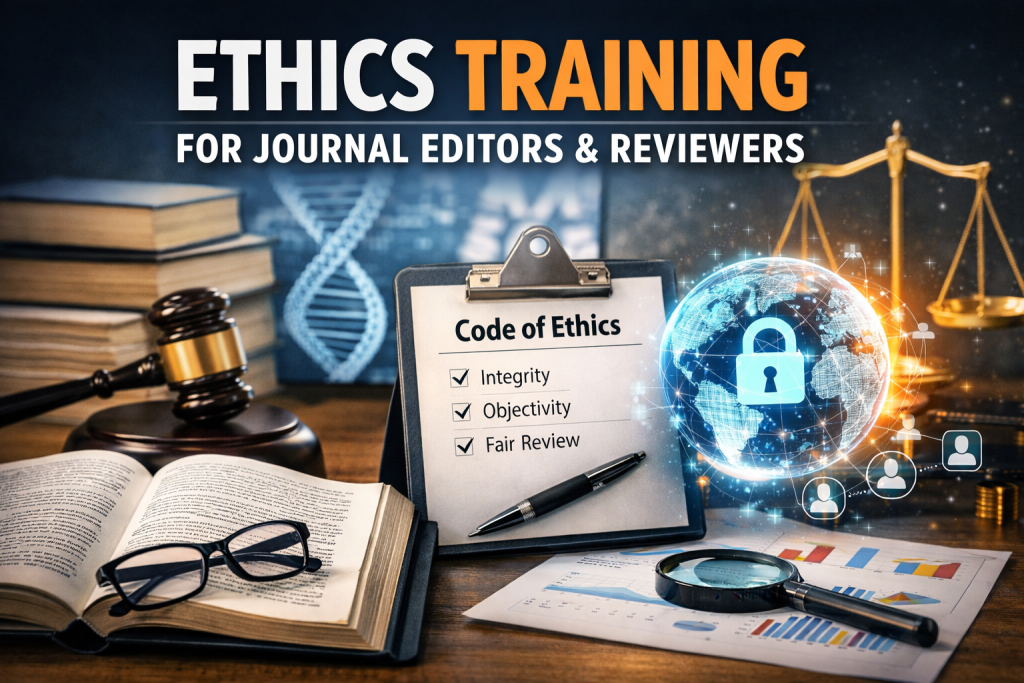
Ethics is the invisible infrastructure of academic publishing. Without it, peer review becomes performative, editorial decisions become questionable, and journals lose credibility fast. Ethics training for journal editors and reviewers is no longer optional — it is a core operational requirement for any serious publishing platform. In an era of paper mills, AI-assisted misconduct, authorship disputes, and data manipulation, journals that fail to train their gatekeepers are actively risking scientific integrity.
This article outlines how structured ethics training, including mass programs and code-of-conduct education, creates accountable editorial ecosystems and produces amplified, trustworthy reviews.
Why Ethics Training Is Now a Non-Negotiable
Academic publishing has scaled rapidly, but ethical oversight hasn’t kept pace. Editors and reviewers often learn “on the job,” which leads to inconsistent decisions and blind spots.
Common ethical failures include:
- Undisclosed conflicts of interest
- Bias against regions or institutions
- Mishandling of plagiarism cases (Understand more about plagiarism on Clincapress\)
- Breaches of reviewer confidentiality
- Inappropriate authorship decisions
According to guidance from the Committee on Publication Ethics, journals must actively train editorial teams rather than assume competence. Ethical literacy is a skill — not a personality trait.
A journal that invests in ethics and code of conduct training signals seriousness to authors, indexers, and readers.
Core Components of Effective Ethics Training
Not all training works. Passive slide decks and one-time webinars change nothing. High-impact programs share specific features.
1. Scenario-Based Learning
Editors need exposure to real dilemmas:
- Suspected fabricated data
- Duplicate submissions
- Reviewer misconduct
- Authorship disputes
Case simulations force decision-making under uncertainty — exactly what editors face daily.
Authoritative resources such as the guidelines published by the U.S. emphasize case-based instruction as the most effective method for research ethics education.
2. Clear Decision Frameworks
Training must provide structured protocols:
- When to retract vs. correct
- How to handle whistleblowers
- Escalation pathways
- Documentation standards ( Get professional help with Paperedit professional formatting service)
Without frameworks, editors improvise — which creates inconsistency.
3. Bias Awareness and Fairness
Unconscious bias influences editorial decisions more than most editors admit. Ethical training must address:
- Geographic bias
- Language bias
- Institutional prestige bias
- Gender bias
Research summarized on highlights systemic biases that can distort publication outcomes if reviewers are not trained.
Mass Ethics Training for Editorial Boards
Large publishing platforms cannot rely on one-to-one mentoring. Mass ethics training allows consistent standards across hundreds of editors and reviewers.

Scalable training models include:
- Modular online certification programs
- Recorded masterclasses with assessments
- Interactive workshops
- Annual ethics refreshers
Mass programs ensure that even new reviewers joining mid-year meet baseline expectations.
For journals operating marketplaces or large submission volumes, this is operational risk management — not just education.
Business Ethics Training Meets Academic Publishing
Publishing is also a business. Revenue pressures, impact factor competition, and author expectations can influence decisions.
Business ethics training prepares editors to resist:
- Pressure to accept low-quality papers for revenue
- Citation manipulation tactics
- Editorial favoritism toward sponsors
- Marketing disguised as scholarship
International standards promoted by organizations such as emphasize independence and transparency as pillars of trustworthy science communication.
Journals that blur commercial and editorial lines eventually face reputational damage — or delisting.
Ethics and Code of Conduct Training
Every journal should maintain a written editorial code of conduct — and train people on how to apply it.
Key elements include:
- Confidentiality rules
- Reviewer anonymity policies
- Data protection obligations
- Communication standards with authors
- Appeals and complaints procedures
Training should clarify consequences for violations. Without enforcement, policies are symbolic.
ClinicaPress has emphasized governance frameworks in resources such as
“Cost of Publishing in Medical Journals — Full Breakdown”noting that ethical infrastructure is part of publishing costs.
Amplified Reviews: The Outcome of Ethical Training
When reviewers are trained, reviews become:
- More constructive
- Evidence-based
- Transparent
- Consistent across manuscripts
This is what we call amplified reviews — feedback that genuinely improves research rather than merely filtering submissions.
Training also reduces hostile or dismissive reviewer behavior, a major complaint among authors.
A strong editorial culture transforms peer review from gatekeeping into quality assurance.
Implementing an Ethics Training Program: A Practical Model
Phase 1 — Baseline Assessment
Evaluate current knowledge gaps:
| Area | Common Weakness | Training Priority |
| Plagiarism handling | Over-reliance on software | High |
| Conflict disclosure | Inconsistent reporting | High |
| Reviewer conduct | Tone and bias issues | Medium |
| Retraction process | Lack of clarity | High |
Phase 2 — Structured Curriculum
A complete program should include:
- Research integrity fundamentals
- Publication ethics standards
- Legal considerations
- Editorial decision ethics
- Crisis management
The World Health Organization’s research ethics resources provide models for structured training in health research governance.
Phase 3 — Certification and Accountability
Require:
- Passing assessments
- Periodic renewal
- Documentation of training completion
Journals should maintain training records as part of compliance audits.
The Cost of Ignoring Ethics Training
Journals that neglect training eventually encounter:
- Retractions ( Get to know How Journals Reject Papers for Credibility in the Post-Retraction Era)
- Author distrust
- Indexing problems
- Legal exposure
- Loss of reviewer pool
Rebuilding credibility is exponentially harder than preventing damage.
The Future: Continuous Ethics Education
Ethical challenges evolve:
- AI-generated manuscripts
- Synthetic data
- Reviewer identity fraud
- Citation cartels
Training must be continuous, not one-time. Leading journals now run annual ethics refreshers similar to compliance training in high-risk industries.
Platforms that institutionalize ethics education will dominate the next decade of scholarly publishing.