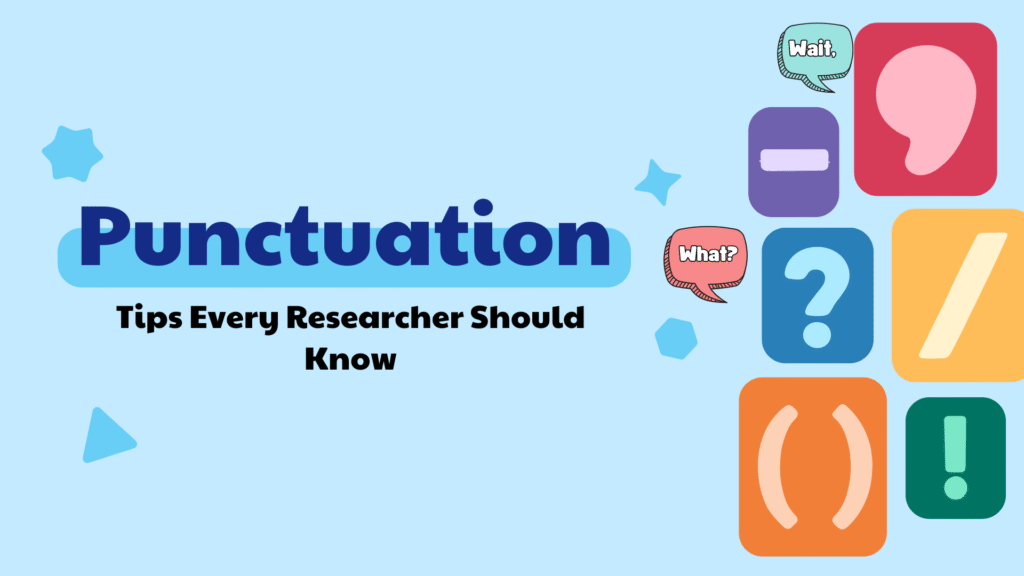
Punctuation is like the traffic system of writing — without it, everything would crash into confusion. It directs readers where to pause, stop, or continue. From commas to colons, punctuation marks clarify meaning, organize ideas, and maintain rhythm. When used correctly, punctuation ensures smooth reading and precise communication.
The Role of Punctuation in Written Language of Scientific Articles
Every punctuation mark serves a specific purpose. Commas indicate short pauses, periods close thoughts, and semicolons connect closely related ideas. Yet, among these symbols, three often create confusion — the hyphen, en dash, and em dash. Though they may look similar, their functions differ dramatically.
Common Punctuation Marks in Scientific Articles – You Already Know
Before diving into the dashes, let’s recall the basics:
| Punctuation Mark | Purpose | Example |
|---|---|---|
| Period (.) | Ends a sentence | She went home. |
| Comma (,) | Separates ideas | She bought apples, bananas, and pears. |
| Semicolon (;) | Connects clauses | I came; I saw. |
| Colon (:) | Introduces a list | Bring these: pens, paper, and notes. |
| Question Mark (?) | Indicates inquiry | Where are you going? |
| Exclamation Point (!) | Adds emotion | That’s amazing! |
Now, let’s explore the lesser-known yet powerful trio of punctuation marks that every writer should master.
The Hyphen (‐): A Small but Powerful Connector
What Is a Hyphen?
A hyphen (‐) is the shortest horizontal line used to connect two or more words or parts of words. It’s primarily used in compound terms to create clarity and precision.
Common Uses of Hyphens
- Compound Modifiers:
When two words function together to modify a noun, a hyphen connects them.
✅ A well-known author
✅ A high-speed train - Prefixes and Suffixes:
Hyphens connect prefixes to avoid confusion.
✅ ex-president
✅ non-toxic - Line Breaks in Text:
When a word doesn’t fit at the end of a line, it can be split with a hyphen (in print formatting).
Common Hyphen Mistakes
- ❌ He is a well known author.
✅ He is a well-known author. - ❌ We used state of the art technology.
✅ We used state-of-the-art technology.
Remember: if two words describe a noun together, use a hyphen.
The En Dash (–): Bridging Distances and Relationships
What Is an En Dash?
An en dash (–) is slightly longer than a hyphen and represents a range, connection, or relationship. It’s about the width of the letter “n” — that’s how it got its name.
Keyboard Shortcuts:
- Windows: Alt + 0150
- Mac: Option + Hyphen (-)
When to Use an En Dash
- Ranges (to or through):
✅ Pages 10–20
✅ Monday–Friday
✅ 1990–2020 - Relationships and Connections:
✅ The New York–London flight
✅ The east–west corridor - Complex Compound Adjectives:
✅ The post–World War II generation
En Dash vs. Hyphen
The hyphen connects close elements (like well-known), while the en dash connects elements with a relationship (like New York–London).
👉 Think of the en dash as a replacement for “to” or “through.”
The Em Dash (—): The Master of Emphasis
What Is an Em Dash?
The em dash (—) is the longest of the three, roughly the width of the letter “m.” It’s a punctuation mark that adds power and personality to your writing. It can replace commas, parentheses, or colons for dramatic effect.
Keyboard Shortcuts:
- Windows: Alt + 0151
- Mac: Shift + Option + Hyphen (-)
How to Use an Em Dash
- To Create a Pause or Emphasis:
✅ She was late—again. - To Insert an Interruption:
✅ I was just about to leave— when the phone rang. - To Replace Parentheses:
✅ Everything he owned—books, clothes, and furniture—was lost in the fire. - To Replace a Colon:
✅ She knew what she had to do—win.
Em Dash vs. En Dash
| Feature | En Dash (–) | Em Dash (—) |
|---|---|---|
| Length | Medium (n-width) | Long (m-width) |
| Use | Ranges, connections | Emphasis, interruption |
| Example | 2010–2020 | She was gone—without a trace. |
Visual Comparison: Hyphen vs. En Dash vs. Em Dash
| Mark | Name | Length | Usage Example |
|---|---|---|---|
- | Hyphen | Short | well-known author |
– | En Dash | Medium | 10–20 pages |
— | Em Dash | Long | She disappeared—without a word. |
These marks may look alike but convey completely different meanings. Choosing the right one shows mastery of punctuation and adds sophistication to your writing.
Style Guides and Punctuation Rules
Different writing styles have slightly different rules for dashes. Here’s how major guides interpret them:
| Style Guide | Hyphen (‐) | En Dash (–) | Em Dash (—) |
|---|---|---|---|
| APA (7th ed.) | For compounds | For ranges | For emphasis (no spaces) |
| Chicago Manual of Style | For compounds | For ranges or relationships | For breaks in thought (no spaces) |
| MLA | For compounds | For number ranges | For emphasis or interruption |
Note: Always check the style guide relevant to your publication or academic paper.
(Reference: The Chicago Manual of Style)
Common Misconceptions About Dashes
- ❌ Using hyphens for ranges — Use an en dash instead (e.g., 2010–2020).
- ❌ Adding spaces around em dashes — Most style guides prefer no spaces.
- ❌ Using multiple dashes unnecessarily — Limit dashes for clarity.
Punctuation and Readability: Why It Matters
Proper punctuation doesn’t just make writing grammatically correct—it makes it beautiful. The difference between a good sentence and a great one often lies in how punctuation is used to guide the reader’s rhythm and emotion. Mastering punctuation enhances professionalism, readability, and impact.
FAQs on Hyphens, En Dashes, and Em Dashes in scientific articles
1. What’s the main difference between a hyphen and a dash?
A hyphen connects words, while dashes (en and em) separate or emphasize ideas.
2. When should I use an en dash?
Use it for ranges (e.g., 10–20) or relationships (e.g., New York–London).
3. Can I use a hyphen instead of an en dash?
Technically, no. Although many people do, it’s stylistically incorrect.
4. Are there spaces around an em dash?
Usually no, but British English sometimes adds spaces (e.g., She left — without warning).
5. How do I type these on a keyboard?
- Hyphen: just press
- - En Dash:
Alt + 0150(Windows) orOption + Hyphen(Mac) - Em Dash:
Alt + 0151(Windows) orShift + Option + Hyphen(Mac)
6. Why are punctuation marks important in writing?
They ensure clarity, rhythm, and professionalism—without them, meaning gets lost.
Conclusion
Hyphens, en dashes, and em dashes are small marks that make a big difference. The hyphen connects, the en dash bridges, and the em dash emphasizes. Understanding their roles is essential for anyone who values precise, polished writing. Mastering punctuation is mastering communication — and that’s a skill worth perfecting.