The Access Divide That Shapes Modern Science
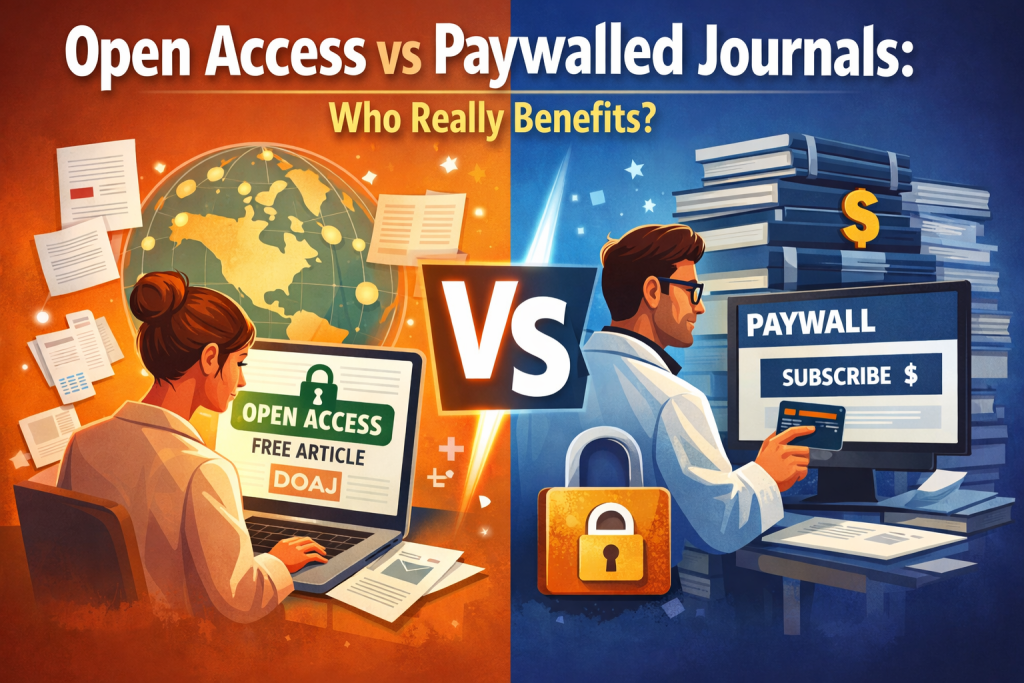
The debate around open access vs paywalled journals is no longer academic — it is economic, ethical, and deeply political. On one side, open access promises democratized knowledge. On the other, paywalled journals claim sustainability, prestige, and rigorous gatekeeping.
Researchers, institutions, funders, publishers, and even patients are all stakeholders in this model. The question is not which is “better” in theory — it is who actually benefits in practice.
For a generation trained to believe that science should serve humanity, the current system often feels like a paradox: publicly funded research locked behind private paywalls.
What Open Access Actually Means
Open access (OA) publishing allows anyone to read research without subscription fees. But OA is not a single model — it includes multiple pathways managed by open-access operators, universities, and independent publishers.
The most widely recognized registry of legitimate OA journals is the Directory of Open Access Journals, often referenced as the directory of open access journals (DOAJ). It screens journals for quality, transparency, and ethical publishing practices.
Researchers typically encounter three OA routes:
- Gold OA: Immediate free access on the journal website (often with article processing charges).
- Green OA: Authors archive a version in institutional repositories.
- Diamond OA: No fees for authors or readers, funded by institutions or societies.
According to a policy overview by the U.S. government’s public access initiative, publicly funded research is increasingly expected to be openly available — signaling a structural shift toward OA worldwide.
Why Paywalled Journals Still Dominate Prestige
Despite the momentum of OA, paywalled journals retain enormous influence. Legacy publishers control high-impact titles, citation networks, and academic career incentives.
Prestige still flows through subscription journals because:
- Hiring committees equate journal impact with researcher quality.
- Universities maintain expensive subscriptions to maintain access.
- Editorial boards often overlap with elite institutions.
Many clinicians and policymakers rely on these journals for curated, peer-reviewed information. A feature analysis by Nature notes that subscription models fund intensive editorial processes, investigative journalism, and infrastructure.
In short, paywalls often finance the machinery that produces perceived authority.
Who Pays in the Open Access Model
Open access shifts the cost burden from readers to authors — primarily through article processing charges (APCs).
These fees can exceed thousands of dollars per paper, creating a new inequality:
- Researchers in wealthy institutions publish more easily.
- Scholars from low-income regions face barriers.
- Early-career scientists struggle without grants.
Ironically, a model designed to democratize knowledge can restrict who gets to contribute to it.
This is where open access operators UK and other regional initiatives attempt to negotiate national agreements, reducing APC costs for affiliated researchers.
The Ethics Question: Knowledge as a Public Good
When medical research funded by taxpayers sits behind paywalls, the ethical tension becomes obvious. Patients, practitioners, and journalists cannot access findings that could influence care and policy.
A policy explainer from the National Institutes of Health emphasizes that public access accelerates innovation, reproducibility, and transparency.
Yet publishers argue that removing subscription revenue without replacing it risks destabilizing peer review and editorial oversight.
The real ethical dilemma is not access alone — it is sustainability.
How Predatory Publishing Complicates the Debate
The rise of predatory journals has damaged trust in open access. Some exploit the OA model by charging fees without providing legitimate peer review.
Researchers now rely heavily on the DOAJ directory of open access journals and institutional guidance to distinguish credible outlets from fraudulent ones.
ClinicaPress has previously highlighted how editorial transparency separates legitimate OA from exploitative publishing practices in the blog “Predatory Medical Journals”.
Without strong vetting systems, open access risks becoming synonymous with low quality — an unfair but persistent perception.
What the Data Actually Shows

| Factor | Open Access Journals | Paywalled Journals |
|---|---|---|
| Reader Access | Free for anyone worldwide | Restricted to subscribers or institutions |
| Publishing Cost | Often paid by authors (APCs) via open access operators | Usually free for authors but costly for readers |
| Visibility & Reach | Higher global reach and downloads | Limited to institutions with subscriptions |
| Prestige Perception | Growing but varies by journal | Traditionally higher due to legacy impact factors |
| Speed of Dissemination | Faster public availability | May be delayed by embargoes |
| Equity for Researchers | Can disadvantage unfunded authors | Can disadvantage readers without access |
| Funding Model | Author-side or institutional funding | Library subscriptions and licensing |
| Example Verification Tool | Directory of Open Access Journals (DOAJ directory of open access journals) | Journal indexing databases |
Large-scale citation studies suggest OA articles receive more downloads and broader global reach. However, citation advantages vary by discipline and journal reputation.
A Wikipedia overview of open access publishing notes that accessibility increases visibility, especially in developing regions where institutional subscriptions are limited.
Paywalled journals, meanwhile, maintain higher average impact factors — reinforcing their prestige loop.
The Hidden Winners: Institutions and Publishers
Universities often pay twice in the current ecosystem:
- Funding research.
- Paying subscriptions to read it.
- Covering APCs for OA publishing.
Major publishers remain profitable under both models, adapting hybrid systems that charge authors and readers simultaneously.
ClinicaPress has examined this “double-dipping” phenomenon in its analysis of journal business models.
The result is a publishing economy where the same institutions shoulder most costs regardless of access model.
What Researchers Actually Want
Surveys consistently show that researchers prioritize:
- Visibility
- Career advancement
- Credibility
- Speed of publication
Open access excels at visibility. Paywalled journals still dominate credibility metrics.
Many authors therefore choose hybrid journals — publishing OA within subscription titles — a compromise that reflects systemic incentives rather than ideological preference.
Guidance on selecting the right journal model is discussed in ClinicaPress resources for authors: How to Choose the Right Journal for Your Paper: 10 Expert Strategies for Academic Success.
Who Truly Benefits — The Honest Answer
There is no single winner in the open access vs paywalled journals debate.
Open access benefits:
- Readers worldwide
- Practitioners without subscriptions
- Policymakers and journalists
- Interdisciplinary collaboration
Paywalled journals benefit:
- Established publishers
- Elite institutions
- Researchers seeking prestige signals
Hybrid systems benefit:
- Publishers most of all
The ultimate beneficiaries should be society — but that requires structural reform, not just shifting payment models.
ClinicaPress has argued that the future lies in transparent publishing ecosystems that prioritize integrity over profit: Top 10 Powerful Reasons the Importance of Impact Factor in Journal Selection Matters.
The Future: Toward Responsible Access
Global initiatives increasingly mandate open access for publicly funded research. At the same time, reforms are pushing for fairer APC pricing, stronger peer review standards, and clearer journal accountability.
The direction is clear: knowledge is moving toward openness, but credibility frameworks must evolve alongside it.
Until then, researchers must navigate a complex terrain where access, prestige, cost, and ethics intersect — and every publication decision becomes a strategic one.