For early-career researchers, the difference between SCI vs SCIE journals is not just academic trivia — it directly affects hiring decisions, grant approvals, promotions, and institutional rankings. Yet many authors still misunderstand what these labels actually mean, how indexing works, and which category their target journal belongs to. If you are serious about publishing strategically, you need clarity — not myths passed around in lab corridors.
This guide breaks down the real distinctions, why they matter, and how to choose wisely without compromising research integrity.
What Is an SCI Journal?
The term what is SCI journal comes up constantly in academic circles. SCI stands for Science Citation Index, originally created by Eugene Garfield and now maintained by Clarivate. It was designed to track citation relationships among top scientific journals — essentially mapping how knowledge builds upon previous work.
An SCI-indexed journal historically represented the highest tier of scientific publishing. These journals demonstrated:
- Rigorous peer review
- Strong citation performance
- International editorial standards
- Consistent publishing ethics
Today, SCI refers specifically to the core print index, while its expanded digital counterpart has become more relevant.
Researchers often confuse SCI with impact factor alone. Impact factor is just one metric derived from citation data — not the index itself.
What Is SCIE and How Is It Different?
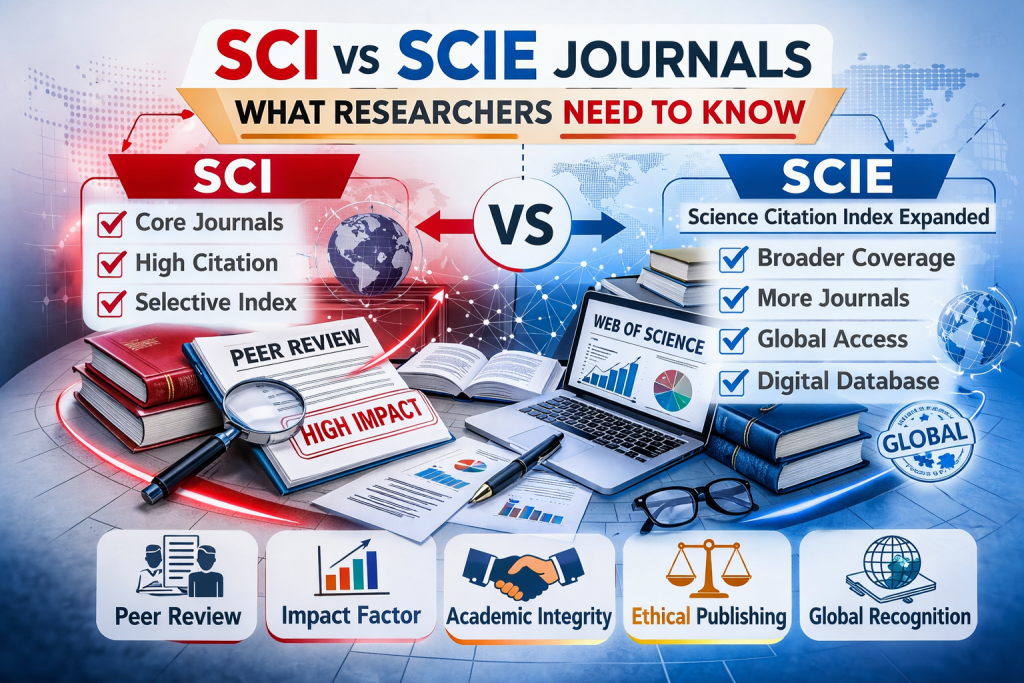
SCIE stands for Science Citation Index Expanded. It is the online, broader version covering thousands more journals across disciplines.
In practical terms:
| Feature | SCI | SCIE |
| Coverage | Select core journals | Expanded global coverage |
| Format | Originally print | Digital database |
| Number of journals | Smaller | Much larger |
| Accessibility | Limited | Widely accessible |
| Relevance today | Historical prestige | Current standard |
Most journals researchers target today are indexed in SCIE rather than the original SCI. Universities that still demand “SCI journals only” are often relying on outdated terminology.
Why the Confusion Persists in Academia
Many institutions — especially in developing research systems — continue using SCI as shorthand for high-impact journals. Promotion guidelines, scholarship requirements, and grant criteria sometimes lag behind database updates.
This confusion creates problems:
- Researchers chase the wrong journals
- Predatory publishers exploit misunderstanding
- Early-career scholars panic unnecessarily
Understanding indexing systems is part of responsible proof research practice. Before submitting, verify the journal’s status directly in Clarivate’s Master Journal List rather than relying on email claims or third-party lists.
How SCI vs SCIE Affects Your Career
Publishing in indexed journals influences far more than citations.
Academic Promotions
Universities often require indexed publications for tenure. Knowing whether SCIE counts in your institution can prevent wasted effort.
Grant Competitiveness
Funding agencies evaluate publication quality. Indexed journals signal credibility and visibility.
Global Recognition
International collaborations often screen potential partners based on indexed output.
This is why training programs like the research science institute emphasize publication literacy alongside experimental skills.
Ethical Publishing vs Shortcuts

Pressure to publish pushes some researchers toward questionable practices, including illegal paper access platforms like sci hub. While widely used, such platforms raise serious copyright and ethical concerns and do not replace legitimate institutional access.
Ethical publishing behavior includes:
- Respecting copyright laws
- Avoiding predatory journals
- Maintaining transparent authorship
- Using proper citation practices
Academic integrity is not optional — it is the currency of scientific trust.
Choosing the Right Journal Strategically
Instead of obsessing over labels, evaluate journals using a balanced checklist.
Key Selection Criteria
- Indexing status (SCI/SCIE/Web of Science)
- Scope alignment with your study
- Peer-review transparency
- Publication timeline
- Acceptance rate
- Open-access policies
Your goal is visibility and credibility, not just ticking an indexing box.
Journaling Techniques That Improve Acceptance Chances
Strong research can still be rejected if poorly presented. Effective journaling techniques — meaning structured academic writing habits — significantly increase success rates.
Practical habits include:
- Writing daily summaries of experiments
- Maintaining citation logs
- Drafting sections early
- Tracking reviewer feedback patterns
Clear writing signals clear thinking — something editors notice immediately.
Common Myths About SCI vs SCIE
Myth 1: SCI is always better than SCIE
Reality: Many top journals are SCIE indexed.
Myth 2: Impact factor equals indexing quality
Reality: Indexing evaluates broader criteria.
Myth 3: Non-indexed journals are worthless
Reality: Some emerging journals are high quality but newly indexed.
Myth 4: More publications matter more than indexed ones
Reality: Quality consistently outweighs quantity.
The Future of Journal Indexing
Publishing is evolving rapidly. Open science, preprints, and alternative metrics are reshaping evaluation systems. While SCI vs SCIE distinctions still matter today, future assessments may focus more on transparency, reproducibility, and societal impact.
Researchers who adapt early — prioritizing ethical publishing and methodological rigor — will stay ahead regardless of indexing changes.
Final Takeaway
Understanding SCI vs SCIE journals is about publishing smarter, not just harder. Choose journals based on relevance, credibility, and ethical standards rather than outdated prestige myths.
If your research is solid and your submission strategy informed, indexing becomes a gateway — not a barrier.