In academic publishing, the phrase “publishable research” isn’t a synonym for good research — far from it. Too often, students and early researchers conflate thoroughness with publishability, and then crash into the reality that journals are not grading rubrics. They operate on standards of novelty, rigor, and relevance that extend beyond academic coursework. This article slices through the confusion and gives you a focused, evidence-based roadmap for what journals actually want vs. what makes research academically sound.
What Good Research Actually Means
At its core, good research is rigorous, transparent, and answerable. It tackles a clear question, follows a disciplined method, and generates evidence that can be evaluated and repeated.
In practical terms, good research:
- Defines a precise, answerable research question — not broad curiosity.
- Uses a sound methodology, whether qualitative, quantitative, or mixed.
- Collects and reports data ethically and transparently.
- Analyses results logically, without overclaiming or speculation.
- Is situated within existing literature — it builds on and critiques prior work.
This aligns with standard definitions: primary research involves collecting new data to answer a question directly, often through surveys, experiments, observations, or interviews. It is distinct from secondary research, which synthesizes existing findings and doesn’t introduce new empirical evidence. (Scribbr)
In academic terms, good research stands on its own merits — it’s valid, reliable, rigorous, and ethically conducted. But that doesn’t guarantee it’s publishable.
What Publishable Research Actually Means
“Publishable research” is good research that meets the criteria of scholarly journals. These criteria include but are not limited to:
- Originality and novelty — journals publish work that contributes something new, not just well-rehearsed summaries.
- Fit with journal scope and readership — even excellent research can be rejected if it doesn’t match where it’s submitted.
- Methodological rigor and clarity — reviewers must be able to assess the work’s validity.
- Significance and impact — the research should advance understanding or practice in the field.
- Ethical integrity and transparency, including proper consent, data handling, and conflict disclosures.
Many student papers that earn high grades never make it to publication because they lack novelty, depth, or alignment with a journal’s standards. That’s not a question of quality — it’s a matter of academic contribution.
The journey to publishable research typically starts with a thorough understanding of what a research project is and how to publish a research paper effectively — topics we’ve addressed in guides like “What Is a Research Paper? A Beginner’s Guide – ClinicaPress.com” and “Process of Publishing Your Research Paper Successfully – ClinicaPress.com”.
Head-to-Head: Good vs Publishable
| Criterion | Good Research | Publishable Research |
| Novelty | Not required | Essential |
| Fit for Journals | Nice to have | Mandatory |
| Methodological Rigor | Expected | Scrutinized by reviewers |
| Contribution to Field | Nice to have | Must be clear and defensible |
| Ethical Standards | Required | Non-negotiable |
| Journal Scope Alignment | Not relevant | Critical |
What Is Primary Research — and Why It Matters
Understanding what is primary research helps you grasp why some good studies fail publishing filters. Primary research refers to original data collection by the researcher (through interviews, experiments, surveys) rather than relying on others’ analyses. (Scribbr)
This form of research is a foundation for publishable work because it generates new evidence that journals can evaluate and build upon — a prerequisite for most journals’ original research categories. Many journals follow an IMRAD format (Introduction, Methods, Results, Discussion), and the Methods section must be strong enough so another researcher could replicate the work. (HPU LibGuides)
Yet not all publishable research requires new data. Systems like well-executed meta-analysis or systematic review can be publishable if they follow rigorous methodology and synthesize knowledge in ways that answer new questions. The key is not data type but scientific contribution.
Anatomy of Publishable Evidence
A peer-reviewed journal article (often called a journal article) typically includes:
- Abstract — concise summary of why, how, and what was found.
- Introduction and Literature Review — positions your question within existing knowledge.
- Methods (Methodology) — clearly outlines your research design and rationale.
- Results — what you found.
- Discussion — what your findings mean.
- Conclusion and References — implications and context.
This exact structure enables scrutiny, validation, and reproducibility — all core to editorial standards and things coursework alone rarely enforces. (DCCC LibAnswers)
What Is a Good Research Question — The Starting Line
Both good and publishable research start with a hypothesis or problem that’s:
- Specific
- Feasible
- Significant
- Grounded in literature
A vague question like “Is climate change bad?” is good research curiosity, but not a publishable research question. Journals need a precise, measurable, and defensible question — something like “How does increasing average temperatures affect coastal fish species’ spawning behaviour?” — which can be tested or analysed. Good research questions act as a compass; publishable questions are also milestones. They must promise contribution.
Why Methodology Matters More Than You Think
What is the methodology in research?
It’s the strategy and rationale that guides the research design, data collection, and analysis. Strong methods create strong journals decisions.
A methodological mismatch — e.g., inappropriate sampling, unclear variable definitions, or weak analysis — will kill a submission even if the question is excellent. That’s because reviewers evaluate how you answered the question as much as what you found.
Some journals now expect preregistration, transparency in data sharing, and advanced analytical approaches to be explicitly justified — pushing methodology from a technical step to a scientific guardrail.
Avoiding Common Pitfalls: Becoming Publishable
- Skipping the Literature Gap: If you don’t prove the research fills a gap, reviewers won’t care.
- Ignoring Journal Guidelines: Every journal’s submission rules are a contract — break them, and you fail before peer review.
- Submitting Too Early: Preliminary or under-powered studies often get rejected without review.
- Neglecting Clarity: Dense prose and unclear methods kill credibility.
ClinicaPress has resources such as “How to Write an Effective Research Abstract – ClinicaPress.com” and detailed “Author Guidelines – ClinicaPress.com” that walk through how to shape your manuscript for editorial success.
Why Many Good Research Projects Don’t Get Published
A student project might be accurate, thorough, and academically solid — and still not publishable because:
- It doesn’t break new ground.
- It fails to align with a journal’s scope.
- It lacks sufficient methodological detail.
- Its contribution is deemed incremental rather than impactful.
Publishable research isn’t just good research — it’s good research with demonstrable value to a wider scientific audience.
Realistic Expectations for Early Researchers
The hardest part of academic publishing is not writing — it’s positioning your research as novel and relevant. This is a strategic process:
- Know your field’s leading journals.
- Assess where your methodology adds value.
- Frame your findings so they answer real scientific needs.
ClinicaPress’s “Top 10 Medical Journals for Early Researchers 2026 – ClinicaPress.com” provides practical insights on venue selection — a key publishability factor often missing in coursework.
Conclusion: Two Overlapping Circles
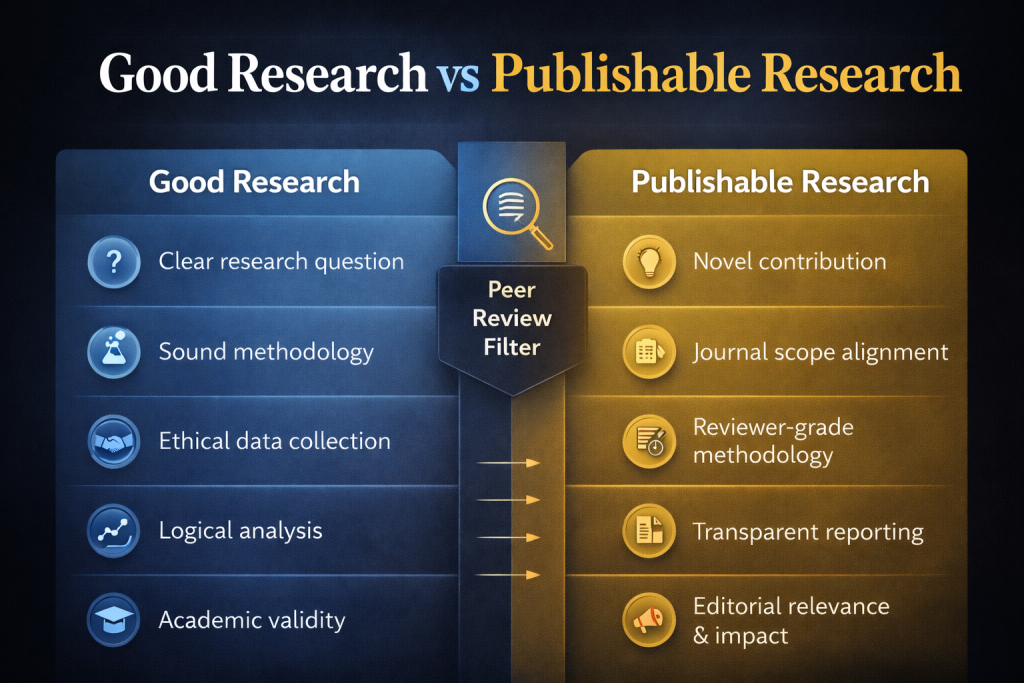
Good research and publishable research overlap — strong methodology, ethical rigor, and clear reporting are common to both. But publishability adds another dimension: scientific contribution and fit with editorial standards. Knowing this distinction is not academic hair-splitting — it’s strategic, and it’s why most submissions are rejected before peer review.
Great research should be both credible and contributive. If you aim for publishable work, sharpen your question, strengthen your methodology, and align early with the standards of your target journal.