From Journal to Bedside
Medical research without clinical application is incomplete. Every year, thousands of studies are published, yet only a fraction meaningfully influence treatment decisions. The real measure of scientific progress isn’t citations or journal impact factors ( learn
Top 10 Powerful Reasons the Importance of Impact Factor in Journal Selection Matters) — it’s patient outcomes. Translating Research into Clinical Practice ensures that evidence moves ethically, systematically, and safely from the lab bench to the patient’s bedside.
This process is not glamorous. It is disciplined, ethical, and meticulously structured.
Understanding the Evidence Pipeline
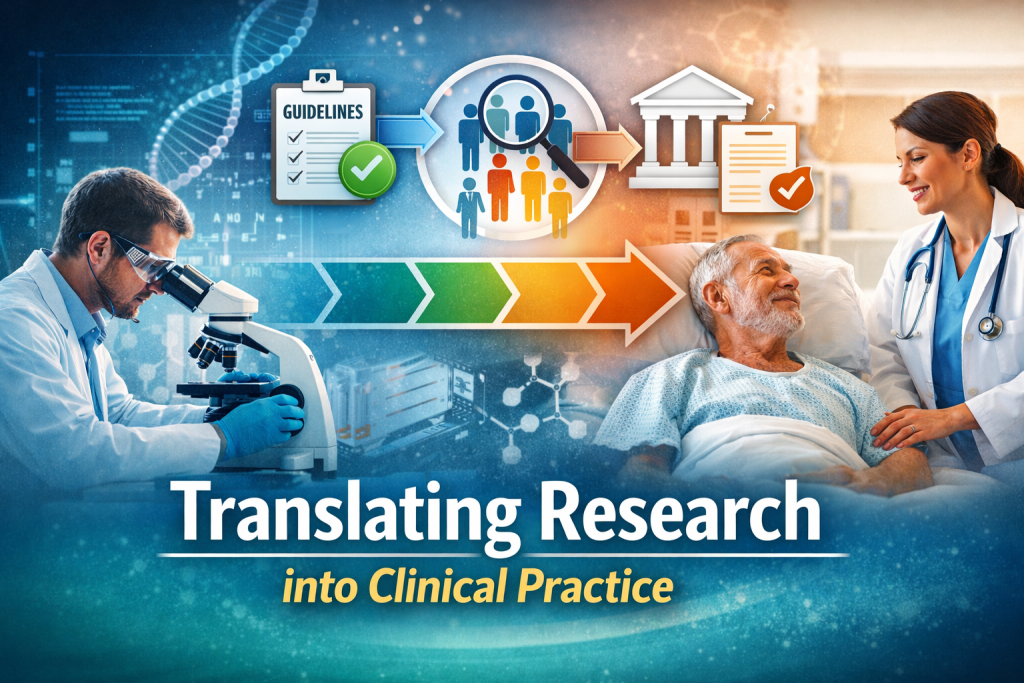
The journey from discovery to patient care follows a rigorous progression. There is no shortcut. Each stage filters out uncertainty and risk:
- Basic Research – Laboratory studies uncover biological mechanisms, molecular targets, or potential therapeutic compounds.
- Preclinical Testing – Animal and in vitro models assess preliminary efficacy and safety.
- Clinical Trials – Human studies are conducted in phases I–III to evaluate safety, dosing, and efficacy.
- Regulatory Review – Agencies like the FDA or EMA assess trial data before approving therapies for wider use.
- Guideline Integration – Evidence is synthesized into clinical practice recommendations.
- Clinical Adoption – Practitioners implement the findings into routine patient care.
These stages are reinforced by internationally recognized frameworks, including the FDA’s Good Clinical Practice (GCP) standards, ensuring ethical conduct and reliable data. Without these steps, “research” remains theoretical and potentially unsafe.
What Are Clinical Practice Guidelines and Their Importance?
If research is the engine of medical progress, guidelines are the steering system that ensures safe navigation.
Clinical practice guidelines are systematically developed statements designed to assist clinicians and patients in making appropriate healthcare decisions for specific conditions. These guidelines synthesize available evidence, assess its quality, and make graded recommendations. Leading organizations, including the World Health Organization (WHO), provide authoritative guidance for a variety of clinical scenarios.
Benefits of robust guidelines include:
- Standardizing care across institutions
- Preventing overuse or misuse of therapies
- Minimizing patient harm
- Guiding ethical resource allocation
Without guidelines, clinical practice becomes inconsistent and subject to individual preference rather than evidence-based decision-making.
Translational Research: Turning Evidence Into Therapy

Translational research is the bridge between discovery and care. It is not an academic luxury; it is a patient-centered imperative.
Centers like the Smilow Center for Translational Research exemplify how multidisciplinary teams accelerate bench-to-bedside progress. Translational research laboratories combine scientific expertise with clinical insight, regulatory knowledge, and ethics oversight to ensure that evidence is both robust and applicable.
Key characteristics include:
- Cross-disciplinary collaboration
- Iterative trial design based on emerging evidence
- Ethical oversight to protect patient safety
The average “17-year gap” between research discovery and routine clinical use highlights the need for structured translation, as summarized in Wikipedia’s overview of translational research. This delay is intentional — it allows evidence to mature before exposure to patients.
Workforce in Translational Science
Translating research into practice requires specialized professionals. Good clinical practice jobs form the backbone of this ecosystem, including:
- Clinical research coordinators
- Regulatory affairs specialists
- Pharmacovigilance officers
- Medical writers and data analysts
- Implementation scientists
These roles protect patients by ensuring rigorous methodology and ethical oversight. ClinicaPress previously discussed this expanding career landscape in How Publishing in Clinical Journals Influences Medical Careers.
Effective translation is not just about medical knowledge — it requires regulatory literacy, ethical rigor, and precise communication skills.
Common Barriers to Translation
Evidence translation can fail due to several preventable issues:
- Underpowered or poorly designed trials – results may be inconclusive or misleading
- Selective reporting – positive results are overemphasized, while negative outcomes are ignored
- Funding bias – commercial interests skew research priorities
- Neglect of implementation science – findings remain confined to journals without structured integration
The NIH emphasizes implementation science as a field dedicated to bridging the evidence-practice gap. Translation is not automatic after publication; it requires policies, clinician training, reimbursement mechanisms, and infrastructure readiness.
A breakthrough therapy without logistical planning or trained staff is a headline — not a treatment.
Communication, Translation Services, and Multinational Trials
Scientific accuracy alone does not guarantee safe application. Misinterpretation can compromise outcomes. Market research translation services ensure that research findings are communicated accurately across language and cultural boundaries, which is critical in multinational trials.
Benefits include:
- Protocol fidelity across sites
- Accurate informed consent
- Standardized outcome reporting
Translation is not only scientific — it is linguistic and ethical.
Evidence Readiness: When Is Research Ready for Clinical Application?
Not every discovery should be immediately implemented. Here’s a structured view of evidence readiness:
| Stage | Evidence Type | Translation Status | Clinical Action |
| Discovery | In vitro / animal studies | Exploratory | No patient use |
| Phase I | Safety in small human groups | Early testing | Controlled trials only |
| Phase II | Preliminary efficacy | Experimental | Limited trial implementation |
| Phase III | Large-scale validation | Strong | Review for guideline integration |
| Post-Marketing | Real-world surveillance | Continuous monitoring | Routine clinical practice |
This framework prevents premature adoption that could risk patient safety. Clinical translation is not a race — it is a measured, ethically guided process.
Oversight and Ethical Safeguards
Multiple layers of review protect patients before new evidence is applied:
- Institutional Review Boards (IRBs)
- Data Safety Monitoring Boards (DSMBs)
- Regulatory agencies
- Clinical guideline panels
Oversight is not bureaucracy; it is ethical insurance. ClinicaPress previously explored this in Clinical Trial Registration: Why Journals Require It.
Transparency and ethical rigor maintain public trust, a cornerstone of modern medicine.
Technology and the Future of Translation
Emerging technologies are shortening feedback loops between research and clinical use:
- AI-assisted trial design and predictive modeling
- Adaptive and platform trial methodologies
- Real-world evidence analytics
- Remote patient monitoring through digital health tools
Forward-thinking institutions integrate translational research laboratories with data science, regulatory oversight, and clinical networks to accelerate safe adoption.
The challenge remains: speed must not compromise rigor. Patients cannot be experimental subjects in the pursuit of efficiency.
Conclusion: Evidence as Responsibility
Publication is achievement. Translation is obligation. The journey from journal to bedside is deliberate, multi-layered, and ethically guided.
Key principles for successful translation:
- Methodological discipline
- Regulatory and ethical literacy
- Multidisciplinary collaboration
- Clear communication across borders
- Ongoing monitoring after implementation
Every step is intentional. Every patient is a stakeholder. Research exists for them — not for citations or awards.
The translation of research into clinical practice is science in service of humanity.