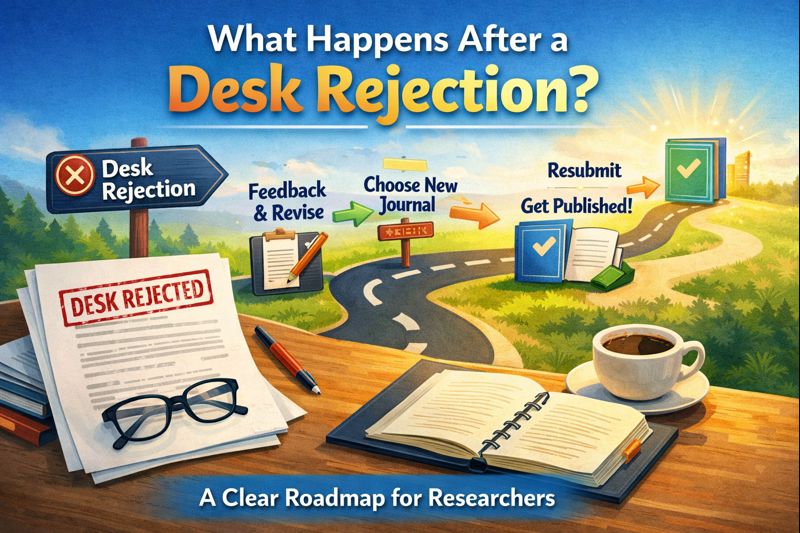
Getting a desk rejection feels like a dead end — but it isn’t.
Understanding what happens after desk rejection transforms a gut punch into a strategic pivot. This isn’t about “stay positive” fluff. This is about process, decision logic, and action steps grounded in academic publishing realities.
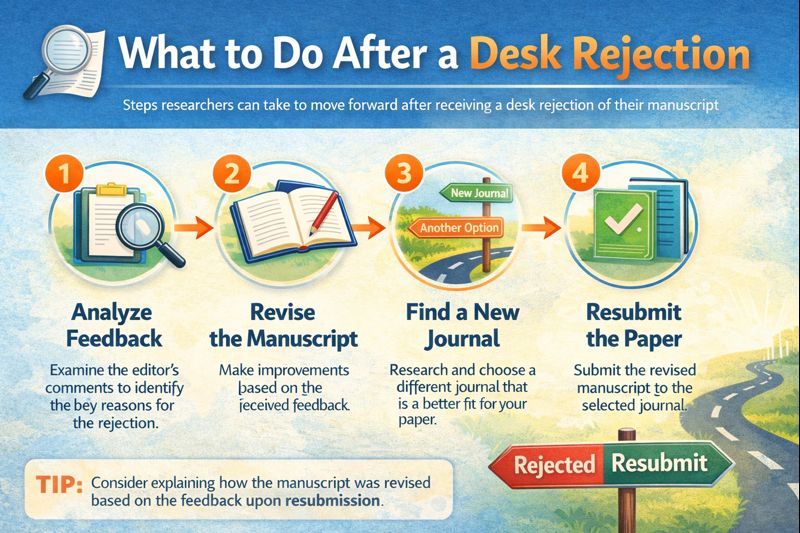
Here’s a simple roadmap of what to do next:
In this article you’ll get:
- A clear cycle of what comes after a desk rejection
- Practical checkpoints for your next submission
- Where to include distress protocol in a research paper — when required
- How to critically assess your work before re-submitting
- Sample response frameworks to editors and reviewers
Let’s break it down.
What Is a Desk Rejection — And Why It Matters
A desk rejection happens when your manuscript is rejected by an editor before peer review. It’s fast — sometimes within days — and sometimes feels brutal because it lacks detailed feedback.
Unlike peer review, desk rejection is usually about fit and baseline criteria: scope alignment, writing quality, methodological clarity.
This is not to be confused with editorial review or peer review. It’s a screening step that many journals (especially top-tier) use to protect reviewer bandwidth and maintain editorial focus. According to academic publishing norms, desk rejection can account for up to 50–70% of initial editorial decisions in competitive journals.
If your submission is desk rejected, the editor probably sees one or more of the following:
- Misalignment with journal aims
- Underdeveloped research example paper sections
- Lack of clear contribution
- Structural issues (title/abstract/keywords mismatch)
- Ethical compliance gaps (like where to include distress protocol in a research paper when human subjects are involved)
There’s no shame in desk rejection — but there is preventable preparation that most authors overlook.
Why Desk Rejections Happen: The Common Triggers
To fix a problem, you need to diagnose it. Common reasons for desk rejection include:
1. Misfit With the Journal’s Scope
If a journal focuses on clinical applications and your paper is theoretical, that mismatch alone can send it straight to rejection.
2. Weak or Undefined Contribution
Editors want to see clearly why this paper matters. If your abstract — including your sample abstract of research paper — doesn’t signal novelty or impact, that’s a red flag.
Write a strong research abstract and get your paper accepted. View our guide to strengthen your abstract with useful tried and tested tips.
3. Methodological or Ethical Gaps
For studies involving human subjects, distress protocols and ethical safeguards must be clearly stated. That’s not optional — many journals require this to even consider the work. (See Harvard’s guide on human subject research guidance)
4. Poor Writing, Structure, or Presentation
Inadequate formatting, ambiguous language, and bad figure labeling signal lack of rigor. Often, this is what saves a paper from a desk reject — strong editing before submission. Get to know how poor presentation triggers rejection from our blog How Journals Reject Papers for Poor Presentation and Why It Matters.
If you struggle with this, consider editing by a professional service like PE (for papers) or TE (for theses) — both tailored to help authors avoid desk-level rejections.
3. First Action After Desk Rejection: Read the Letter Carefully
This cannot be overstated.
A desk rejection letter — even if terse — contains clues:
✔ Did the editor mention fit?
or
✔ Did they mention methodology?
and
✔ Did they comment on writing quality?
or
✔ Was there any suggestion for another journal?
Don’t skim. Extract the type of rejection:
| Type of Desk Rejection | Meaning |
| Scope mismatch | Look for journals with a closer aim |
| Technical deficiency | Revise methods/results before resubmitting |
| Quality issues | Requires deep editorial revision |
This first step separates reactive writers from strategic revisers.
Perform a Self-Audit — Before You Do Anything Else
Rejection isn’t random — and your revision shouldn’t be either.
Use this checklist:
Title & Abstract
- Does the sample abstract of research paper clearly state objective, methods, results, and contribution?
- Do the title and keywords reflect the core discussion?
Scope Fit
- Does the journal’s aim align with your topic?
- Can you justify that alignment in your cover letter?
Methodology
- Is your method transparent and replicable?
- For human subjects, have you declared ethical protocols such as where to include distress protocol in a research paper and other safeguards?
Narrative Flow
- Can a reader follow your logic without guessing?
- Are conclusions supported by results?
References
- Are you citing current work and appropriate scholarship?
This is where most authors fall short. If your self-audit finds multiple weaknesses, rushing to another journal without fixing these only doubles your rejection risk.
If you need guided revision help, consider PE for structured editorial support — especially to strengthen your methodology and narrative.
Where to Include Distress Protocol in a Research Paper
If your work involves human participants in sensitive settings — surveys, interviews on trauma, clinical interactions, etc. — most reputable journals require a clearly stated distress protocol.
Here’s exactly where it must appear:
In the Methods Section
This is the primary location. It should include:
- How distress was anticipated
- What steps were taken to minimize it
- What support mechanisms were in place
- Who monitored participant well-being
- Ethical approvals and informed consent processes
The declaration should be explicit, concise, and reproducible. Many journals now require structured statements about participant care.
For example:
“Participants were informed of support services; trained staff monitored emotional distress; a predefined distress protocol was implemented, including referral pathways.”
In Ethical Declarations
Some journals require a line under Ethics Approval confirming distress safeguards and IRB clearance.
Failing to declare this — or burying it deep in text — increases the risk of both desk rejection and ethical inquiries later.
How to Critically Analyse a Research Paper — Your Next Skill
Once you’re in revision mode, the ability to critically evaluate your own paper becomes essential.
Key focus areas:
Logic and Argument Strength
Does each claim flow from evidence? Can every inference be justified?
Methodological Validity
Is your sample appropriate? Are your measures reliable? Are confounders addressed?
Ethical Transparency
Are all risks addressed? Are distress protocols where required?
Writing Clarity and Precision
Are sentences direct? Does the language avoid ambiguity?
You want to treat your manuscript the way reviewers will. There’s no shortcut — only disciplined vetting.
If you struggle with self editing, editorial services (like PE) provide structured critiques that align with reviewer expectations.
Planning Your Next Submission
Once you’ve audited and revised, it’s time to reposition.
Choose a Better-Fit Journal
Re-read the aims and scope. Search recent issues. Match your topic categorically.
Tailor Your Cover Letter
Explicitly state how your work aligns with the journal’s mission. Reference your contributions in concrete terms.
Adjust Formatting to Target Journal
Every journal has specific style guides. Don’t assume the system will auto-correct this for you.
Include All Ethical Declarations
Especially when you have protocols for participant distress. Cover both content and location (Methods and Ethics Declarations).
Every element here reduces friction in editorial screening — which is the exact gatekeepers that cause desk rejection.
Example Path After Desk Rejection
Let’s look at a practical sequence:
- Receive desk rejection email
- Extract rationale (scope, ethics, method, writing)
- Audit your manuscript using checklist
- Revise content thoroughly
- Get professional editorial feedback (e.g., PE)
- Identify new target journal
- Rewrite title/abstract for better fit
- Resubmit with tailored cover letter
This process turns one rejection into a learning cycle — not a roadblock.
Common Mistakes Authors Make After Rejection
Avoid these:
- Submitting without revision
- Ignoring editorial hints
- Choosing a lower-tier journal reflexively
- Skipping ethical transparency sections
- Assuming peer review will “fix” writing quality
Desk rejection isn’t punishment — it’s feedback.
Final Thoughts: Desk Rejection Is Part of the Process
If you want to publish in reputable outlets, most seasoned researchers will tell you: desk rejection is routine. What separates successful authors is not how often they get rejected — but how strategically they respond.
Use this cycle to sharpen:
- Structure
- Scope alignment
- Ethical transparency
- Methodology
- Writing quality
Your next submission should be better because of the rejection — not in spite of it.