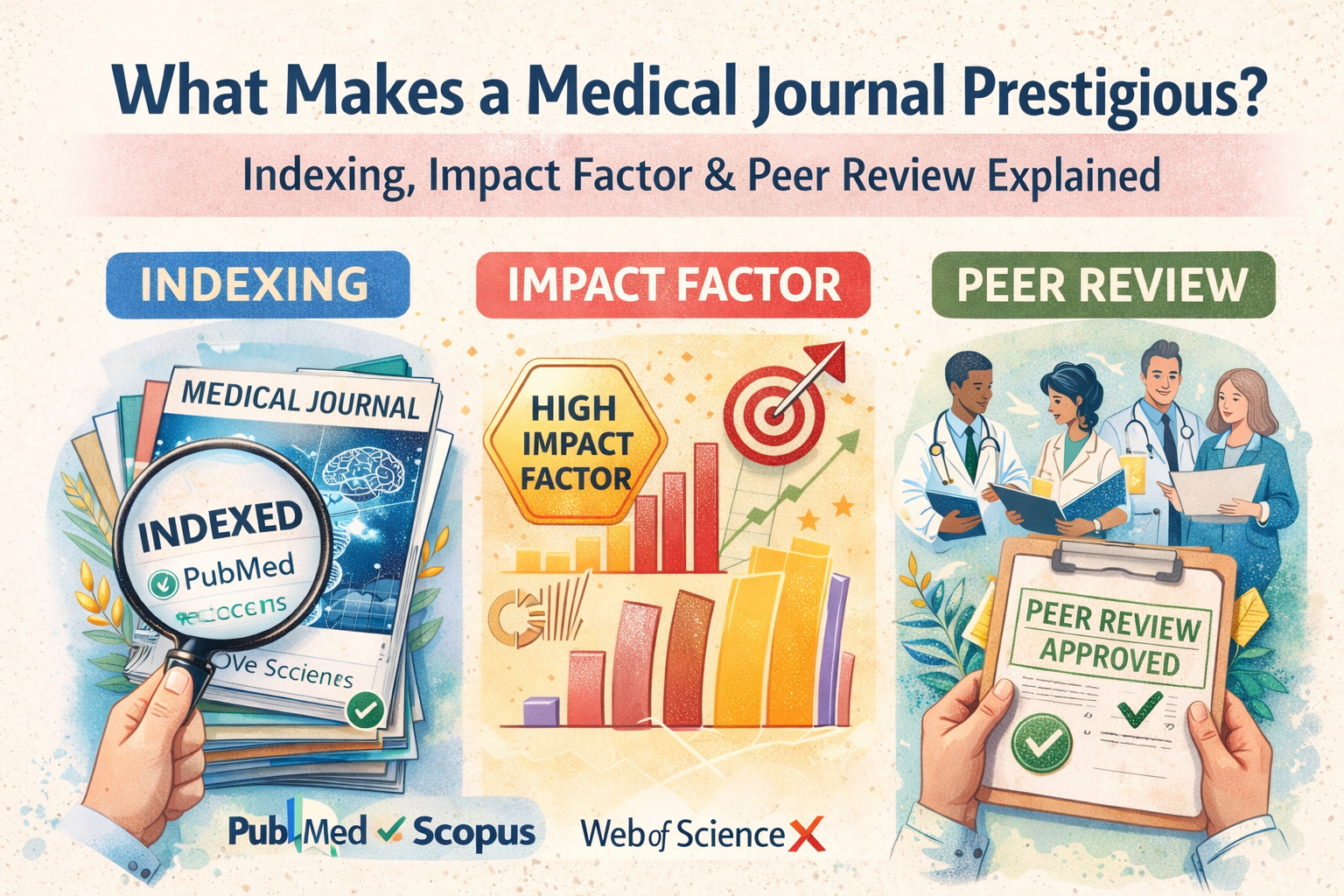
Indexing, Impact Factor & Peer Review Explained
Medical journal prestige is not a marketing language. It’s an academic filter. A strict one. And in medical research, this filter determines whether your work is trusted, cited, funded, or quietly ignored.
Many students and early-career researchers misunderstand prestige. They think it’s about how old a journal is or how polished the website looks. That’s surface-level thinking. In reality, medical journal prestige is built on systems that universities, hospitals, and funders can verify without debate.
This article breaks down those systems clearly, ethically, and without hype.
Why Medical Journal Prestige Matters in Academic Medicine
In medicine, publication is not just communication. It’s validation.
When you submit a paper for a postgraduate degree, promotion, or grant, reviewers rarely start by reading your abstract. They start by scanning the journal name. That single line already signals expected quality.
Prestige works as a credibility shortcut. Institutions trust journals because they trust the processes behind them. That’s why publications in established outlets such as the Postgraduate Medical Journal carry weight before the content is even assessed.
If a journal lacks prestige, your research is forced to prove itself from zero. That’s an uphill battle most authors don’t win.
Indexing: The Non-Negotiable Foundation of Prestige
Indexing is the first checkpoint in medical journal evaluation.
A prestigious journal is indexed in recognized databases like PubMed, MEDLINE, Scopus, or Web of Science. These databases apply១n’t list journals casually. Each applies selection criteria related to editorial quality, publishing ethics, and consistency.
According to Wikipedia’s explanation of academic journal indexing, indexing ensures that research is discoverable, citable, and integrated into the scientific record.
If a journal is not indexed in a recognized database, it may exist online, but academically it has limited value.
ClinicaPress guides authors through indexing verification in its resource on journal indexing support, helping researchers avoid misleading claims before submission.
Impact Factor for a Journal: Signal, Not a Guarantee
The impact factor for a journal measures how often its articles are cited over a defined time period. It’s widely referenced, frequently misunderstood, and often misused.
A legitimate impact factor is calculated by Clarivate and published in Journal Citation Reports. Prestigious journals display this information transparently.
For example, the British Medical Journal impact factor is publicly available, updated annually, and easy to verify. There is no ambiguity.
However, the impact factor does not equal ethical rigor. It reflects influence, not necessarily review quality or author care. Some journals chase citations aggressively while neglecting editorial depth.
Prestige requires impact factor to be paired with accountability, not used as a standalone badge.
Peer Review: Where Prestige Is Earned
Peer review is the core mechanism that separates serious journals from performative ones.
A credible peer review process involves independent experts evaluating:
- Methodology
- Ethical approval
- Statistical integrity
- Interpretation of results
This process is uncomfortable by design. It takes time. It challenges authors. That friction is the point.
Journals that rush peer review or provide generic feedback are signaling low standards. According to the Committee on Publication Ethics (COPE.org), transparency in peer review policies is essential for ethical publishing.
ClinicaPress emphasizes review readiness through its peer review guidance, helping authors align submissions with real editorial expectations instead of shortcuts.
No rigorous review means no prestige. It’s that simple.
Editorial Boards and Academic Accountability
Prestigious journals do not hide behind anonymity. Their editorial boards consist of identifiable experts with:
- Institutional affiliations
- Research publication histories
- Defined editorial responsibilities
These editors are accountable to universities, hospitals, and professional bodies. Their reputations are on the line with every issue published.
Educational ecosystems linked to platforms such as British Medical Journal learning show how editorial governance extends beyond publishing into professional development and training.
If a journal’s editors cannot be independently verified, its prestige claim collapses instantly.
Prestige in the Context of Postgraduate Medical Research
For postgraduate researchers, journal prestige is not optional. It’s survival.
Thesis committees, supervisors, and examiners often assess publications using proxy indicators:
- Indexing status
- Impact metrics
- Peer-review rigor
Publications in recognized journals like the Postgraduate Medical Journal reduce friction during evaluations because the journal’s standards are already understood.
ClinicaPress addresses this reality through its medical journal publishing tips, helping postgraduate authors choose journals aligned with institutional expectations instead of personal convenience.
Prestige, in this context, is risk management.
Transparency and Ethical Publishing Practices
Prestigious journals operate openly because they can withstand scrutiny.
They clearly disclose:
- Publication fees
- Review timelines
- Conflict-of-interest policies
- Retraction and correction mechanisms
The U.S. National Institutes of Health (.gov) has emphasized that transparency in publishing protects the integrity of medical evidence, especially when research informs clinical decisions.
Opaque policies are not a minor flaw. They are a warning sign.
ClinicaPress reinforces ethical publishing behavior through its medical research editorial services, ensuring authors understand journal expectations before submission, not after rejection.
How Authors Should Evaluate Medical Journal Prestige
Evaluating prestige is part of responsible authorship.
Before submitting, authors should:
- Confirm indexing directly through official databases
- Verify impact metrics using recognized sources
- Read and assess peer-review policies
- Investigate editorial board credibility
ClinicaPress supports this process through its guidance on responsible journal selection, helping authors avoid reliance on branding or promises.
If a journal’s prestige cannot be independently verified, it should not be trusted with your research.
Final Perspective
Medical journal prestige is not elitism. It’s infrastructure.
It exists to protect scientific quality, clinical safety, and academic credibility. Journals earn prestige by maintaining standards consistently, not by advertising them loudly.
For authors, the lesson is clear: publish where your work will be defended by the journal itself.
Anything less is a gamble you don’t need to take.