
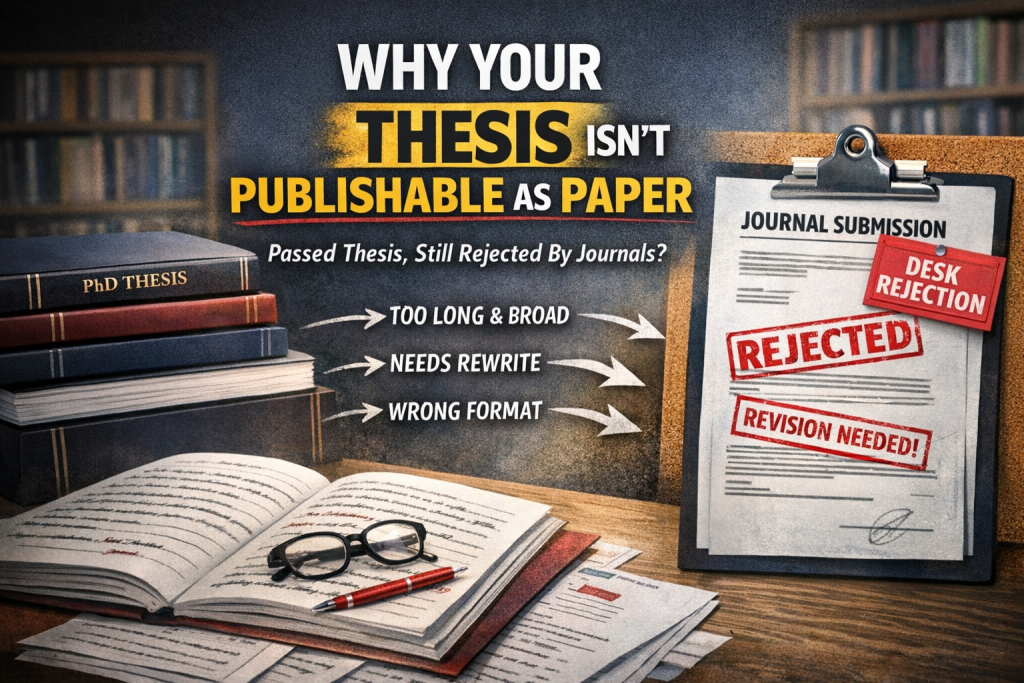
Your PhD thesis sat on a shelf. You passed, got the degree, and maybe even defended brilliantly — so why won’t journals touch your work?
The blunt truth: a thesis not publishable as paper isn’t a reflection of your intellect — it’s about format, focus, framing, and the very different standards of academic publishing.
This isn’t hit‑piece rhetoric. It’s a precise breakdown of why a substantial thesis at university usually fails to translate directly into scholarly articles, and what you must do next if you want peer‑reviewed visibility for your research.
Early-career researchers frequently underestimate how different academic writing becomes once it shifts from thesis assessment to publication, a challenge we explore further in our academic writing guide.
What Makes a Thesis Different from a Journal Paper?
At the core of this issue is the academic structure of a dissertation vs thesis and how both differ from journal expectations.
A thesis (or PhD thesis) is designed to demonstrate mastery of a subject and contribute original insight. It’s evaluated by internal and external examiners, not by anonymous peer reviewers.
A journal article must:
- Present one tight contribution, not ten related studies.
- Be concise and framed for readers who don’t know your advisor.
- Align with a journal’s scope and methodological norms.
The formal definition of a thesis, as outlined in academic norms on Wikipedia, already explains why its purpose diverges from that of a journal article. In contrast, a thesis tries to show breadth and depth — which is exactly what editors don’t want.
Why “Lined Paper” Thinking Fails in Publishing
Imagine your thesis as a massive notebook: thousands of words, chapters upon chapters, often with lined paper discipline but lacking narrative compression.
Journals want laser‑focused argumentation. They reward:
- A single hypothesis
- A clean dataset
- A clear theoretical claim
What they don’t want is everything you ever did, which is exactly how most theses are framed.
If you dump entire chapters into a submission, reviewers will flag:
- Redundancy
- Lack of focus
- Unnecessary literature review
- Weak framing of contribution
The result?
Rejections or “revise and resubmit” forever.
PhD Thesis Structure vs. Journal Expectations
| Feature | PhD Thesis | Journal Paper | Notes |
| Length | 150–300 pages | 5–20 pages | Theses aim for breadth; papers aim for focus |
| Scope | Multiple research questions | One central hypothesis | Narrow scope increases publishability |
| Audience | Committee/examiners | Global peer reviewers | Papers must be readable by wider community |
| Structure | Chapters with detailed methods, results, discussion | IMRaD: Intro, Methods, Results, Discussion | Papers need concise narrative, not exhaustive detail |
| Contribution Statement | Implied through multiple chapters | Explicit in abstract & intro | Journals require clear, single contribution |
A classic phd thesis is typically:
- Intro + broad literature
- Methodology depth
- Several empirical chapters
- Theoretical contributions scattered
- Conclusions spanning all
Journal format is:
- Focused intro
- Targeted literature that justifies the study
- Method-solution-result narrative
- Tight discussion
Leading publishers like Nature explicitly emphasize concise argumentation and focused contribution in their author guidelines.
The two are structurally incompatible. Even if content overlaps, you are expected to reshape, refocus, and retheme — not just trim.
For real-world examples of journal format expectations, see the Nature submission guidelines or your target journal’s “Instructions for Authors” page. These highlight why theses need reengineering rather than reuse.
Common Flaws When Attempting to Publish a Thesis Without Editing
Here are recurrent pitfalls:
- Scope Too Broad
A thesis often answers a series of related questions. A paper can usually handle one.
- Poor Narrative
Theses are reporting vehicles; papers are arguments. If your manuscript reads like a report, it will fail.
- Weak Contribution Statement
In a thesis, your contribution is implied through chapters. In a published paper, it must be explicit and concise.
- Mixed Audiences
Academic committees and journal reviewers want radically different things. A PhD panel will tolerate pedagogical exposition. A journal editor will not.
These issues are not subjective. Academic publishers like Elsevier and Wiley outline strict submission criteria that force authors to rewrite for clarity and novelty.
Turning a Thesis Into Quality Publishable Papers
Stop thinking of your thesis as one massive deliverable. Think of it as raw materials.
Selecting the right journal is often more decisive than the quality of the data itself, as discussed in our breakdown of how to choose the right journal.
Successful conversion requires:
1. Identifying Publishable Sub‑Contributions
Not every chapter is journal‑ready. Find the distinct insight that can stand alone.
2. Rewriting Completely
You will almost always rewrite the literature review, conceptual framing, and sometimes even the methodology to fit the target journal narrative.
3. Targeting Right Journal Scope
A mismatch between topic and journal is the #1 reason for desk rejection. Use tools like Journal Finder or look at recent published articles to match themes.
If you’ve published before, review your previous work for patterns that journals rewarded. If not, dissect high‑impact papers in your field to see how they structure arguments.
Use of Internal and External Authority to Guide the Rewrite
A strong rewrite references current, reputable sources. Excellent external authority informs your framing:
- For general thesis vs. article differences, see the Wikipedia explanation of theses and dissertations. (Wikipedia reflects broad academic norms.)
- For how journals review submissions, the Committee on Publication Ethics offers clear guidelines on expected practices.
- For evidence of the publication pipeline and peer‑review realities, Nature and Science regularly publish commentary on reproducibility and editorial standards.
- For graduate student publication expectations, check academic career resources from the U.S. National Institutes of Health or NIH Office of Intramural Training & Education.
Incorporating these perspectives will boost both your credibility and your likelihood of acceptance.
Why Your University Graded You and Journals Reject You
Grades evaluate completeness and adherence to academic standards. They don’t promise public impact.
A thesis is a pedagogical artifact — its success criterion is academic fulfillment.
A journal paper is a disciplinary artifact — its success criterion is scholarly advance and readability.
Many students miss this distinction and treat the thesis as a pre‑packaged article.
If you do that, expect:
- Multiple rejections
- Long delays
- Argumentative reviews
Don’t compound the problem. Restructure.
Checklist Before You Submit a Paper Derived From Your Thesis
Here’s a practical pre‑submission checklist:
Scope & Focus
- Is there one central claim?
- Does the title reflect that claim?
Length & Tightness
- Is the text within journal limits?
- Are tables and figures necessary and clear?
Audience
- Will someone outside your institution understand the argument without extra chapters?
Contribution
- Is your unique contribution crystal clear in the abstract and intro?
Citation
- Have you cited current debates in your field (last 5 years)?
If you can’t answer “yes” to all of these, you’re not ready.
Conclusion: Your Thesis Is Not Trash — It Just Isn’t a Journal Article
Let’s be blunt: thesis not publishable as paper isn’t a sign you failed; it’s a sign you *haven’t yet translated your work into the language of journals.
This is a skill — and it’s separate from writing your thesis. Treat it that way. Rethink your framing, tighten your argument, and target journals with precision.
Your research deserves readership. But it won’t get it in thesis format.