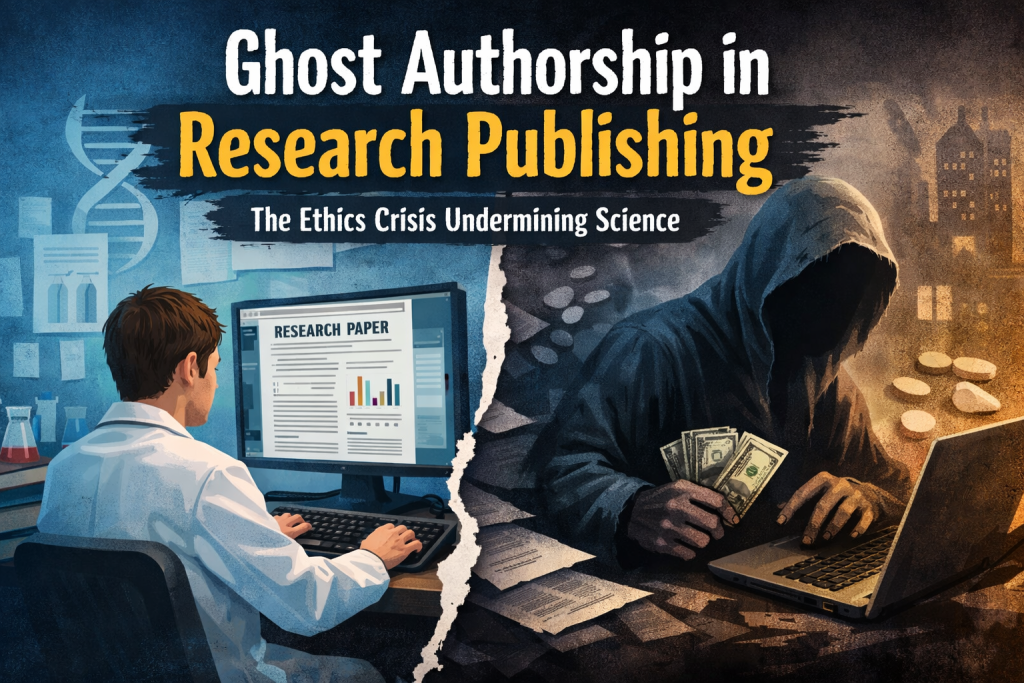
Science runs on trust. When that trust is manufactured, outsourced, or hidden behind unnamed writers, the entire system starts to fracture. Ghost authorship in research publishing is not a niche misconduct issue anymore — it is a structural ethics crisis quietly reshaping how knowledge enters the scientific record.
For early-career researchers trying to learn how to publish a research paper, this hidden practice creates a dangerous illusion: that publication is a polished performance rather than a transparent process. The result is a distorted academic culture where credit, accountability, and responsibility no longer align.
What Ghost Authorship Actually Means
Ghost authorship occurs when someone makes a substantial contribution to a manuscript — writing, data analysis, or interpretation — but is not credited as an author or acknowledged.
Sometimes the ghost is a professional writer hired by a sponsor. Sometimes it is a senior academic who rewrites a paper but declines authorship to avoid scrutiny. In industry-funded studies, it can be a medical writer shaping conclusions while remaining invisible.
The International Committee of Medical Journal Editors defines authorship based on four criteria: substantial contribution, drafting or revising, approval of the final version, and accountability. Ghost authorship violates all four simultaneously.
According to guidelines summarized on Wikipedia’s authorship page undisclosed contributors distort responsibility for the work’s accuracy and integrity.
This is not a technical oversight. It is deliberate opacity.
Why the Practice Is Spreading
Pressure to publish research paper outputs has never been higher. Hiring committees, grant agencies, and university rankings all reward quantity. That pressure creates a market for invisible writing labor.
Three forces are accelerating ghost authorship:
- Commercial editing and writing services blurring ethical lines
- Pharmaceutical and corporate sponsorship of studies
- Academic prestige systems tied to publication metrics
The World Health Organization has repeatedly emphasized research transparency as essential to public health decision-making. When authorship is concealed, accountability disappears — and flawed evidence can influence real-world policy.
For researchers learning how to publish a research article, this creates confusion about what support is ethical versus deceptive.
Editing for clarity is acceptable. Undisclosed writing is not.
The Damage to Scientific Integrity
Ghost authorship doesn’t just misallocate credit — it corrupts the reliability of literature itself.
When readers cannot identify who shaped the narrative, they cannot evaluate conflicts of interest or biases. That undermines peer review, systematic reviews, and clinical guidelines.
The Committee on Publication Ethics warns that undisclosed contributors can hide sponsor influence and compromise editorial independence.
Consequences ripple across the ecosystem:
- Retractions and loss of journal credibility
- Legal liability when misleading findings cause harm
- Public distrust in science
If you are trying to understand how to publish a research paper for free through legitimate journals, ghost authorship scandals can make the entire publishing landscape feel predatory or manipulated — even when ethical pathways exist.
How Ghost Authorship Distorts Career Pathways
For early researchers, visibility equals survival. When senior figures outsource writing but retain authorship, junior scholars lose opportunities to build portfolios.
Meanwhile, those who refuse unethical shortcuts often feel disadvantaged.
A feature in Nature highlighted how hidden writing arrangements skew authorship credit and reinforce academic hierarchies.
The message becomes toxic: results matter more than honesty.
This is the opposite of what responsible publishing training should teach.
Ethical Support vs. Unethical Substitution
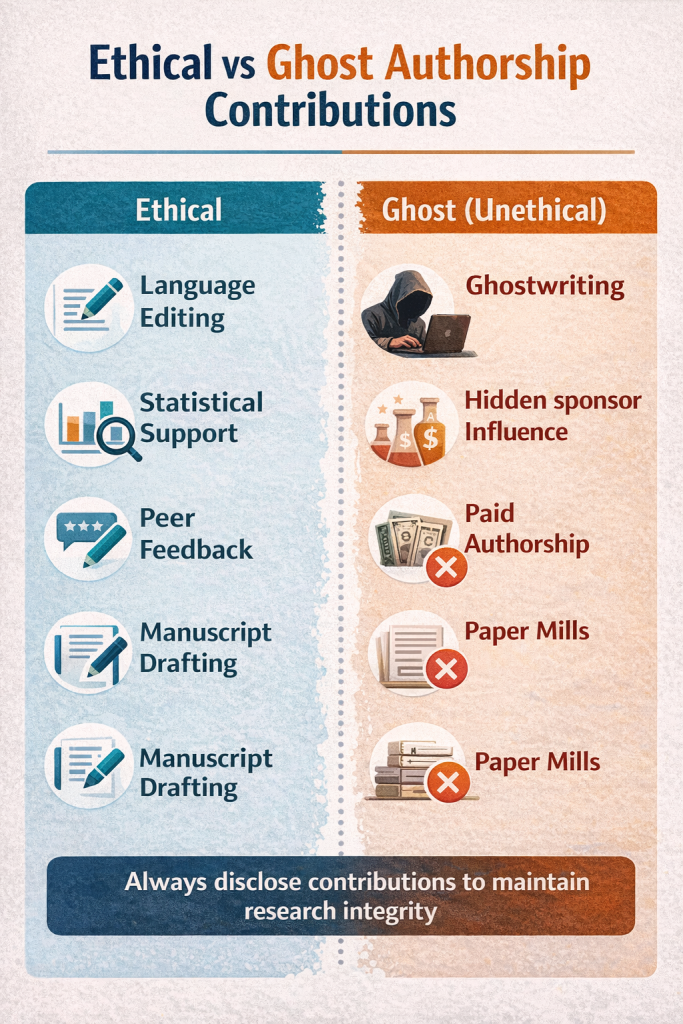
| Contribution Type | Ethical (Acceptable) | Unethical (Ghost Authorship) | Disclosure Required | Impact on Integrity |
|---|---|---|---|---|
| Language Editing | Editing grammar, clarity, flow without altering ideas | Rewriting arguments or conclusions | Acknowledgment section | Low risk if disclosed |
| Statistical Support | Advising on analysis methods | Conducting analysis without credit | Yes — contributor acknowledgment | Moderate risk if hidden |
| Medical/Technical Writing | Formatting and structuring manuscript | Writing full manuscript without authorship | Must be disclosed | High risk |
| Data Interpretation | Collaborative discussion with authors | External party shaping conclusions | Yes — authorship if substantial | Severe risk |
| Funding Sponsor Input | Reviewing for accuracy | Influencing results or messaging secretly | Full disclosure required | Critical risk |
| Manuscript Drafting | Co-author writes sections | Paid writer produces paper anonymously | Authorship required | Violates ethics standards |
| Peer Feedback | Informal comments from colleagues | Undisclosed major revisions by outsiders | Recommended disclosure | Moderate risk |
| Paper Mills / Purchased Papers | Not applicable | Selling ready-made authorship | Cannot be legitimized | Systemic corruption |
Not all external assistance is misconduct. Ethical editing strengthens research communication without altering intellectual ownership.
Legitimate support includes:
- Language editing
- Formatting according to journal guidelines
- Statistical consultation (acknowledged)
- Peer feedback
Unethical substitution includes:
- Hiring someone to write the manuscript
- Concealing sponsor involvement
- Paying for authorship placement
- Using paper mills
ClinicaPress has repeatedly emphasized the distinction in its editorial guidance, including discussions on publication ethics, manuscript preparation standards , and transparency in author contributions.
Understanding that boundary is essential for anyone learning how to publish a research article responsibly.
Why Journals Are Struggling to Stop It
Detection is difficult. Ghost authorship leaves no plagiarism trail because the work is original — just misattributed.
Editors rely on disclosure forms and trust.
Some journals now require:
- Contributor role taxonomies (CRediT system)
- Funding transparency statements
- Conflict-of-interest declarations
- Data availability disclosures
ClinicaPress has analyzed these evolving safeguards in pieces on peer review reforms and publication integrity checks
But enforcement varies widely across publishers.
Without cultural change, policies alone cannot solve the problem.
Ethical Crisis Management for Institutions
Universities and research institutes often treat ghost authorship as a reputational risk rather than a structural flaw.
True ethical crisis management requires proactive education:
- Mandatory authorship training
- Clear institutional policies
- Protection for whistleblowers
- Transparent investigation processes
Institutions that ignore these measures risk cascading scandals — especially when ghostwritten studies influence clinical practice or public policy.
How Researchers Can Protect Themselves
If you want to publish research paper outputs without compromising integrity, adopt a defensive approach:
- Document all contributions from the start
- Agree on authorship roles early
- Use written contribution statements
- Disclose editorial assistance
- Reject offers of paid authorship
Publishing ethically may feel slower, but it builds credibility that shortcuts cannot replicate.
ClinicaPress’s guidance on responsible publishing pathways “Top 10 Ethical Academic Journals That Follow COPE, ICMJE, and WHO Publishing Standards” emphasizes that transparency is now a competitive advantage, not a burden.
The Future of Authorship Transparency
Science is moving toward radical openness: open data, open peer review, and contributor-level accountability.
Ghost authorship is fundamentally incompatible with that future.
The next generation of researchers must treat authorship as a responsibility, not a reward. Otherwise, the credibility crisis will deepen — and public trust in science will continue to erode.
Learning how to publish a research paper should not mean learning how to hide the people behind it.
It should mean learning how to stand visibly behind your work.