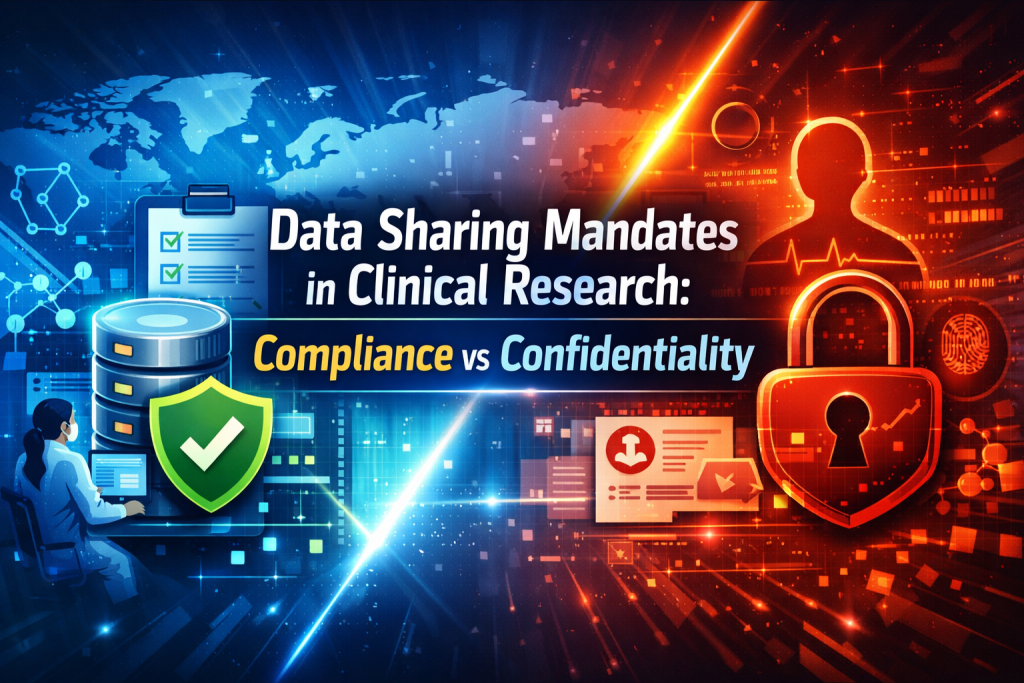
Data sharing mandates in clinical research are no longer a soft expectation — they are a condition of funding, publication, and regulatory approval. The logic is blunt: publicly funded science must produce publicly useful knowledge. When datasets sit locked on private servers, duplication, bias, and selective reporting thrive.
Organizations such as the World Health Organization and the National Institutes of Health now require structured data access plans before trials even begin. Major journals aligned with the International Committee of Medical Journal Editors demand data availability statements as a publication prerequisite.
A clinical trial without a sharing strategy today looks scientifically incomplete — and ethically suspicious.
This shift is also reshaping clinical research jobs. Recruiters increasingly prioritize candidates who understand data governance, anonymization protocols, and compliance frameworks. A modern clinical research associate is expected to monitor not only protocol adherence but also data stewardship obligations.
Compliance Pressure: Funders, Journals, and Regulators
Mandates come from three power centers:
1. Funding agencies — Public grants now require a formal data sharing agreement before disbursement.
2. Journals — Publication may depend on making de-identified datasets accessible. ( Explore our guide on manuscript publicaion)
3. Governments — Regulations increasingly treat data as a public asset.
The NIH’s policy illustrates the tone: transparency is framed as essential for reproducibility and public trust.
For research teams, compliance is administrative labor layered onto scientific work. A clinical research assistant may spend weeks preparing metadata, consent documentation, and repository submissions — tasks that did not exist a decade ago.
Yet failure to comply can freeze funding pipelines or trigger legal exposure, especially when international collaborations are involved.
Explore What Happens After a Desk Rejection — A Clear Roadmap for Researchers!
The Confidentiality Counterargument: Patients Are Not Data Points
Patients consent to research participation — not to unlimited redistribution of their personal histories. Even de-identified datasets carry re-identification risks when combined with external databases.
This is where the debate turns ethical, not procedural.
Consider sensitive domains:
- Rare disease cohorts
- Genetic studies
- Psychiatric trials
- Pediatric populations
In such cases, anonymity can be fragile. A dataset describing a rare condition in a small region may indirectly identify participants.
Global privacy frameworks reinforce this caution. WHO guidance on health data governance emphasizes balancing openness with participant protection.
Researchers must therefore design consent forms that anticipate future sharing — a practice now standard in well-run trials.
The Legal Minefield: Agreements, Injunctions, and Jurisdiction
A data sharing agreement is the legal firewall between openness and misuse. It defines:
- Who can access the data
- For what purpose
- Under what security conditions
- With what penalties for breach
Without it, sharing becomes liability.
Cross-border research complicates matters further. A dataset collected in one country may be governed by another country’s privacy laws once shared internationally.
Recent policy disputes — including court actions affecting Medicaid data access in the U.S. — show how quickly political shifts can reshape the landscape. These episodes, sometimes described in news coverage as a “medicaid data sharing injunction,” demonstrate that mandates are not purely scientific decisions; they are policy instruments.
For researchers seeking stable clinical research positions, understanding legal compliance is now a career asset, not a bureaucratic nuisance.
Clinical Trial Data Sharing: Scientific Benefits That Actually Matter
Proponents are not wrong. When executed responsibly, clinical trial data sharing delivers tangible gains:
Faster discovery — Secondary analyses generate new findings without new trials.
Error detection — Independent scrutiny exposes methodological flaws.
Equity — Researchers in lower-resource settings gain access to high-quality data.
Public trust — Transparency counters accusations of hidden results.
A widely cited rationale is that participants accept risk partly to benefit future patients. If data are never reused, that social contract weakens
For clinicians, shared datasets can directly influence practice guidelines. For trainees entering the field, data literacy is becoming as fundamental as statistical knowledge.
Where Compliance Collides With Reality
The idealized model assumes perfect infrastructure. Reality looks different.
Many research teams face:
- Underfunded data management systems
- Lack of trained personnel
- Unclear repository standards
- Conflicting institutional policies
A small hospital research unit cannot operate like a global pharmaceutical company. Mandates sometimes ignore this asymmetry.
This is where ethical intent collides with operational feasibility.
A young clinical research associate juggling monitoring visits, documentation, and regulatory communication may realistically struggle to implement complex sharing workflows without institutional support.
Practical Framework: How Ethical Sharing Should Work
A responsible model balances transparency with protection:
Before the Trial
- Include data sharing in protocol design
- Obtain explicit consent for future use
- Plan anonymization strategy
During the Trial
- Maintain clean, standardized datasets
- Document metadata continuously
After Completion
- Deposit data in a secure repository
- Enforce controlled access rather than open download
This lifecycle approach turns sharing from an afterthought into an integrated process.
The Career Dimension: Why This Topic Matters for Researchers
Data governance skills are rapidly becoming hiring criteria. Job listings for clinical research jobs increasingly mention:
- Data compliance experience
- Knowledge of sharing policies
- Familiarity with repositories
- Legal documentation skills
In short, transparency is shaping workforce expectations.
For early-career professionals, mastering these competencies may determine advancement opportunities.
Conclusion: Transparency Without Betrayal
Data sharing mandates in clinical research are not a temporary trend. They represent a structural shift in how science defines accountability.
But transparency cannot come at the cost of participant trust. The future lies in controlled sharing systems that maximize scientific value while minimizing personal risk.
Researchers who understand both sides — compliance and confidentiality — will define the next era of clinical science.
Those who treat it as paperwork will struggle to remain relevant.
Factual Table: Compliance vs Confidentiality Trade-Off
| Dimension | Compliance Advantage | Confidentiality Risk |
| Scientific progress | Enables replication and new discoveries | May expose sensitive participant data |
| Public trust | Demonstrates transparency | Breaches can destroy trust |
| Career impact | Enhances researcher credibility | Legal liability for misuse |
| Global collaboration | Facilitates cross-border studies | Jurisdictional conflicts |