Public health research is not just about publishing—it’s about impact. Policies, funding, and real-world interventions depend on what gets published. Yet here’s the uncomfortable reality: a large proportion of submissions never make it past peer review. The rejection of public health research articles isn’t random—it follows patterns. And if you understand those patterns, you can systematically reduce your chances of rejection.
This isn’t about motivation. It’s about precision.
The Reality of Rejection in Public Health and Research
Public health and research exist in one of the most competitive publishing environments in academia. Journals receive thousands of submissions annually, especially in high-demand areas like epidemiology, environmental health, and health systems research.
Take journals with competitive metrics like the International Journal of Environmental Research and Public Health Impact Factor—they prioritize studies that are not just technically sound, but also globally relevant and methodologically sharp.
According to standards outlined by the National Institutes of Health (NIH), research must meet strict expectations for reproducibility, transparency, and ethical compliance. Falling short in even one domain can push a manuscript toward rejection.
In short, good research is not enough anymore—only well-executed, well-presented research survives.
Getting professional formatting and proofreading services from platforms like Paperedit can help you survive the rejection phase.
Top Reasons Behind Rejection of Public Health Research Articles
Let’s get specific. These are not abstract issues—they are the exact reasons editors decline manuscripts daily.
1. Weak or Misaligned Research Questions
A research question is the backbone of your study. If it’s weak, everything collapses.
Common issues include:
- Questions that are too broad or descriptive
- Lack of real-world relevance
- No clear hypothesis or objective
In public health research, your question must connect to population-level outcomes, not just theoretical curiosity.
2. Methodological Flaws That Undermine Credibility
Methodology is where most submissions fail—especially among early-career researchers.
Red flags for reviewers:
- Inadequate sample size
- Selection bias
- Poorly defined variables
- Missing ethical approval
The World Health Organization (WHO) emphasizes that methodological rigor is essential for translating research into policy. Weak methods mean your findings cannot be trusted—and journals won’t take that risk.
3. Journal Scope Mismatch
This sounds basic, but it’s one of the most common causes of immediate rejection.
Submitting a paper meant for a qualitative health research journal to a data-heavy epidemiology journal shows a lack of strategy.
Each journal—whether it’s focused on qualitative health research or policy analysis—has a defined audience and expectation. Ignoring that is a fast track to rejection.
4. Poor Academic Writing and Presentation
Even strong data fails when communication is weak.
Typical writing issues:
- Overly complex sentences
- Lack of logical flow
- Redundancy and filler
- Inconsistent formatting
Editors expect clarity. If your argument isn’t easy to follow, it won’t be reviewed favorably.
Academic resources like Purdue OWL highlight that clarity and structure are critical for scholarly communication.
5. Lack of Novelty or Contribution
This is where many papers silently fail.
Ask yourself:
- Does this add something new?
- Does it challenge or expand existing knowledge?
- Does it have policy or practice implications?
If your answer is “not really,” reviewers will reach the same conclusion.
6. Statistical and Data Interpretation Errors
Even if your data collection is solid, poor analysis can destroy your credibility.
Common mistakes:
- Misuse of statistical tests
- Overgeneralization of results
- Ignoring confounding variables
- Selective reporting
Public health decisions rely heavily on data accuracy. If your interpretation is flawed, rejection is inevitable.
The Role of Peer Review in Rejection Decisions
Peer review is not just a checkpoint—it’s a filtration system.
According to Wikipedia’s overview of peer review, manuscripts are evaluated based on:
- Scientific validity
- Originality
- Ethical integrity
- Relevance to the field
Reviewers are trained to identify weaknesses quickly. And they don’t fix problems—they flag them.
That’s why many authors receive feedback that feels harsh. It’s not personal—it’s structural.
Where Most Early Researchers Go Wrong
Many individuals entering the field—especially those exploring public health research assistant jobs or health research authority jobs—approach publishing with the wrong assumptions.
They believe:
- Data alone guarantees acceptance
- Journals will overlook minor issues
- Writing quality is secondary
This mindset leads to repeated rejection.
In reality, publishing is a skill set—one that requires deliberate development.
Table: Common Mistakes vs Strategic Fixes
| Common Mistake | Strategic Fix |
| Vague research objectives | Define a focused, measurable research question |
| Weak study design | Use validated frameworks and protocols |
| Journal mismatch | Analyze journal scope and previous publications |
| Poor writing quality | Use professional academic editing |
| Lack of novelty | Clearly state unique contribution |
| Statistical errors | Consult a biostatistician |
| Ignoring reviewer guidelines | Follow submission instructions strictly |
How to Improve Acceptance Chances: A Strategic Approach
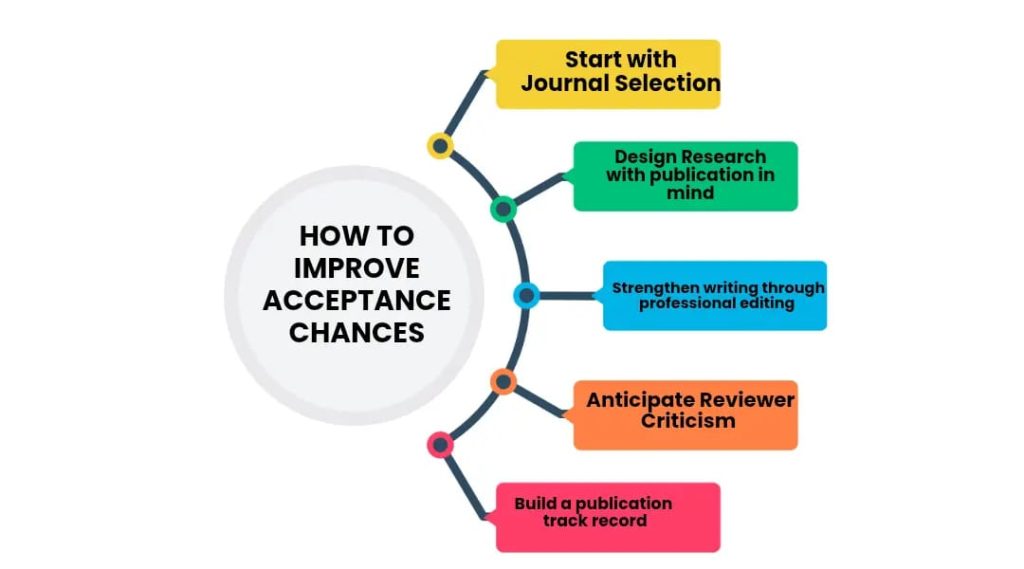
If you want to reduce rejection, you need a system—not guesswork.
1. Start With Journal Selection
Don’t treat journal selection as an afterthought.
Before writing:
- Identify target journals
- Study their recent publications
- Align your research accordingly
ClinicaPress explains this in detail in “How to Choose the Right Medical Journal for Your Research Portfolioe” emphasizing alignment over convenience.
2. Design Research With Publication in Mind
Your study should be built for publication from day one.
This means:
- Clear objectives
- Ethical approval in place ( For further assistance, read Ethics Training for Journal Editors and Reviewers)
- Robust data collection methods
If your design is weak, no amount of editing can fix it later.
3. Strengthen Writing Through Professional Editing
Academic writing is not casual writing.
It requires:
- Precision
- Logical structure
- Consistent terminology
ClinicaPress explores this in “How to Structure a Research Paper (IMRaD Format Explained)”, where structure is treated as a critical success factor.
4. Anticipate Reviewer Criticism
Before submission, review your own paper critically.
Ask:
- What would a reviewer question?
- Are limitations clearly addressed?
- Is the conclusion justified by data?
This step alone can drastically improve acceptance rates.
5. Build a Publication Track Record
If you’re new, don’t aim for top-tier journals immediately.
Instead:
- Publish in mid-tier journals like Clinica Press and BMC Medical Education.
- Collaborate with experienced researchers.
- Explore public health research opportunities through institutional partnerships.
The Importance of Ethical and Regulatory Compliance
Ethics is not just a checkbox—it’s a dealbreaker.
Organizations like the Health Research Authority require:
- Informed consent
- Data protection compliance
- Transparent reporting
Failure here leads to immediate rejection and potential blacklisting.
ClinicaPress addresses these concerns in “Ethics Training for Journal Editors and Reviewers”, highlighting real-world ethical pitfalls.
Why “Research Paper Rejected” Is Not the End
Rejection feels personal—but it’s not.
It’s feedback.
Most published papers go through:
- Multiple revisions
- Resubmissions
- Structural changes
ClinicaPress discusses this in “What Happens After a Desk Rejection — A Clear Roadmap for Researchers“, emphasizing that rejection is part of the refinement process.
Advanced Strategies for Competitive Journals
If you’re targeting high-impact journals, basic fixes are not enough.
You need to:
- Incorporate interdisciplinary perspectives
- Use advanced statistical models
- Align with global health priorities
- Ensure policy relevance
This is especially important in areas covered by pure health research reviews, where synthesis and insight matter more than raw data.
The Role of Mentorship and Collaboration
Solo research is harder to publish—especially in public health.
Working with experienced researchers helps:
- Improve study design
- Strengthen analysis
- Navigate peer review
Many successful publications are collaborative for a reason.
If you’re exploring public health research opportunities, prioritize environments that offer mentorship—not just data access.
Final Insight: Publishing Is a System You Can Learn
The rejection of public health research articles is not a mystery. It’s a system with clear rules.
If you:
- Design better studies
- Write with clarity
- Align with journal expectations
- Respect ethical standards
…your chances of acceptance increase significantly.
The difference between rejection and acceptance is rarely intelligence.
Its execution.