

Let’s be honest — most researchers dread the introduction. Not the experiments. Not the data. The writing.
You’ve done months of rigorous work, and now you have to convince a journal editor in 600 words that your study matters, that a gap exists, and that you’re the one to fill it. That’s not just writing. That’s strategy.
The introduction of a medical research paper is the most scrutinized section after the abstract. It either pulls the reviewer in or loses them before they even reach your methods. And yet, most researchers treat it as an afterthought — a few background paragraphs slapped together before the real content.
That mindset will get your paper rejected.
This guide breaks down exactly how to write a medical research paper introduction that works — structurally, rhetorically, and in terms of SEO-readable academic authority. Whether you’re writing your first original article or refining drafts with the help of a medical research paper writing service, these principles apply universally.
You may also get help from How to Write a Medical Research Paper That Journal Editors Actually Accept?
Why the Introduction Is the Hardest Section to Write (And Why That’s Okay)
The introduction demands that you simultaneously:
- Demonstrate mastery of the existing literature
- Identify a specific, defensible research gap
- Justify why your study is necessary right now
- State your objectives with surgical clarity
That’s a lot to accomplish in under 600 words. And unlike the Methods or Results section — which are largely formulaic — the Introduction requires judgment. You’re making an argument, not just reporting facts.
The good news? Once you understand the underlying logic, the structure becomes second nature.
The CARS Model: The Framework That Actually Works
The most evidence-based framework for writing a research introduction is the CARS Model (Create a Research Space), developed by applied linguist John Swales. It’s used in the greatest health and medical research programs around the world — from Johns Hopkins to Oxford — because it mirrors how expert readers actually process scientific argumentation.
The CARS model has three rhetorical “moves”:
| Move | Purpose | Key Phrases |
| Move 1 — Establish Territory | Show the topic matters; review existing knowledge | “X has been widely studied,” “evidence suggests,” “is associated with” |
| Move 2 — Establish Niche | Identify the gap, problem, or controversy | “however,” “despite,” “remains unclear,” “no study has” |
| Move 3 — Occupy Niche | State your study’s purpose and design | “the aim of this study,” “we hypothesized,” “to determine” |
Every strong medical introduction maps onto these three moves — whether the author knows it or not. The writers who struggle are usually those who skip Move 2 and jump from background straight to objectives. That shortcut destroys the rhetorical logic.
Move 1 — Establish Territory: Writing a Background That Commands Respect
Your first paragraph sets the context. It tells the reader: this topic is real, it matters clinically, and there is a scientific conversation already happening.
This is not the place for encyclopedic definitions. You’re not writing a textbook entry. You’re writing for an expert audience who already knows the basics.
What to include:
- The broad clinical or public health relevance of your topic
- Key statistics (incidence, prevalence, mortality burden)
- The current standard of care or understanding
- 2–4 references to landmark studies or systematic reviews
What to avoid:
- Starting with “Since the dawn of medicine…” (overreach)
- Vague sentences like “This disease is very important”
- Plagiarizing the background sections of other papers (shockingly common)
- Citing outdated sources when newer meta-analyses exist
For example, if your paper investigates a new biomarker for sepsis, your opening paragraph might reference the global burden of sepsis using WHO data, cite a Lancet study on current diagnostic limitations, and note the mortality rates associated with delayed identification.
The National Institutes of Health (NIH) recommends that clinical research introductions establish context through both mechanistic and epidemiological framing — particularly for translational studies. This dual approach anchors your work in both the laboratory and the clinic.
Move 2 — Establishing the Niche: The Research Gap That Justifies Your Existence
This is the most critical move. And it’s where most junior researchers completely fall apart.
A research gap is not “nobody has studied this exact drug at this exact dose in this exact population.” That’s too narrow, and reviewers see through it immediately.
A legitimate research gap is one of three things:
- A knowledge gap — conflicting evidence, inconsistent findings, or truly unexplored mechanisms
- A methodological gap — prior studies used outdated tools, small samples, or flawed designs
- A population gap — underrepresented demographics, geographic regions, or comorbidity profiles
Your job is to name the gap clearly, show why it matters clinically, and set up the logical need for your study — all in 2–3 tight sentences.
The contrastive pivot word matters. “However,” “Despite,” “Although,” and “Nevertheless” are your transition tools. They signal to the reader that the conversation is about to shift from what is known to what is missing.
Poor example:
“Hypertension has been studied extensively. Our study examines hypertension in elderly patients.”
Strong example:
“Although multiple randomized trials have established the efficacy of first-line antihypertensives in middle-aged adults, data on treatment thresholds and titration protocols in patients over 75 years — particularly those with polypharmacy — remain limited and inconsistent.”
Feel the difference? The second version locates the gap with precision. It respects the reader’s intelligence. It doesn’t fabricate a gap — it reveals one.
Researchers working with medical research consultants or institutional writing centers are often coached specifically on this step, because it’s the part that separates publishable work from desk rejection.
Move 3 — Occupying the Niche: The Aim Statement That Seals the Deal
Your final move in the introduction is the aim statement. This is where you tell the reader, plainly and directly, what your study does.
The aim statement should be:
- One to two sentences (not a paragraph)
- Action-oriented (use verbs: determine, evaluate, compare, assess, examine)
- Specific about the population, intervention, and outcome
- Followed optionally by a brief hypothesis (for experimental or clinical trial designs)
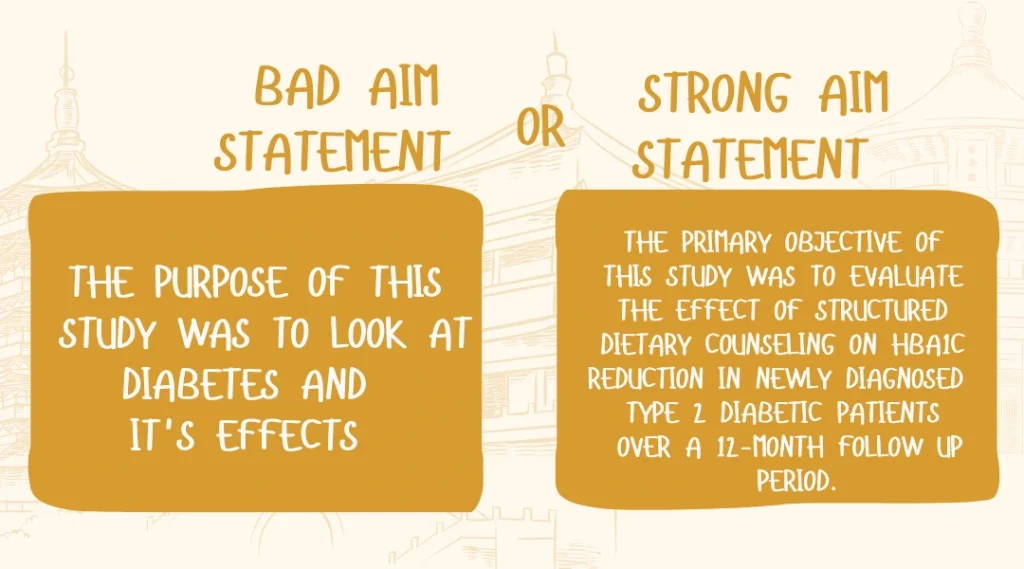
The best introductions end here. Don’t preview your results. Don’t start explaining your methods. Just state what you set out to do — and stop.
Format Medical Research Introductions: The Technical Rules That Get You Published
Structure is not just about rhetoric. Journals have specific formatting expectations, and deviating from them signals inexperience.
Here are the technical rules that matter:
Length: Most high-impact journals expect the introduction to be 350–600 words. Some allow up to 800. Check the Author Guidelines for every journal before you write.
Paragraphs: Three to four paragraphs is the standard. Each paragraph should have a distinct function mapped to the CARS model.
Citations: Cite only what is directly relevant. Avoid over-citation of the background (more than 8–10 references in the intro is usually a red flag). Cite the most recent, highest-quality evidence available.
Tense: Use present tense for established facts (“Sepsis affects approximately 50 million people annually”). Use past tense for specific prior study findings (“Smith et al. reported that…”).
Voice: Most journals now permit or even prefer active voice. “We aimed to determine…” is clearer than “It was aimed to determine…”
Subheadings: Generally not used within the introduction section — it’s meant to flow as connected prose.
The format medical research guidelines published by the International Committee of Medical Journal Editors (ICMJE) provide the gold standard for manuscript structure. If you’re unsure, ICMJE’s Recommendations are the single most authoritative document you should bookmark.
Common Mistakes Even Experienced Researchers Make
Even researchers from the greatest health and medical research programs make introduction-level errors that invite rejection. Here are the ones that show up repeatedly in peer review:
1. The “textbook introduction” trap Writing a detailed history of the disease rather than framing the current research context. Reviewers don’t want a Wikipedia summary. They want evidence that you understand where the field stands today.
2. Fabricating or overstating the gap Claiming “no study has ever examined X” when three RCTs on X exist in PubMed. This is both sloppy and a form of academic dishonesty. Always search systematically before declaring a gap.
3. Burying the aim statement Some researchers bury their objective in the middle of a paragraph, surrounded by hedging language. Put it at the end of the introduction, make it prominent, and don’t apologize for your study’s scope.
4. Mismatching the introduction and the study If your aim statement says you’re evaluating efficacy, your methods need to reflect that. If there’s a mismatch between what the introduction promises and what the study delivers, reviewers will catch it — and it will look like post-hoc rationalization.
5. Ignoring the journal’s scope Every introduction must implicitly argue that this paper belongs in this journal. If you’re submitting to a nephrology journal, your introduction should frame the problem in nephrological terms — not just general medicine.
How Progressive Medical Research Programs Train Writers
The shift toward progressive medical research training at institutions like the World Health Organization’s Human Reproduction Programme and major academic medical centers has led to structured scientific writing curricula being embedded into postgraduate training.
These programs emphasize that introduction writing is a transferable academic skill, not just a one-time task. Researchers are now trained to:
- Conduct systematic literature reviews before drafting the introduction
- Map their background literature against the CARS model explicitly
- Peer-review each other’s introductions using structured rubrics
- Revise introductions post-data-collection to ensure alignment
Institutions with dedicated research and administration medical rooms — integrated writing labs, biostatistical support, and editorial consultation services — have measurably higher publication success rates. This infrastructure makes a direct difference.
At ClinicaPress, we’ve covered how institutional writing support changes research outcomes. If you’re building a writing culture in your department, our guide on setting up a medical writing unit at your institution is a practical starting point.
When to Use a Medical Research Paper Writing Service
Let’s address this directly — because it’s a real conversation happening in academic medicine.
A legitimate medical research paper writing service does not write papers for researchers. What it provides is:
- Structural and language editing
- Reference verification and formatting
- Compliance checking against journal guidelines
- Ghost-drafting of non-intellectual sections (tables, figure legends)
This is categorically different from contract cheating or academic fraud. The distinction matters ethically and legally.
Researchers who are non-native English speakers, who are early-career and unfamiliar with journal norms, or who are working under tight institutional deadlines often benefit enormously from editorial consultation — without compromising authorship integrity.
If you’re considering this route, always look for services with declared editorial policies, transparent author agreements, and peer-reviewed credibility. At ClinicaPress, our article “Choosing Legitimate Medical Editing Services — Red Flags to Avoid” outlines the red flags and green flags to watch for.
Checklist: Before You Submit Your Introduction
Use this checklist to self-audit your introduction before it reaches a reviewer:
- [ ] Does Move 1 establish the clinical/scientific context without being encyclopedic?
- [ ] Is there a clear contrastive pivot into the research gap (Move 2)?
- [ ] Is the gap specific, defensible, and honestly described?
- [ ] Does the aim statement appear at the end of the introduction?
- [ ] Is the aim statement action-specific (verb + population + outcome)?
- [ ] Is the word count within the journal’s stated limits?
- [ ] Are all cited references high-quality, recent, and directly relevant?
- [ ] Does the introduction logically set up everything that follows in the paper?
- [ ] Is it free of plagiarism, self-plagiarism, and citation fabrication?
- [ ] Has a peer or mentor reviewed it independently?
For a more detailed self-assessment tool, see our guide ” Manuscript Submission to Publication Process” on ClinicaPress — built using ICMJE and EQUATOR Network guidelines.
The Introduction’s Relationship to the Rest of the Paper
One thing that doesn’t get discussed enough: the introduction is not written in isolation. It must align with every subsequent section.
- Your Methods section must directly address the objectives you stated
- Your Results must answer the questions your introduction implied
- Your Discussion must circle back to the gap you identified and explain whether — and how — your findings address it
Think of the introduction as a contract with your reader. You’re promising a specific intellectual journey. If the paper doesn’t deliver on that promise, no amount of good writing in the introduction will save it.
This is why some experienced researchers — particularly those supported by medical research consultants at major academic centers — write a draft introduction, complete the full manuscript, and then revise the introduction again at the end. The final introduction is always more precise because it’s written with the knowledge of what the study actually found.
This is not a trick. It’s professional practice.
A Note on AI Tools and Introduction Writing
There’s an elephant in the room. AI tools are increasingly being used to draft portions of medical manuscripts — including introductions. Some journals now require disclosure of AI assistance. Others prohibit it outright.
At ClinicaPress, our position is clear: AI can assist with structure, language polish, and reference formatting. It cannot replace the intellectual work of identifying a legitimate research gap, synthesizing a body of literature, or crafting an argument that reflects original scientific judgment.
If you use AI tools in your writing process, disclose it — and ensure that every factual claim, every citation, and every logical inference has been independently verified by a human author. Journals and readers are getting much better at detecting AI-generated text that lacks substantive expertise.
Final Word
The introduction of your medical research paper is not a formality. It’s the first argument you make — and in academic publishing, first arguments either open doors or close them.
Master the CARS model.
Write the gap honestly.
State the aim with precision.
Format it correctly.
And revise it last.
That’s not just how you write a good introduction. That’s how you write one that gets published.
Publish your Journals here.
Reference Books for Medical Research Writing
1. Reporting Research in Medicine and Related Fields by Robert A. Day & Nancy Sakaduski The classic guide to scientific writing — direct, practical, and still unmatched for its clarity on section-by-section manuscript construction, including a dedicated treatment of the introduction’s rhetorical function.
2. How to Write and Publish a Scientific Paper by Barbara Gastel & Robert A. Day Now in its eighth edition, this book is the closest thing to a universal standard for biomedical writing training. It covers everything from literature review to dealing with rejection — and the chapters on introduction structure are essential reading for any researcher at any career stage.