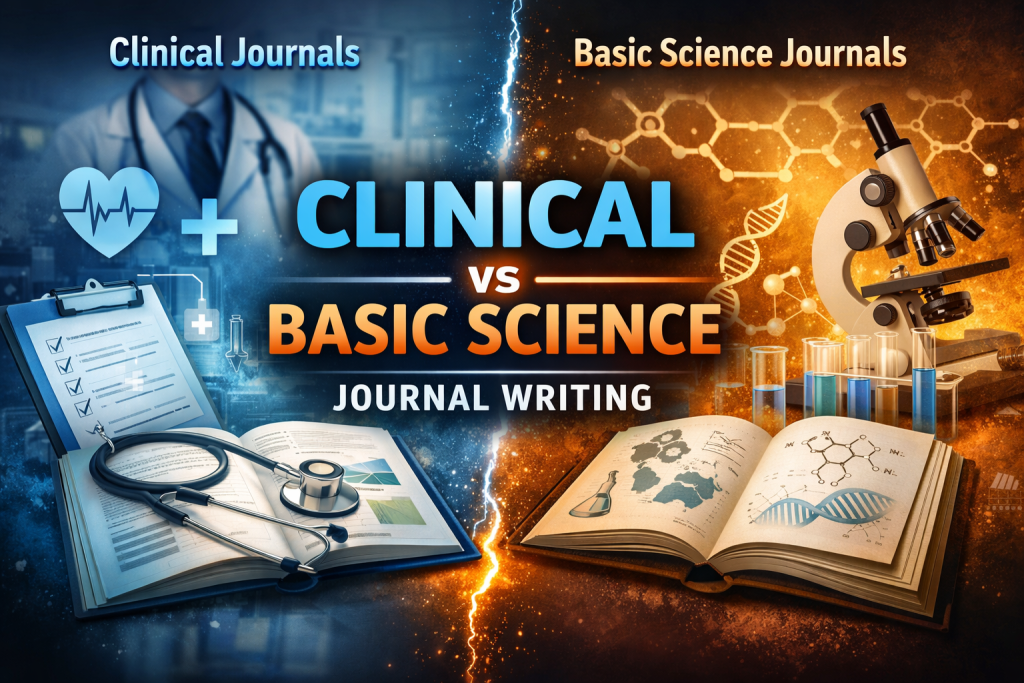
Writing for journals is not a single skill. It splits sharply depending on whether your target is a clinical journal or a basic science journal. Both demand rigor, but they reward different thinking, structure, and evidence styles. If you approach them with the same manuscript strategy, rejection is predictable.
This guide cuts through the confusion and shows exactly how Clinical vs Basic Science Journal Writing diver — in purpose, structure, evidence standards, and editorial expectations.
Purpose: Patient Impact vs Mechanistic Insight
Clinical journals exist to change practice. Basic science journals exist to change understanding.
Clinical editors ask one brutal question: Will this improve decisions at the bedside?
Basic science editors ask a different one: Does this reveal a new biological mechanism?
Clinical manuscripts must demonstrate applicability — diagnostic accuracy, treatment outcomes, safety, or health policy relevance. That’s why frameworks like CONSORT and STROBE dominate clinical publishing, supported by institutions such as the World Health Organization.
Basic science papers, by contrast, prioritize internal validity and mechanistic depth. A molecular pathway discovery with no immediate therapeutic use can still be high-impact if it reshapes scientific models.
If you blur these purposes, reviewers will call the paper “misaligned with journal scope.”
Audience Expectations: Practitioners vs Researchers
Clinical readers are time-poor decision makers — physicians, surgeons, policy experts. They scan for actionable conclusions.
Basic science readers are specialists who scrutinize methodology, reproducibility, and theoretical contribution.
Clinical writing must therefore be:
- Direct
- Outcome-focused
- Conservative in claims
- Clear about limitations affecting patient care
Basic science writing can be:
- More exploratory
- Mechanism-heavy
- Hypothesis-expanding
- Technically dense
According to guidance from the National Institutes of Health, translational clarity becomes essential when moving discoveries from lab to clinic — a boundary where many manuscripts fail.
If your discussion section reads like a lab meeting transcript, it belongs in a basic science journal — not a clinical one.
Structure Differences That Editors Notice Immediately
Clinical Journal Structure
Clinical journals expect strict reporting frameworks:
- Study design clarity (RCT, cohort, case-control)
- Patient population description
- Outcomes and endpoints
- Statistical transparency
- Ethical approval and consent
Even the abstract format is often structured.
Clinical manuscripts also foreground real-world constraints — cost, feasibility, adverse effects. Resources such as CONSORT guidelines exist precisely because clinical evidence influences human lives.
Basic Science Journal Structure
Basic science manuscripts revolve around experiments rather than patients:
- Hypothesis and theoretical rationale
- Experimental model description
- Methods reproducibility
- Mechanistic interpretation
- Future research directions
The narrative is discovery-driven, not application-driven.
A paper explaining a signaling cascade can be impactful even without clinical translation — something clinical journals rarely accept.
Evidence Standards: Statistical Outcomes vs Experimental Proof
Clinical journals prioritize statistical significance tied to patient outcomes.
Editors want to see:
- Sample size justification
- Confidence intervals
- Risk ratios or hazard ratios
- Real-world effect size
Clinical writing must answer: Does this change treatment decisions?
Basic science journals prioritize experimental rigor:
- Controls
- Replication
- Mechanistic plausibility
- Internal consistency across experiments
A statistically strong clinical trial may still be rejected by a basic science journal if mechanistic explanation is weak.
Likewise, a groundbreaking molecular discovery may be rejected by clinical journals for lacking patient relevance.
Language Style: Precision vs Interpretation
Clinical writing favors cautious language. Overstatement can be dangerous because it may influence care.
Phrases like:
- “May improve outcomes”
- “Associated with”
- “Suggests potential benefit”
are common.
Basic science writing tolerates stronger interpretive statements when supported by data:
- “Demonstrates a novel pathway”
- “Reveals a previously unknown mechanism”
This stylistic difference reflects risk. Clinical claims affect lives; mechanistic claims affect theory.
For authors struggling with tone calibration, editorial guidance available at Paperedit emphasizes aligning claims with evidence strength — a core rule across both domains.
The Impact Factor Trap
Many authors chase prestige journals without understanding fit.
For example, the journal of clinical investigation impact factor attracts submissions that are clinically oriented yet mechanistically deep — a rare hybrid.
But submitting a purely bench-based study to a clinical journal because of prestige wastes months.
Before writing, analyze:
- Scope statements
- Recently published articles
- Methodological preferences
- Acceptance of translational work
Wikipedia’s overview of impact factor methodology explains why citation patterns differ between clinical and basic science fields.
Your manuscript must match citation culture as well as scope.
Translational Boundary: Where the Two Worlds Meet
The most difficult writing challenge is translational research — studies bridging lab discoveries and patient application.
Here, both audiences must be satisfied.
You must:
- Explain biological mechanism clearly
- Demonstr clinical relevance credibly
- Avoid speculation beyond evidence
- Show pathway to implementation
This is where topics like clinical trial solutions and basic science research vs clinical research debates become central.
High-quality translational papers explicitly map how findings move from bench to bedside — not just claim they might.
The U.S. government’s clinical research portal illustrates how structured reporting supports this transition.
Common Reasons Manuscripts Get Rejected
Clinical Journal Rejections
- Weak patient relevance
- Poor study design
- Overgeneralized conclusions
- Missing ethical transparency
Basic Science Journal Rejections
- Insufficient novelty
- Lack of mechanistic depth
- Irreproducible methods
- Incremental findings
Many authors fail because they treat writing journal submissions as formatting exercises rather than audience alignment.
Strong manuscripts are designed for the journal before the first paragraph is written.
Guides on manuscript positioning available at Paperedit stress this pre-writing strategy — a step most researchers skip.
How to Decide Where Your Paper Belongs
Ask four non-negotiable questions:
- Does this directly affect patient care?
- Does it reveal a biological mechanism?
- Is the contribution practical, theoretical, or both?
- Who will cite this work?
If answers skew toward practice, target clinical journals.
If they skew toward theory, target basic science journals.
Insteasd, if both — pursue translational journals carefully.
Researchers seeking structured support often use resources like Paperedit’s guides to match manuscripts with appropriate outlets before submission.
Final Reality Check: Writing Strategy Must Change
| Feature | Clinical Journal Writing | Basic Science Journal Writing | Placement in Blog |
| Purpose | Improve patient care, guide treatment decisions | Discover biological mechanisms, expand theoretical understanding | After “Purpose: Patient Impact vs Mechanistic Insight” |
| Primary Audience | Practitioners, physicians, policy makers | Researchers, specialists, experimental scientists | After “Audience Expectations: Practitioners vs Researchers” |
| Structure | CONSORT/STROBE-based: study design, endpoints, ethics, outcomes | Hypothesis-driven: experimental methods, reproducibility, mechanistic interpretation | After “Structure Differences That Editors Notice Immediately” |
| Evidence Standards | Statistical significance, effect sizes, confidence intervals, real-world outcomes | Experimental rigor, replication, mechanistic plausibility, internal consistency | After “Evidence Standards: Statistical Outcomes vs Experimental Proof” |
| Language Style | Cautious, outcome-focused, avoids overstatement | Interpretive, mechanism-focused, allows stronger claims | After “Language Style: Precision vs Interpretation” |
| Impact Factor Consideration | Journals like Journal of Clinical Investigation favor patient-relevant studies | High-impact basic journals reward novelty and mechanistic insight | After “The Impact Factor Trap” |
| Translational Relevance | Applies findings to patient care | Provides foundation for future translational studies | After “Translational Boundary: Where the Two Worlds Meet” |
Clinical vs basic science writing is not about terminology differences. It’s about worldview.
Clinical journals prioritize safety, applicability, and evidence hierarchy.
Basic science journals prioritize discovery, mechanism, and reproducibility.
Trying to satisfy both without a clear strategy produces unfocused manuscripts that neither side wants.
Professional editorial workflows outlined at Paperedit emphasize tailoring narrative structure to journal type — not retrofitting after rejection.
If you want acceptance, write for the reader who will use your findings — not the one you wish would.