The rejection You Never Talk About
You worked for six months on your study. You cleaned up the data, did all the necessary statistical analyses, rewrote the paper 17 times, and submitted it with great optimism. Suddenly, after three days, you receive an auto-reply from the editor: “This journal does not consider papers of this type.”Your paper got rejected automatically, without any peer-review or comments whatsoever. Out of scope — one of the most frequent, most preventable, and most discouraging outcomes in scientific publishing.But here is the truth: your work was rejected not because it is bad. In the vast majority of cases, manuscripts get such a reply because most people perceive Aims & Scope of journals as a formality, while the key to a successful submission lies precisely there. It takes no more than 300 words to define everything that is needed in order to understand the whole editorial logic of a journal.The following guide explains step by step how to interpret these words in the right way.
For more clarity before journal section, read:
- How to Choose the Right Journal for Your Paper: 10 Expert Strategies for Academic Success
- AI Tools for Journal Selection: Find the Right Medical Journal Faster
What “Aims and Scope” Really Mean (Almost Everybody Understands This Wrong)
First, let us clarify what “aims” mean in the context of scientific publication. A journal’s aims represent: It is not a marketing copy. It is not a wish list. It is the editorial constitution of the journal.When editors say a paper is “out of scope,” they are applying this framework — often in under five minutes. They do not read your abstract with fresh curiosity. They match your manuscript against a mental model built from years of handling submissions. If the match fails, the paper goes back, regardless of quality. This is why reading the Aims and Scope page is less about comprehension and more about alignment mapping — a skill that separates researchers who publish consistently from those who cycle through rejections. Understanding the scope and sequence of a journal’s focus — meaning, the order of priorities it places on specific disciplines, methodologies, and audiences — is the core of that skill.
Learn more with “Factors Influencing Desk Rejection in Clinical and Surgical Journals.“
The Anatomy of an Aims and Scope Page
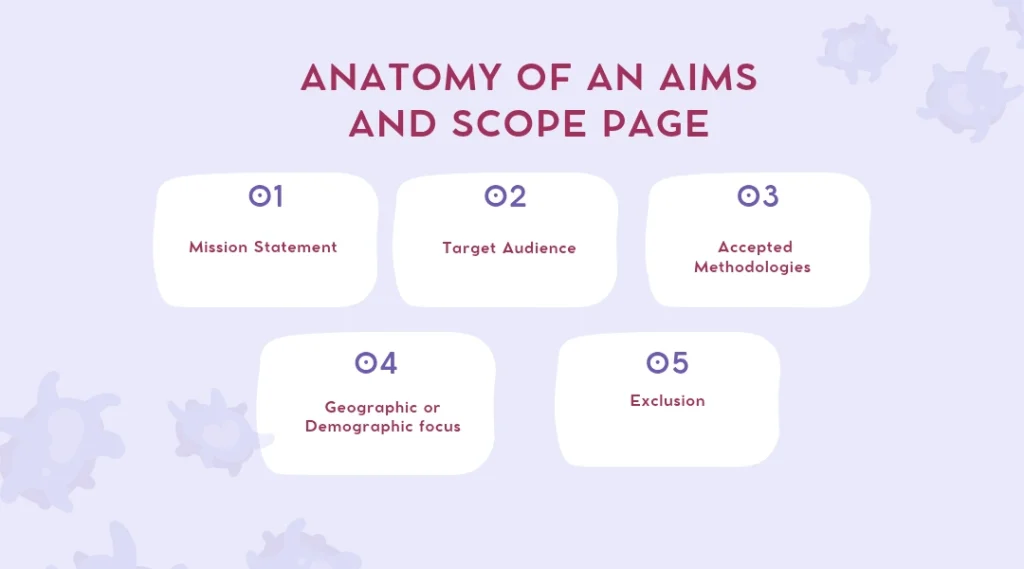
Not all Aims and Scope sections are structured the same way, but most share a recognizable architecture. Here’s what to look for:
- The Mission Statement (often the first 1–2 sentences): This is the broadest signal. It tells you who the journal serves and what intellectual tradition it belongs to. A health scope journal like *The Lancet* positions itself around global health equity and policy influence. A narrower specialty journal, such as an aims medical science journal, might restrict itself to translational research in a single disease area.
- Target Audience: Some journals explicitly name their readership: clinicians, epidemiologists, public health policymakers, behavioral scientists. If your paper’s primary audience doesn’t match, neither will the scope
- Accepted Methodologies: This is where researchers most frequently go wrong. Many journals explicitly exclude certain study designs — some will not publish case reports; others won’t accept qualitative work; some require multi-country data. These are not suggestions. They are hard filters.
- geographic or Demographic Focus: The aims public health journal network includes journals that restrict their focus to specific regions — sub-Saharan Africa, South Asia, LMIC settings. Submitting a US-only dataset to one of these is an immediate mismatch.
- Exclusions: Some Aims and Scope pages explicitly list what they do not publish.
Read these with the same weight as what they do publish.
Why Researchers Keep Getting It Wrong
The problem isn’t literacy. Most researchers can read. The problem is interpretation bias — the tendency to see what you want to see.After months of work, you naturally want your paper to fit. So you read the Aims and Scope and unconsciously stretch the interpretation. “Interdisciplinary health research” feels like it could include anything. “Clinical outcomes” sounds broad enough. It rarely is.There are four common misreading patterns:-
- Over-broadening: Treating vague language as permission rather than limitation.
- Keyword matching without context: Finding one word (e.g., “nutrition”) that appears in both the paper and the scope, without checking if the disciplinary framework aligns.
- Ignoring the implied methodology: to Some journals are quantitative-only even if they don’t say so explicitly — you can detect this by scanning their recent publications.
- Confusing impact factor with fit:A high scope journal impact factor does not mean it’s the right journal for your paper. Fit and prestige are different variables. (Review the guide “Top 10 Reasons Impact Factor in Journal Selection Matters“)
According to the World Health Organization’s global health publishing guidelines, alignment with a journal’s stated health mission is one of the most critical determinants of manuscript success — even before peer review begins.
A Practical Step-by-Step Framework for Reading Aims and Scope
Here’s how to approach this strategically every single time:
Step 1: Read the full Aims and Scope section without stopping
Don’t annotate yet. First pass is for overall tone and positioning
.Step 2: Identify the core mission in one sentence
If you can’t summarize the journal’s mission in your own words, you don’t understand it well enough to submit.
Step 3: Map your paper’s identity
Ask: What is my paper’s primary discipline? What methodology did I use? Who is my audience? What is my geographic scope? What problem am I solving?
Step 4: Run a line-by-line alignment check
Compare your paper’s identity against each element of the Aims and Scope. Create a simple checklist.
Step 5: Audit the last 12 months of published content
This is non-negotiable. The published record reveals what the editors actually prioritize, not just what they claim to prioritize. Look for patterns in study design, topic clusters, and geographic diversity.
Step 6: Read the rejection criteria
If the journal publishes explicit rejection reasons or editorial policies, read them as carefully as the Aims and Scope itself.
Comparing Journal Types: A Reference Table
Different journal categories carry different scope philosophies. Understanding these categories helps narrow your target before you read any individual Aims and Scope page.
| Journal Category | Typical Scope Focus | Common Methodology Preference |
| General Medical | Broad clinical and public health topics | RCTs, systematic reviews |
| Health Scope Journal | Interdisciplinary health systems, policy | Mixed methods, qualitative acceptable |
| Aims Medical Science Journal | Translational/basic-to-clinical research | Experimental, laboratory-based |
| Aims Public Health Journal | Population-level health, determinants | Epidemiological, cross-sectional |
| Specialty Journals | Disease- or organ-specific research | Varies widely by specialty |
| Open-Access Multidisciplinary | Broad, often rapid publication | Most designs accepted |
Use this table as a pre-screening matrix. Match your paper type to the category first, then investigate specific journals within that category.
Impact Factor vs. Scope: Stop Confusing Them
This deserves its own section because the conflation is almost universal.The scope journal impact factor is a metric of citation influence, not editorial breadth. A journal with a high impact factor may actually have a narrower scope because it publishes only the most highly cited topic clusters. Submitting a novel but niche paper to a high-impact-factor journal because “it’s prestigious” is often the wrong move.The National Library of Medicine’s journal selection guide makes this explicit: researchers should prioritize fit over prestige, particularly at early career stages where rejection cycles delay progress significantly. The aims medical science journal impact factor reflects citations within a specific translational science ecosystem — it tells you nothing about whether your paper fits unless your paper lives squarely in that ecosystem.
High impact factor + wrong scope = guaranteed rejection.
Moderate impact factor + perfect scope = strong publication potential.
The math is not complicated. The execution requires ego management.
Get additional information from “Scopus vs Web of Science vs UGC-CARE: The Ultimate Guide.”
How Specialty and Public Health Journals Define Scope Differently
This distinction matters enormously, especially for interdisciplinary researchers. An aims public health journal typically defines scope through a population lens. It asks:
- Does this research speak to a definable population?
- Does it address a social determinant, a policy gap, or a disease burden at scale?
Papers that are clinically rich but population-thin often fail here. A specialty journal, by contrast, defines scope through a biological or clinical mechanism lens. It asks:
Does this research deepen our understanding of a specific disease process, intervention, or clinical outcome?
Papers with robust epidemiology but thin mechanistic contribution often fail here. Interdisciplinary papers — those sitting between clinical science and public health — need to identify which lens is primary and submit accordingly. Trying to satisfy both simultaneously usually satisfies neither.As the PLOS Medicine editorial guidelines notes, papers must have a clear primary audience. “Broad relevance” is not a positioning strategy. It is an editorial red flag.
A Note on Open-Access and Multidisciplinary Journals
Researchers sometimes interpret open-access multidisciplinary journals as having no meaningful scope. This is a mistake. Journals like PLOS ONE still require methodological soundness and scientific validity as scope criteria. Journals like Scientific Reports still reject papers that fail to demonstrate clear scientific contribution.The scope is just different — it is defined by methodological rigor rather than topical restriction. Submitting a conceptual opinion piece to a journal that requires primary data is an out-of-scope rejection, even if the journal accepts papers from every scientific discipline. Reading the Aims and Scope of open-access journals requires the same precision — arguably more, because the permissive reputation leads to careless submissions.
Building an Aims and Scope Reading Practice
Good researchers develop a systematic habit around this. Think of it like the scope and sequence concept used in curriculum design — each piece of learning has a defined place, order, and depth. Journal selection works the same way.
Here’s a habit loop that works:
- Before writing: Identify 3–5 target journals and read their Aims and Scope before you finalize your manuscript framing. This lets you shape your argument to fit without compromising the science.
- After writing: Re-read the Aims and Scope with your completed manuscript in hand and run a cold-eyed alignment check.
- Before submitting: Read the most recent editorial or “From the Editors” piece, if the journal publishes one. These often reveal current scope priorities that aren’t in the official Aims and Scope text.
This practice, according to Nature’ s author guidance resources, significantly reduces desk rejection rates and improves the quality of peer review feedback when papers do advance.
What Editors Actually Want You to Understand
Editors are not trying to exclude good research. They are curating an intellectual identity. Every paper they publish makes a statement about what knowledge matters and to whom.When you submit outside scope, you are not just wasting your time — you are asking an editor to violate their journal’s identity. That is why desk rejections are fast and impersonal. It’s not about your paper. It’s about fit.The researchers who publish consistently are not necessarily better scientists. They are better readers — of journals, of editorial signals, of disciplinary positioning. Reading a journal’s Aims and Scope is where that skill begins.Stop treating it as a box to check. Start treating it as the first and most important editorial decision you make.
To get a better understanding of editors’ principles, refer to Ethics Training for Journal Editors and Reviewers.
Common Misconceptions: Quick Busts
- ❌ “If my topic is mentioned anywhere in the Aims and Scope, I’m good.” ✅ Topic mention ≠ scope alignment. Disciplinary framework and methodology must also match.
- ❌ “A high impact factor means broad scope.” ✅ Often the opposite. High-impact journals are frequently narrow and highly selective.
- ❌ “If I write a good enough paper, scope won’t matter.” ✅ Scope is evaluated before quality. Out-of-scope papers never reach peer review.
- ❌ “Open-access journals have loose scope requirements.” ✅ Open-access refers to access model, not editorial standards or topical breadth.
- ❌ “The Aims and Scope hasn’t changed, so what worked before will work now.” ✅ Editorial priorities shift. Always cross-check with recent published content.
Conclusion: The Skill That Changes Everything
Reading a journal’s Aims and Scope correctly is not a bureaucratic task. It is a high-leverage intellectual skill that affects every paper you will ever submit. It determines whether your work reaches the right audience, gets the right reviewers, and contributes to the right conversation. Most researchers treat this as the last step before submission. The best researchers treat it as the first step before.
Try your understanding and Publish Your Journals Now!
For any query during publication stage, refer to our exclusive guides in The Blogs.