Choosing where to publish is no longer a simple “submit and hope” game. The gap between Medical, Surgical, and Health Science Journals is widening—and picking the wrong lane can stall your paper for months or bury it where no one reads it.
If you’re serious about visibility, citations, and academic credibility, you need to think like an editor—not an author.
Let’s break this down with precision.
Understanding the Core Differences
At a glance, these journal categories seem interchangeable. They’re not.
- Medical journals focus on clinical research, diagnostics, and patient outcomes.
- Surgical journals prioritize operative techniques, procedural outcomes, and innovations.
- Health science journals cover broader domains: public health, systems, policy, and interdisciplinary science.
The problem?
Many authors misclassify their work.
A clinical trial with surgical intervention doesn’t automatically belong in a surgical journal. Likewise, a systems-level analysis won’t perform well in a purely clinical outlet.
This is where most submissions fail before peer review even begins.
For deeper insight into how journals filter submissions, see this guide on internal editorial screening at AI in Manuscript Screening and Peer Review.
Match Your Study Design to Journal Scope
Before chasing impact factor, ask a more brutal question: Where does your methodology actually belong?
Here’s a practical alignment:
| Study Type | Best Journal Category |
| Randomized Clinical Trial | Medical journals |
| Surgical technique innovation | Surgical journals |
| Meta-analysis of health systems | Health science journals |
| Case reports in rare surgeries | Surgical or specialty journals |
| Public health intervention study | Health science journals |
| AI-driven healthcare modeling | Surgical Outcomes Cohort Study |
| Surgical outcomes cohort study | Surgical journals |
If your study is system-driven (e.g., AI in healthcare), journals like the Journal of Medical Systems Category become more relevant.
For authors struggling with positioning, this breakdown helps clarify scope mismatch issues: How to Choose the Right Medical Journal for Your Research Portfolio?
Impact Factor Isn’t Everything (But It Still Matters)
Let’s be real—impact factor still drives decisions.
Metrics like:
- journal of surgical research impact factor
- Impact factor of the British Medical Journal
- medical journals ranking 2025 impact factor
- British Medical Journal impact factor
… is often used as a shortcut. But blindly chasing high-impact journals is a rookie mistake.
High-impact journals:
- Reject up to 90% of submissions
- Prioritize novelty over incremental findings
- Demand near-perfect methodology and reporting
For example, the British Medical Journal’s impact factor is among the highest globally, but it’s not suitable for niche or region-specific studies.
A small but rigorous regional study may be more likely to be accepted in a mid-tier indexed journal rather than being instantly rejected by a top-tier one.
You can verify journal metrics via sources like PMC or Nature Portfolio
The smarter move?
Balance ambition with realism.
Aim for the highest-impact journal that actually fits your paper.
Evaluate Audience and Citation Potential
Publishing isn’t just about acceptance—it’s about being read.
Ask:
- Who is your target audience?
- Will surgeons, clinicians, or policymakers cite this work?
- Is your research practice-changing or knowledge-extending?
For example:
- A paper on laparoscopic techniques fits surgical endoscopy journal-type audiences
- A study on medical training methods belongs in medical education journals
- A digital health system paper aligns with health science or systems journals
If your work targets multiple audiences, prioritize the primary reader group—not all of them.
A confused audience leads to low citation performance.
A deeper discussion on maximizing citation potential is covered here: Altmetrics in Medicine — Measuring Impact Beyond Citations.
Journal Scope vs. Keywords: Don’t Confuse Them
Many authors rely on keyword overlap to select journals. That’s lazy—and risky.
Just because your paper includes “health science” doesn’t mean it belongs in a health science reports journal.
Editors evaluate:
- Conceptual alignment
- Research question relevance
- Audience value
- Methodological compatibility
Not keyword density.
A smarter approach:
- Read 5–10 recent articles from your target journal
- Compare study design, tone, and structure
- Assess whether your paper feels native to that journal
- Check if similar studies were accepted recently
If it doesn’t align, rejection is almost guaranteed—no matter how strong your data is.
Open Access vs. Subscription Journals
This decision is strategic—not ideological.
Open access journals:
- Faster dissemination
- Higher visibility and downloads
- Often indexed widely
- Require APCs (Article Processing Charges)
Subscription journals:
- Traditional prestige
- Strong historical citation networks
- Lower upfront costs
- Limited accessibility for low-resource settings
For global health or policy-driven research, open access in a health science journal can dramatically increase reach.
And for surgical innovation or clinical trials, high-impact subscription journals may still dominate citations and prestige.
For ethical publishing practices, refer to COPE guidelines.
Indexing and Visibility: The Real Gatekeepers
Impact factor is just one metric. Indexing determines whether your paper even exists in the academic ecosystem.
Key indexing platforms:
- Scopus
- Web of Science
- PubMed/MEDLINE
If your target journal isn’t indexed in at least one major database, your research is effectively invisible.
For medical authors, PubMed indexing is often non-negotiable.
A journal can have a decent impact factor but poor discoverability if indexing is weak or inconsistent.
Also explore our guide Scopus vs Web of Science: Key Differences Explained (2025).
Understanding Acceptance Timelines and Review Culture
Not all journals operate at the same speed—or with the same rigor.
Typical timelines:
| Journal Type | Review Time | Decision Pattern |
| High-impact medical | 2–6 months | Multiple revision rounds |
| Surgical journals | 1–4 months | Technique-focused critique |
| Health science | 1–3 months | Broader methodological focus |
Fast doesn’t always mean bad—but extremely fast often signals weak peer review.
Also consider:
- Does the journal offer transparent peer review?
- Are reviewer comments detailed or generic?
- Is a statistical review included?
These factors influence not just acceptance, but the quality of your final publication.
Avoid Predatory Journals (No Exceptions)
Let’s be blunt: publishing in predatory journals can destroy your credibility.
Red flags:
- Unrealistically fast acceptance (2–5 days)
- Fake or unverifiable impact factors
- Poor website quality
- No transparent peer review process
- Aggressive email invitations
If a journal of surgical research or health science reports journal claims instant indexing or guarantees publication, it’s a scam.
Always cross-check:
- Editorial board authenticity
- Indexing claims
- Publisher reputation
For a full checklist, see: Predatory Medical Journals
Practical Workflow for Choosing the Right Journal
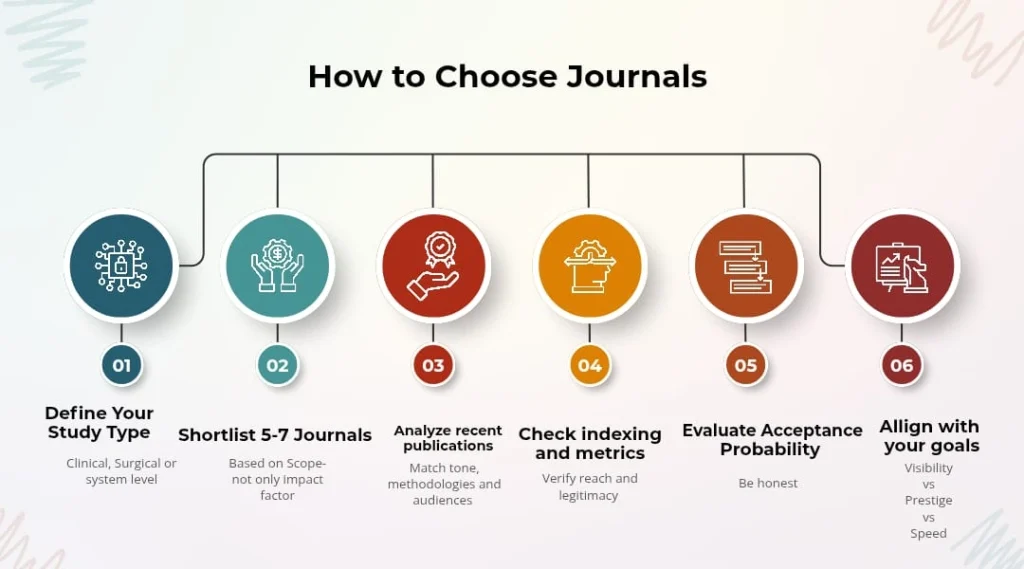
Here’s a streamlined, no-nonsense workflow:
- Define your study type
Clinical, surgical, or system-level? - Shortlist 5–7 journals
Based on scope—not just impact factor - Analyze recent publications
Match tone, methodology, and audience - Check indexing and metrics
Verify legitimacy and reach - Evaluate acceptance probability
Be honest about your study strengths - Align with your goals
Visibility vs. prestige vs. speed - Prepare for rejection
Always have a backup journal ready - Customize your submission
Adapt formatting, referencing, and tone per journal
If you skip even one of these steps, you’re gambling—not strategizing.
For submission strategy optimization, explore: Manuscript Submission to Publication Process.
Common Mistakes Authors Still Make
Even experienced researchers fall into these traps:
- Submitting to journals outside their scope
- Overestimating novelty and aiming too high initially
- Ignoring journal-specific formatting requirements
- Choosing journals based only on the impact factor
- Failing to analyze previously published articles
These mistakes cost time—sometimes 6–12 months per failed submission cycle.
Final Take: Think Like an Editor
Choosing between Medical, Surgical, and Health Science Journals isn’t about preference—it’s about precision.
Editors are asking:
- Does this fit our audience?
- Does this add value to our field?
- Is this worth publishing here?
If your answer isn’t a confident “yes” to all three, you’re targeting the wrong journal.
Stop chasing prestige blindly.
Start aligning strategically.
Because in academic publishing, fit beats fame—every single time.